
Mastering Electrical Wiring in India: A Homeowner's Blueprint
Executing a safe and compliant electrical wiring in India project requires navigating a unique landscape of metric wire gauges, specific Bureau of Indian Standards (BIS) codes, and extreme environmental factors like monsoon humidity and high summer temperatures. As of 2026, the rapid adoption of smart home automation, high-draw kitchen appliances, and residential EV chargers means legacy wiring setups are fundamentally inadequate. This guide provides a deep-dive, actionable framework for Indian home wiring projects, moving beyond basic advice into the exact specifications required for modern Indian residences.
Decoding Indian Wire Sizes: The Metric Standard
Unlike North America, which relies on the American Wire Gauge (AWG) system, electrical wiring in India strictly uses the metric system, measured in square millimeters (sq mm). Selecting the correct cross-sectional area is critical to prevent voltage drops and thermal degradation inside concealed PVC conduits.
| Wire Size (sq mm) | Max Ampacity (Concealed) | Recommended MCB | Standard Home Application |
|---|---|---|---|
| 1.0 | 10A | C6 | Low-draw LED lighting circuits |
| 1.5 | 14A | C10 | Standard lighting, ceiling fans, smart switches |
| 2.5 | 20A | C16 / C20 | Power sockets (16A), microwaves, washing machines |
| 4.0 | 27A | C25 / C32 | 1.5 Ton Split ACs, 3kW solar inverters, EV chargers |
| 6.0 | 35A | C40 | Main DB feeds, 2+ Ton ACs, heavy induction cooktops |
Pro-Tip for 2026 Builds: Never use 1.0 sq mm wire for general lighting, even if the LED load is low. The mechanical strength of 1.5 sq mm wire prevents strand breakage during the pulling process through rigid PVC conduits, a common failure mode in Indian construction.
Mandatory IS Codes for Indian Home Wiring
Compliance is non-negotiable for safety and insurance validity. The Bureau of Indian Standards (BIS) dictates the framework for all electrical installations. When auditing your contractor's work, ensure adherence to these specific codes:
- IS 732: Code of Practice for Electrical Wiring Installations. This governs conduit routing, spacing, and the mandatory separation of low-voltage (data/coax) and high-voltage (230V) lines by at least 150mm to prevent electromagnetic interference.
- IS 694: General requirements for cables. Ensure your wires carry the ISI mark under this standard, guaranteeing 99.8% pure electrolytic copper.
- IS 9537 (Part 1 & 3): Specifies the requirements for PVC conduits. Only use heavy-duty (Class 3) rigid PVC conduits for concealed slab and brick-wall wiring to withstand concrete pouring pressures.
- IS 3043: Code of Practice for Earthing. Crucial for mitigating India's high soil resistivity variations between summer and monsoon seasons.
Top FRLS Cable Brands & Real-World Pricing
Standard FR (Fire Retardant) wires are being phased out in premium builds in favor of FRLS (Fire Retardant Low Smoke) and ZHFR (Zero Halogen Fire Retardant) cables. FRLS cables emit less toxic smoke during a fire, a critical safety upgrade for enclosed Indian apartments.
2026 Pricing Matrix (Per 90-Meter Coil, FRLS Grade)
| Brand | 1.5 sq mm (₹) | 2.5 sq mm (₹) | 4.0 sq mm (₹) | Best For |
|---|---|---|---|---|
| Havells (Lifeline Plus) | 1,650 - 1,800 | 2,600 - 2,850 | 4,200 - 4,500 | Premium apartments, high reliability |
| Polycab (FlameX) | 1,550 - 1,700 | 2,450 - 2,700 | 3,900 - 4,300 | Cost-to-performance ratio, bulk buys |
| Finolex (FlameRet) | 1,600 - 1,750 | 2,500 - 2,800 | 4,100 - 4,400 | Coastal regions (excellent insulation) |
| KEI (Pro+ | 1,500 - 1,650 | 2,400 - 2,650 | 3,800 - 4,100 | Budget-conscious new construction |
Note: Prices fluctuate based on local copper indices and state GST variations. Always verify the holographic ISI authentication tag on the coil shrink-wrap to avoid counterfeit wires, a pervasive issue in unorganized local markets.
The Loop System vs. Joint Box System
Historically, Indian electricians used the Joint Box (Tee) System, where wires were spliced inside circular junction boxes using insulation tape or ceramic connectors. This is now considered obsolete and highly dangerous for modern loads due to oxidation and loose connections causing arc faults.
The mandatory standard for 2026 is the Loop-In System. In this method, the main feed wire enters the switchboard or ceiling rose, loops through the terminal block, and exits to the next point without any intermediate splices inside the conduit. All splicing must occur exclusively inside the Distribution Board (DB) or at the terminal blocks of switches and sockets.
Earthing: Combating Indian Soil Resistivity
According to guidelines referenced by the Institution of Engineers (India), proper earthing is the most neglected aspect of domestic wiring. A standard 3-pin socket is useless if the earth pin reads zero continuity to the ground.
Pipe vs. Plate Earthing for Homes
- GI Pipe Earthing (IS 3043): A 40mm diameter, 2.5-meter long Galvanized Iron pipe with perforations, driven vertically into the earth. Best for sandy or loamy soils. Requires periodic watering during Indian summers to maintain soil moisture and conductivity.
- Copper Plate Earthing: A 600x600mm copper plate (minimum 3.15mm thick) buried vertically at a depth of 3 meters. Mandatory for high-resistivity rocky soils or homes with heavy 3-phase loads and solar inverters.
Crucial Maintenance Step: Surround the earth electrode with Bentonite clay or Marconite earthing compound. This reduces contact resistance and retains moisture, ensuring your earth resistance stays below the mandatory 5 Ohms even during peak May heatwaves.
Protection: MCB and RCCB Selection
Overloading and earth leakage are the primary causes of electrical fires in India. Your Distribution Board (DB) must be segmented logically.
- MCB Curves: Use Curve C MCBs for general household circuits (handles moderate inrush currents from fridge compressors). Use Curve D only for heavy motor loads like borewell pumps.
- RCCB Sensitivity: Install a 30mA RCCB (Residual Current Circuit Breaker) for all socket circuits and wet areas (geysers, washing machines). This trips the circuit in milliseconds if it detects current leaking through a human body, preventing fatal electrocution.
- Type A vs. Type AC RCCBs: With the rise of DC-generating appliances (solar inverters, EV chargers, modern LED drivers), standard Type AC RCCBs may become 'blinded' by DC leakage. Upgrade to Type A RCCBs for circuits feeding these modern loads.
Common Failure Modes in Indian Homes
Avoid these frequent mistakes made by unlicensed contractors:
- Floating Neutrals: If the main neutral wire breaks or loosens at the DB, the voltage across your 230V appliances can spike to 400V (phase-to-phase voltage), instantly destroying TV panels and smart inverters. Always use a 4-pole MCB for the main incomer in 3-phase homes to isolate the neutral safely.
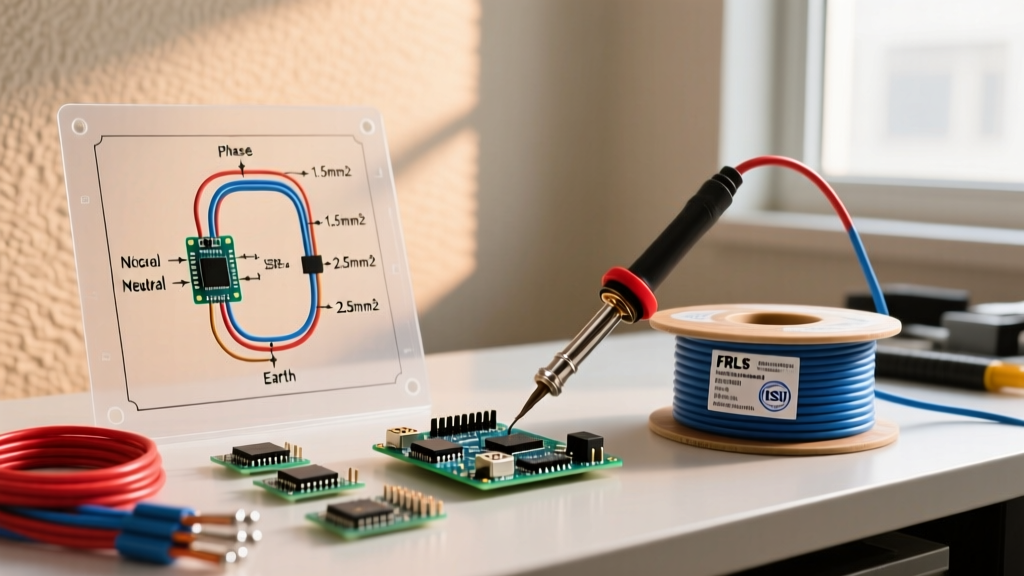
- Undersized Neutral in Harmonic Loads: Cheap, non-IS compliant LED drivers and SMPS (Switched Mode Power Supplies) generate severe 3rd-order harmonics. These harmonics add up in the neutral wire, causing it to overheat even if the phase wires are cool. In heavy LED lighting circuits, never downsize the neutral wire; keep it equal to the phase wire (1.5 sq mm).
- Shared Conduits: Running 230V AC power and CAT6/Coaxial internet cables in the same PVC pipe. This causes severe packet loss and signal degradation. Maintain a minimum 150mm physical separation.
Estimating Project Costs (2026)
For a standard 1,200 sq ft (3BHK) apartment undergoing complete concealed rewiring with premium FRLS cables, modular switches (e.g., Legrand Arteor or Schneider Zencelo), and a double-door DB with RCCB protection, expect the following breakdown:
- Materials (Wire, PVC, Switches, DB): ₹85,000 - ₹1,10,000
- Labor (Chipping, Conduit laying, Pulling, Termination): ₹45,000 - ₹65,000
- Earthing Setup (2 Electrodes + Chemical): ₹8,000 - ₹12,000
- Total Estimated Range: ₹1,38,000 - ₹1,87,000
Investing in IS-compliant materials and certified labor prevents catastrophic failures and ensures your home is ready for the high-power demands of the modern era.