
The 2026 Landscape for Electrical Wiring Home Projects
Planning an electrical wiring home project requires more than just a rough guess; it demands a precise understanding of current material markets, local labor rates, and evolving safety codes. As we move through 2026, the electrical contracting industry has seen a stabilization in copper prices, though they remain historically elevated compared to pre-2020 levels. Concurrently, a persistent shortage of skilled journeyman electricians continues to push hourly labor rates upward. According to the U.S. Bureau of Labor Statistics, the median wage for electricians has steadily climbed, directly impacting the bottom line of residential rough-ins and trim-outs.
Whether you are undertaking a full-gut rewiring of a mid-century home, adding a dedicated 240V circuit for an EV charger, or upgrading a subpanel for a new workshop, understanding the granular costs is critical. This guide provides a comprehensive, data-driven cost estimation framework for residential electrical work in 2026, empowering you to budget accurately and avoid the hidden financial traps that derail renovation projects.
Comprehensive Cost Matrix: Residential Electrical Projects
The table below outlines average national costs for common residential electrical projects. These figures encompass both materials and professional labor, assuming standard accessibility (e.g., open studs or accessible attic/crawlspace) and standard 200-amp service availability.
| Project Type | Material Cost Range | Labor Cost Range | Total Estimated Cost | Typical Timeframe |
|---|---|---|---|---|
| Whole House Rewire (2,000 sq ft) | $4,500 - $7,000 | $9,500 - $16,000 | $14,000 - $23,000 | 7 - 14 Days |
| 200-Amp Service Panel Upgrade | $800 - $1,400 | $1,500 - $2,800 | $2,300 - $4,200 | 1 - 2 Days |
| New 240V/50A Circuit (EV Charger/Range) | $250 - $450 | $600 - $1,100 | $850 - $1,550 | 4 - 8 Hours |
| Add Standard 120V/20A Receptacle Circuit | $80 - $150 | $350 - $650 | $430 - $800 | 3 - 5 Hours |
| Kitchen Remodel Wiring (GFCI/AFCI) | $600 - $1,200 | $2,200 - $4,500 | $2,800 - $5,700 | 3 - 5 Days |
Deep Dive: Material Costs and Wire Gauges
Material selection dictates a significant portion of your budget. In 2026, Non-Metallic Sheathed Cable (NM-B), commonly known by the brand name Romex, remains the standard for interior dry locations. However, copper market fluctuations mean prices are strictly tied to commodity indexes.
NM-B Cable Pricing per Linear Foot
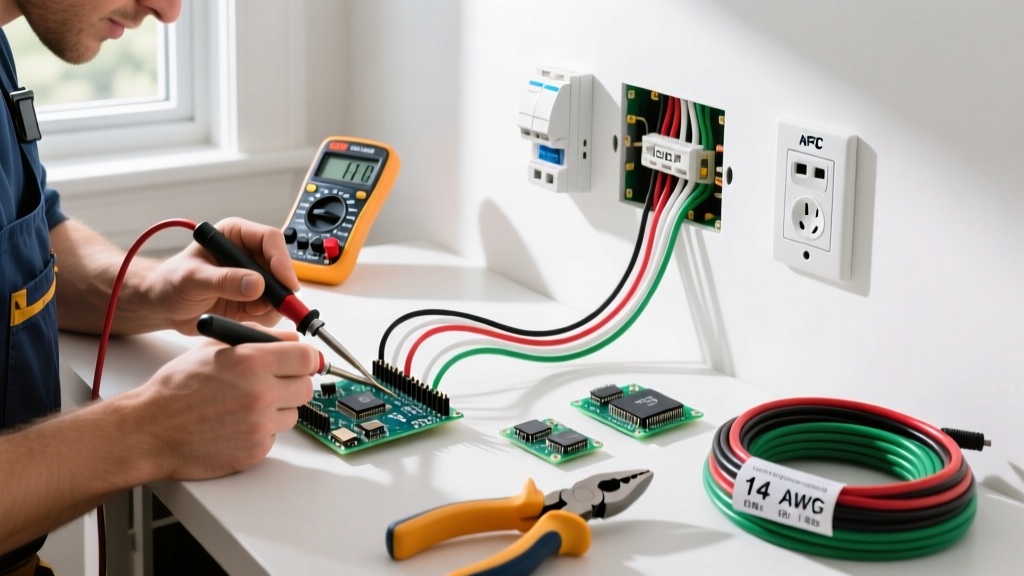
- 14/2 AWG (15-Amp Lighting Circuits): $0.65 - $0.85 per foot. A 250-foot roll averages $165.
- 12/2 AWG (20-Amp Receptacle Circuits): $0.95 - $1.25 per foot. A 250-foot roll averages $240.
- 10/3 AWG (30-Amp Dryer/HVAC): $2.40 - $3.10 per foot. Essential for standard electric dryers.
- 6/3 AWG (50-Amp Range/EV): $4.80 - $6.50 per foot. Heavy-gauge copper required for high-draw appliances.
Panels and Breaker Economics
The choice of panel brand drastically alters long-term material costs. Square D Homeline panels are the budget standard, with a 200-Amp, 40-space main breaker panel costing around $220-$280. However, their proprietary breakers are slightly more expensive than competitors. Square D QO (Qwik-Gard) offers commercial-grade visual trip indicators and superior bus bar durability, but the panel itself jumps to $450-$600, with QO AFCI breakers costing upwards of $65 each. For budget-conscious projects, Eaton BR series panels offer a highly reliable, cost-effective alternative, with standard tandem breakers available for as low as $8.
Labor Rates: Rough-In vs. Trim-Out Phases
Electricians typically bill either by the hour or by the opening (per fixture/switch). In 2026, the national average hourly rate for a licensed journeyman electrician ranges from $95 to $155 per hour, with master electricians or specialized contractors in high-cost-of-living (HCOL) metro areas charging $180+ per hour.
Residential wiring is split into two distinct labor phases:
- The Rough-In Phase: This occurs when wall cavities are open. Electricians drill framing, pull wire, and install nail-on boxes. This phase is highly labor-intensive but physically straightforward. Expect rough-in labor to consume about 60% of the total labor budget.
- The Trim-Out (Finish) Phase: Occurs after drywall and paint. Electricians terminate wires, install receptacles, switches, and hang light fixtures. While less physically demanding, the precision required to avoid damaging finished walls makes this phase highly skilled and meticulously billed.
Pro Tip: If you are managing a general contracting remodel, ensure your drywall crew does not cover up electrical boxes or staple through NM-B cables. Repairing damaged wire behind finished drywall is a primary driver of change-order costs in residential electrical work.
NEC Code Impacts on Your 2026 Budget
Budgeting for an electrical wiring home project requires strict adherence to the National Electrical Code (NEC). By 2026, the vast majority of jurisdictions have adopted the 2023 NEC guidelines (or local equivalents), which heavily mandate advanced fault protection.
- AFCI Requirements: Arc-Fault Circuit Interrupters are now required in virtually all living spaces, including bedrooms, living rooms, hallways, and closets. A standard 20A breaker costs $6, while a 20A Combination AFCI breaker costs $45-$55. For a 2,000 sq ft home requiring 25 breakers, AFCI mandates alone can add $1,000 to your material budget.
- GFCI Expansion: Ground-Fault Circuit Interrupters are mandatory in kitchens, bathrooms, garages, outdoors, and within 6 feet of any sink. Dual-function (AFCI/GFCI) breakers are now common but carry a premium price tag of $70-$90 per unit.
- EV Ready Codes: Many municipalities now require new construction or major renovations to include a 'make-ready' conduit pathway or a dedicated 40-Amp minimum circuit for future EV charging, adding $400-$800 to initial rough-in costs.
For a deeper understanding of how these safety systems protect your property, the U.S. Department of Energy provides excellent primers on residential electrical safety and system architecture.
Hidden Costs That Derail Wiring Budgets
When estimating the cost of an electrical wiring home upgrade, homeowners frequently overlook the ancillary trades and structural repairs required to facilitate the electrical work.
1. Drywall and Plaster Repair
Retrofitting new wiring into a finished home requires cutting access holes every 4 to 6 feet to fish cables through studs. Patching, mudding, taping, and repainting these holes can cost $1,500 to $4,000 depending on the home's size and ceiling height. Always budget for a drywall contractor unless you plan to DIY the patching.
2. Trenching and Concrete Cutting
If your project involves running a new service line from a utility pole to the house, or routing a subpanel feeder through a slab foundation, trenching and concrete core drilling are necessary. Manual trenching runs $8-$12 per linear foot, while boring under driveways can add $1,500+ to the project.
3. Utility Make-Ready and Meter Upgrades
Upgrading from a 100-Amp to a 200-Amp service often requires the local utility company to replace the overhead service drop or the underground transformer tap. While some utilities do this for free, others charge a 'make-ready' fee ranging from $500 to $2,500, alongside the requirement to upgrade your exterior meter socket to a 200-Amp continuous rating.
Frequently Asked Questions
Can I save money by pulling my own wire?
In some jurisdictions, homeowners can obtain an owner-builder permit to perform their own rough-in wiring. This can save 40-50% on labor costs. However, you must possess a deep understanding of NEC box-fill calculations, derating rules, and proper staple spacing. A failed rough-in inspection will require a licensed electrician to tear out and redo the work, ultimately costing more than hiring a pro initially.
Is aluminum wiring a viable cost-saving alternative to copper?
For heavy feeder cables (e.g., 2/0-2/0-2/0-4/0 SER cable for a 200-Amp panel feeder), aluminum is not only viable but standard industry practice in 2026. It costs roughly 60% less than copper equivalents. However, for standard 15A and 20A branch circuits (lighting and receptacles), copper NM-B remains the strict code and safety standard due to the oxidation and thermal expansion risks associated with legacy aluminum branch wiring.
How long does a whole-house rewire take?
A full rewire of a 2,000-square-foot home typically takes 7 to 14 working days for a crew of two to three electricians. This assumes the home is unoccupied or that the crew is working carefully around furniture and finished surfaces, which slows down the fish-tape and pulling process significantly.