
The Conduit Aisle: Where DIY Convenience Meets Professional Code
Walk into any big-box home improvement store, and you will see a limited selection of gray PVC and blue ENT tubing. Walk into a dedicated electrical supply house, and you are met with a sprawling inventory of rigid steel, aluminum, fiberglass, and specialized flexible raceways. The divergence in available electrical wiring conduit types perfectly mirrors the divide between weekend DIYers and licensed electricians. While hobbyists often optimize for low tool costs and ease of cutting, professionals optimize for pull-ability, longevity, installation speed, and strict adherence to the National Electrical Code (NEC).
In this comprehensive analysis, we break down the most common electrical wiring conduit types through both lenses. We will examine the real-world costs, the hidden failure modes that plague amateur installations, and the specific scenarios where professional-grade materials are non-negotiable.
Electrical Metallic Tubing (EMT): The Professional’s Residential Standard
EMT (NEC Article 358) is a thin-walled, unthreaded metal raceway. It is the undisputed king of exposed commercial wiring and high-end residential garage or basement builds.
The Professional Perspective
For a seasoned electrician, EMT is about speed and system grounding. Using a high-quality bender like the Klein Tools 56334 (3/4-inch EMT bender), a pro can knock out precise offsets and saddles in seconds. Furthermore, when assembled with compression fittings, EMT serves as a continuous Equipment Grounding Conductor (EGC) per NEC 250.118, eliminating the need to pull a separate green ground wire in most circuits. In 2026, a 10-foot stick of 3/4-inch galvanized EMT costs roughly $8.50 at wholesale, making it highly cost-effective for large-scale pulls.
The DIY Perspective
DIYers frequently avoid EMT due to the "bending learning curve." Mastering conduit math—understanding shrink, gain, and the specific deduct marks (e.g., a 5-inch deduct for 1/2-inch EMT)—requires practice. Amateurs often resort to buying pre-bent sweeps at a massive premium or using too many pull boxes, which creates friction and makes future wire upgrades nearly impossible.
Pro-Troubleshooting Insight: Never mix aluminum EMT fittings with galvanized steel conduit in damp environments without applying an anti-oxidant compound. Galvanic corrosion will rapidly eat through the metal, compromising the grounding path and causing the conduit to seize, trapping the wires inside.
PVC (Schedule 40 & 80): The DIY Favorite with Hidden Complexities
Polyvinyl Chloride conduit (NEC Article 352) is ubiquitous in underground residential feeds, direct-burial runs, and concrete encasements. It is lightweight, non-corrosive, and requires zero bending tools—just a hacksaw, a reamer, and a can of PVC cement.
Where DIYers Succeed (and Fail)
DIYers love PVC because it mimics standard plumbing. However, amateur installations frequently fail due to thermal expansion. PVC expands and contracts significantly with temperature changes—approximately 4 inches per 100 feet of run for a 100°F temperature swing. A DIYer will often glue a 60-foot outdoor run solid from box to box. By mid-summer, the sun heats the conduit, and lacking expansion joints, the pipe buckles or tears the junction boxes right off the siding.
The Professional Approach
Pros use Schedule 40 PVC primarily for underground transitions and Schedule 80 for areas subject to physical damage (like descending a wall to a hot tub disconnect). Professionals meticulously install expansion couplings on long outdoor runs and use specialized PVC-coated boxes to prevent the plastic from warping under heavy electrical loads. Furthermore, pros know that PVC requires a separate EGC (ground wire) to be pulled inside the pipe, as the plastic cannot carry fault current.
Flexible Conduits: FMC, LFMC, and ENT
Flexible raceways are where the most dangerous code violations occur, primarily because amateurs misunderstand their intended use cases.
- ENT (Electrical Nonmetallic Tubing): Often called "Smurf Tube" due to its bright blue color. DIYers love it for in-wall concrete blocks. Pros use it similarly but limit its use to environments where pulling wires through long, corrugated runs won't result in excessive friction burn on the THHN insulation.
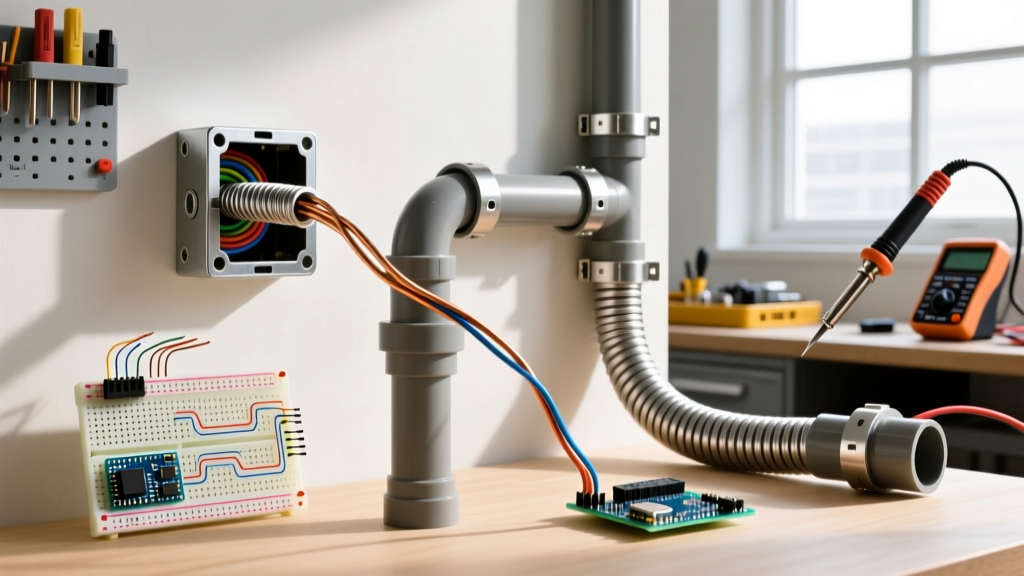
- FMC (Flexible Metal Conduit): Known as "Greenfield." Professionals use FMC strictly for vibration isolation—such as the final 3-foot drop from a hard-mounted EMT ceiling grid to an HVAC blower motor. DIYers incorrectly use FMC as a substitute for EMT to avoid bending, running it 20 feet across an attic. Per NEC 348.12, FMC has strict length limitations and cannot be used as a grounding path for circuits over 20 amps or longer than 6 feet without a separate ground wire.
- LFMC (Liquidtight Flexible Metal): Used for outdoor AC disconnects and wet locations. It features a UV-resistant plastic jacket over a steel core. It is expensive (roughly $3.50 per foot for 3/4-inch) and requires specialized liquidtight connectors that amateurs often overtighten, crushing the inner core.
Comparative Matrix: Electrical Wiring Conduit Types
The following table breaks down the core characteristics, approximate 2026 material costs, and application suitability for the most common raceways.
| Conduit Type | NEC Article | Material Cost (10ft / 3/4") | Tool Investment | DIY Friendliness | Pro Preference Use-Case |
|---|---|---|---|---|---|
| EMT (Galvanized) | Art. 358 | ~$8.50 | High ($150+ for benders) | Moderate | Exposed indoor, commercial, garages |
| PVC Sch. 40 | Art. 352 | ~$6.00 | Low ($20 for saw & cement) | High | Underground, direct burial, concrete |
| PVC Sch. 80 | Art. 352 | ~$14.00 | Low | High | Physical damage zones, utility poles |
| FMC (Greenfield) | Art. 348 | ~$18.00 | Low (Hacksaw) | Low (Code traps) | Vibration drops (HVAC, motors) |
| ENT (Smurf Tube) | Art. 362 | ~$9.00 | Low | High | Inside masonry/concrete walls |
The Ultimate Dealbreaker: Conduit Fill and Wire Derating
The most common point of failure in DIY conduit installations is ignoring Chapter 9, Table 1 of the NFPA 70 National Electrical Code. The NEC dictates that conduit cannot be filled beyond 40% of its cross-sectional area when pulling three or more wires.
Amateurs frequently attempt to pull four 10 AWG THHN wires and a ground through a 1/2-inch EMT nipple. Not only does this violate the 40% fill rule, making the pull physically agonizing, but it also triggers NEC 310.15(C)(1) derating requirements. When you bundle more than three current-carrying conductors in a raceway, the heat cannot dissipate. You must mathematically derate the ampacity of the wire. A 12 AWG wire normally rated for 20 amps might be derated to 14 amps, creating a silent fire hazard behind the walls.
Licensed contractors utilize conduit fill calculators and routinely upsize to 3/4-inch or 1-inch conduit to ensure wires pull smoothly without stretching the copper or tearing the insulation jacket, while simultaneously avoiding thermal derating penalties.
Safety and Compliance: When to Call a Professional
While running PVC conduit for a backyard landscape lighting transformer or pulling ENT through a newly framed interior wall are manageable DIY tasks, certain scenarios demand professional execution. According to OSHA 1926.405 Wiring Methods and local municipal codes, any conduit work involving service entrance conductors, main panel feeders, or transitions through fire-rated assemblies requires strict adherence to fire-stopping and grounding protocols.
Furthermore, the National Electrical Contractors Association (NECA) emphasizes that improper support spacing (e.g., failing to strap EMT every 10 feet and within 3 feet of every box) is a primary reason DIY inspections fail. If your project involves bending offsets around structural beams, transitioning between dissimilar metals, or calculating complex wire derating, the investment in a licensed electrician pays for itself in safety, code compliance, and system longevity.