
The Electrical Wiring Brown Wire: Decoding the Standards
Encountering an electrical wiring brown wire inside a junction box, control panel, or cable harness can trigger immediate caution for any seasoned electrician. Unlike the universally recognized black (hot), white (neutral), and bare/green (ground) conductors found in standard 120V residential circuits, the brown wire does not have a single, universal identity. Its function shifts dramatically depending on whether you are working in a US commercial facility, dealing with imported international machinery, or troubleshooting low-voltage residential control circuits.
As of 2026, the strict enforcement of the 2023 National Electrical Code (NEC) and the harmonization of global equipment standards have made understanding the exact context of the brown wire a critical safety requirement. Misidentifying this conductor can lead to catastrophic arc flash incidents, destroyed equipment, or severe electrical shock. This guide breaks down the exact code requirements, international variances, and real-world troubleshooting protocols for the brown wire.
NEC Article 310.12(C): The 480V 'BOY' Standard
In the United States, the most critical application of the brown wire is found in commercial and industrial 480Y/277-volt, 3-phase electrical systems. Historically, electricians used black, red, and blue for all 3-phase systems regardless of voltage, which created massive safety hazards when transitioning between 208V and 480V panels.
To eliminate this confusion, the NEC codified specific color sequences based on voltage. For 480Y/277V systems, NFPA 70 (NEC) Article 310.12(C) mandates the following conductor identification for feeders and branch circuits:
- Phase A: Brown
- Phase B: Orange
- Phase C: Yellow
- Neutral: Gray (or White with gray tape)
- Ground: Green or Bare
Electricians often use the mnemonic 'BOY' (Brown, Orange, Yellow) to remember the 480V sequence. If you open a commercial lighting panel and see an electrical wiring brown wire connected to a breaker, you are looking at Phase A of a 277V single-phase lighting circuit or a 480V 3-phase motor feed. Phase-to-neutral will read 277V, while phase-to-phase (Brown to Orange or Yellow) will read 480V.
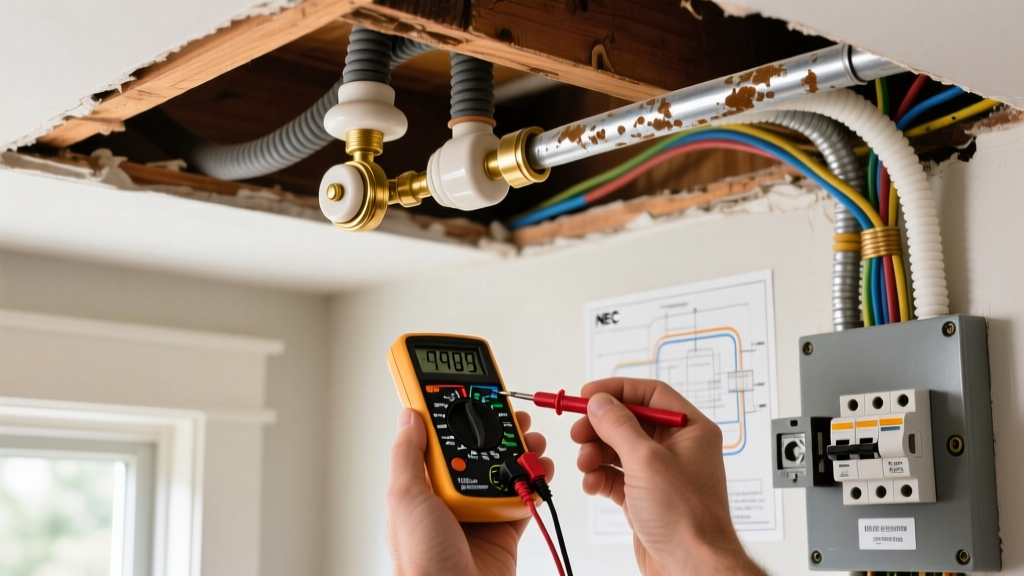
CRITICAL SAFETY WARNING: Never assume a brown wire is a low-voltage traveler or a neutral conductor in a commercial setting. Always treat it as an energized 480V/277V source until proven dead using a properly rated CAT IV multimeter. According to OSHA electrical safety guidelines, failure to verify voltage on high-energy conductors is a leading cause of fatal arc flash incidents in industrial environments.
NEC vs. IEC: The International Brown Wire Conflict
The complexity of the brown wire multiplies when dealing with imported machinery, such as European CNC routers, German HVAC chillers, or international IT infrastructure. The International Electrotechnical Commission (IEC) standard 60445 uses a completely different color scheme than the US NEC.
Under IEC standards (widely used in Europe, the UK, Australia, and many parts of Asia), the brown wire is the primary Line 1 (L1) or Live conductor for both single-phase and 3-phase systems.
Code Comparison Matrix: NEC vs. IEC
| System / Standard | Brown Wire Role | Voltage Potential | Accompanying Phase Colors |
|---|---|---|---|
| US NEC (480Y/277V 3-Phase) | Phase A (Hot) | 277V to Neutral / 480V to Phase | Orange (B), Yellow (C) |
| US NEC (208Y/120V 3-Phase) | Not Standardized (Often Traveler) | 120V / 208V (if used as hot) | Black (A), Red (B), Blue (C) |
| IEC 60445 (Single-Phase) | Line 1 (Live/Hot) | 230V to Neutral | Blue (Neutral), Green/Yellow (PE) |
| IEC 60445 (3-Phase) | Line 1 (L1) | 230V to Neutral / 400V to Phase | Black (L2), Grey (L3) |
The Danger Zone: If a US facility imports a 400V European machine and connects it to a 480V US supply without a step-down transformer, the equipment will fail. Furthermore, if a US electrician assumes the IEC brown wire is just a 120V switch leg and handles it without 480V PPE, they risk a lethal shock. Always check the equipment nameplate for the IEC vs. NEC wiring diagram before terminating imported panels.
Residential Anomalies: Why is There a Brown Wire in My House?
In standard US residential wiring (120V/240V), brown is not a recognized NEC color for branch circuit hot conductors. However, homeowners and remodelers frequently encounter the electrical wiring brown wire in specific low-voltage or appliance-specific scenarios:
- 3-Way and 4-Way Switch Travelers: When pulling 14/3 or 12/3 Romex, the standard colors are black, white, red, and bare. However, in older homes or when using specific commercial-grade MC (Metal Clad) cable adapted for residential use, brown may be used as a traveler wire between multi-way switches.
- Ceiling Fan Light Kits: Many ceiling fan manufacturers use brown for the dedicated light fixture hot wire inside the fan canopy, while blue is used for the fan motor hot. This allows the homeowner to wire the fan and light to separate wall switches.
- Thermostat and HVAC Control Wiring: In 18/5 or 18/8 low-voltage thermostat cables, brown is occasionally used as the 'C' (Common) wire or the 'O/B' (Reversing Valve) wire for heat pumps. While blue is the modern standard for the 'C' wire, brown remains common in older 5-wire harnesses.
- Doorbell and Intercom Systems: Low-voltage (16V-24V) doorbell transformers and intercom harnesses frequently utilize brown as a secondary signal or ground return wire.
Testing and Identification Protocol (2026 Best Practices)
When you encounter an unidentified brown wire, guessing is not an option. Follow this strict testing protocol using modern diagnostic tools. A high-quality CAT IV multimeter, such as the Fluke 87V MAX (retailing around $550 in 2026), is mandatory for commercial panels to ensure protection against transient voltage spikes up to 1000V.
Step-by-Step Verification
- Step 1: Visual Trace. Trace the brown wire back to its origin. Does it enter a 3-phase breaker? Does it originate from a low-voltage transformer? Does it connect to a terminal block labeled 'L1'?
- Step 2: Non-Contact Voltage (NCV) Test. Use a CAT IV NCV detector (e.g., Fluke T6-1000) to verify the presence of an electromagnetic field. Note that NCV testers can give false positives in densely packed commercial panels due to 'ghost voltage' from adjacent 480V phases.
- Step 3: Hard Meter Verification. Set your multimeter to AC Voltage (V~). Test Phase-to-Ground first. If it reads ~277V, you are on Phase A of a 480Y/277V system. If it reads ~120V, it may be a miscolored 120V leg or an IEC 230V system that has been stepped down. If it reads 0V, test Phase-to-Neutral to rule out an open neutral condition.
- Step 4: Phase Tape Identification. Once verified, if the wire is being used in a 208V system as a custom traveler or switch leg, NEC requires you to re-identify it. Wrap the ends in 3M Scotch 35 Phase Tape (approx. $6 per roll) to match the system's documented color code, preventing future electricians from assuming it is a 480V Phase A conductor.
Frequently Asked Questions (FAQ)
Can I use a brown wire for a 120V residential outlet?
Technically, the NEC allows any color other than white, gray, or green to be used as an ungrounded (hot) conductor, provided it is permanently re-identified at all termination points. However, using a brown wire for a standard 120V receptacle is highly discouraged. It violates industry best practices and will likely fail an inspection if the Authority Having Jurisdiction (AHJ) suspects it is a misapplied 480V conductor.
What is the difference between the brown wire and the orange wire in a 240V High-Leg Delta?
In a 240V High-Leg Delta system (common in older US industrial buildings), the 'wild leg' or 'high leg' (which reads 208V to neutral) must be identified by the color Orange per NEC 310.12(B). The brown wire is not part of the standard high-leg delta color code (which typically uses Black, Red, and Blue, with Orange as the high leg). If you see brown and orange together, you are almost certainly looking at a 480V system, not a 240V high-leg.
Is brown ever used as a neutral wire?
Never. Under no circumstances in US NEC or International IEC standards is brown used as a neutral or grounded conductor. US NEC mandates white or gray for neutral, while IEC mandates light blue. Using brown as a neutral is a severe code violation that creates an immediate electrocution hazard.
Final Takeaways for the Modern Electrician
The electrical wiring brown wire is a prime example of why context is everything in electrical work. In a 480V commercial panel, it commands respect as Phase A. In an imported European control panel, it is the primary 230V/400V Line. In a residential ceiling fan, it is simply a low-current switch leg. By anchoring your troubleshooting to NEC Article 310.12(C), verifying voltage with CAT IV equipment, and respecting international IEC variances, you ensure both code compliance and personal safety on every job site.