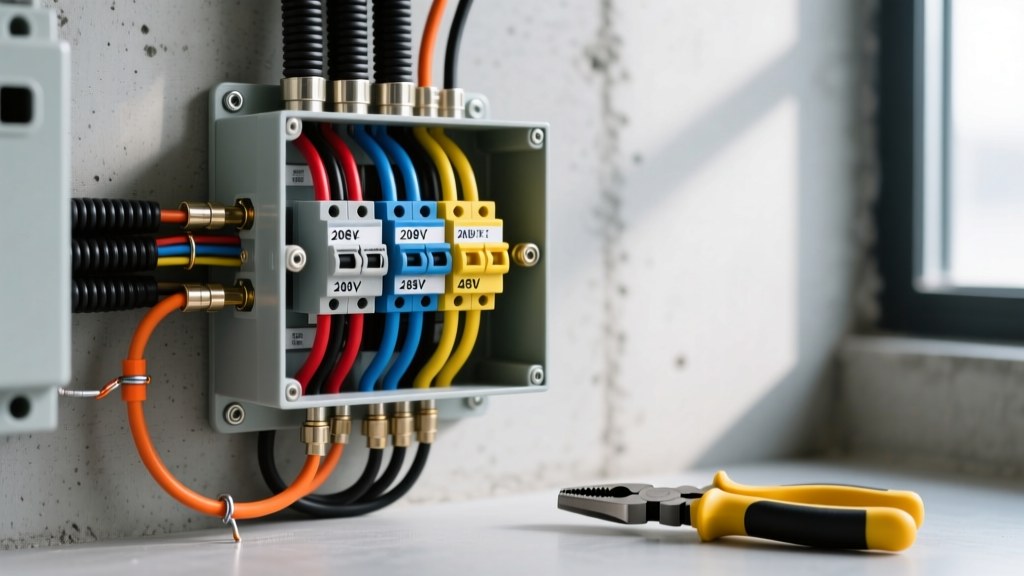

The Foundation of Residential Circuits: Electrical Wiring White and Black
When you peel back the PVC jacket of standard non-metallic (NM-B) sheathed cable, you are immediately greeted by the foundational colors of North American residential power: black and white. Understanding the specific roles, code requirements, and physical properties of electrical wiring white and black conductors is non-negotiable for any DIYer or apprentice electrician. While black universally signifies the ungrounded (hot) conductor carrying 120V of alternating current, the white grounded (neutral) conductor has a far more complex set of rules, exceptions, and termination requirements.
In 2026, with copper prices stabilizing but remaining historically high, selecting the correct gauge and utilizing precision termination tools is critical to prevent voltage drop, arcing, and thermal failures. This guide breaks down the material science, National Electrical Code (NEC) mandates, and professional-grade tools required to safely work with black and white circuit conductors.
NM-B Cable Material Specifications and 2026 Pricing
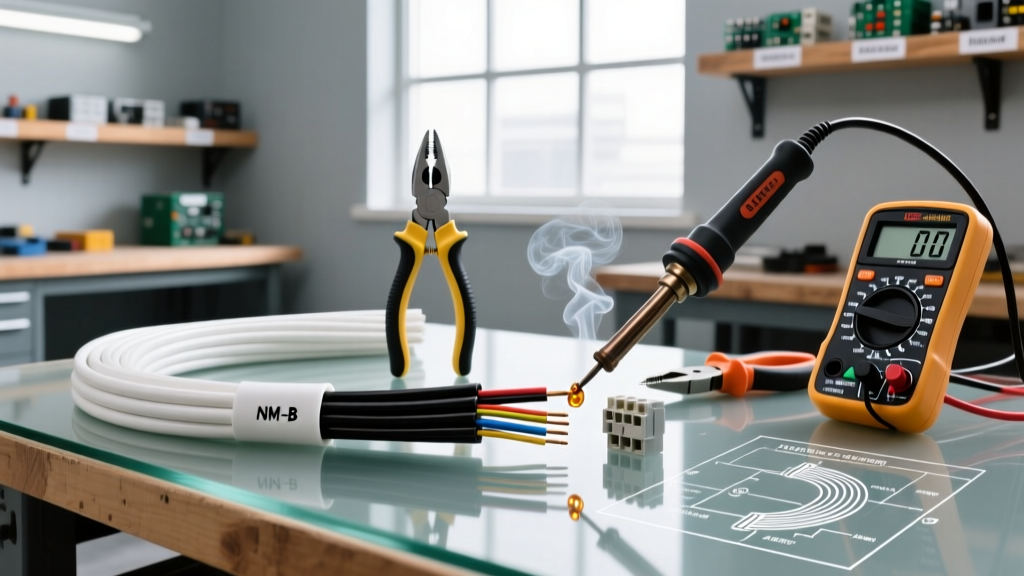
Standard indoor electrical wiring relies on NM-B (Non-Metallic Sheathed Cable, Type B), commonly known by the brand name Romex. The black and white conductors inside are solid, annealed copper, rated for 600V and 90°C (though ampacity is calculated at the 60°C column for standard residential terminations).
| Cable Type | Gauge (AWG) | Black (Hot) Ampacity | White (Neutral) Role | 2026 Avg. Price (250ft Roll) |
|---|---|---|---|---|
| 14/2 NM-B | 14 AWG | 15 Amps Max | Standard Return Path | $85.00 - $105.00 |
| 12/2 NM-B | 12 AWG | 20 Amps Max | Standard Return Path | $115.00 - $140.00 |
| 10/2 NM-B | 10 AWG | 30 Amps Max | Standard Return Path | $170.00 - $210.00 |
| 12/3 NM-B | 12 AWG | 20 Amps (Black & Red) | Shared Neutral (MWBC) | $165.00 - $195.00 |
Note: Never use Copper-Clad Aluminum (CCA) wire for permanent AC branch circuits. While cheaper, CCA suffers from higher resistance, thermal expansion mismatches at brass terminals, and is not UL-listed for standard NM-B residential branch wiring.
When White Isn't Neutral: Critical NEC Exceptions
The most dangerous assumption a novice can make is that the white wire is always safe to touch. According to the National Fire Protection Association (NFPA) NEC guidelines, white or gray conductors must be used exclusively for grounded (neutral) purposes, with specific, heavily regulated exceptions.
1. The Modern Switch Loop (NEC Article 404.2)
Historically, electricians ran 12/2 cable to a switch, using the white wire as the permanent hot feed and the black as the switched leg. This is now a code violation in most jurisdictions. Modern codes require a neutral (white) wire at every switch box to accommodate smart switches and occupancy sensors. You must now use 12/3 or 14/3 cable, reserving the white strictly for neutral, while using black (hot) and red (switched leg/traveler).
2. 240V Pure Resistive Loads
When wiring a 240V baseboard heater or a simple water heater that does not require 120V for controls, a 2-wire cable (black and white) is often used. In this scenario, both the black and white wires are ungrounded (hot) conductors carrying 120V each, out of phase. NEC Article 200.7(C) mandates that the white wire must be permanently re-identified at both ends using black electrical tape, heat shrink, or permanent marker to warn future workers that it is a live hot conductor.
Safety Warning: A floating or disconnected white neutral on a Multi-Wire Branch Circuit (MWBC) can cause 120V appliances to receive up to 200V+ due to series circuit voltage division, instantly destroying electronics and creating a severe fire hazard. Always pigtail white neutrals in MWBCs.
Essential Tools for Black and White Wire Termination
Proper termination prevents the leading cause of electrical fires: high-resistance connections. Here are the specific tools professionals use in 2026 to handle black and white conductors.
- Klein Tools 11065 Katapult Wire Stripper (10-14 AWG): Priced around $28.97, this tool allows for one-handed stripping. It features a precise gauge hole that strips the PVC jacket without nicking the copper. Nicking a 12 AWG black wire reduces its cross-sectional area, creating a localized hot spot under a 20A load.
- WAGO 221-412 Lever-Nuts (2-Conductor): At roughly $0.48 per unit, these transparent, UL-listed lever connectors have largely replaced twist-on wire nuts for joining black-to-black and white-to-white pigtails. They require exactly 11mm (approx. 7/16") of stripped wire and provide a gas-tight, maintenance-free connection that won't vibrate loose over time.
- Ideal 305 Torque Screwdriver: Priced near $115.00. Modern Eaton and Leviton receptacles specify terminal torque requirements (typically 14 in-lbs for 12 AWG wire). Hand-tightening often leads to under-torqued (arcing risk) or over-torqued (stripped threads) connections.
- Milwaukee 48-22-8426 Lineman's Pliers: ($45.00) The integrated fish-tape puller and optimized cutting knives make gripping and twisting black and white wires for traditional wire-nut connections significantly easier.
Step-by-Step Receptacle Termination Guide
Follow this precise workflow when terminating black and white wires to a standard 15A or 20A duplex receptacle:
- Strip the Jacket: Remove exactly 3/4" of insulation from the black and white conductors using the Katapult stripper. Do not score the copper.
- Form the Hook: Using the needle-nose section of your lineman's pliers, bend a clockwise hook at the end of the bare copper. The clockwise direction ensures the hook closes around the terminal screw as you tighten it.
- Connect the White (Neutral): Loop the white wire hook around the silver-colored terminal screw. The white wire always goes to the silver screw, which aligns with the wider slot on the receptacle face.
- Connect the Black (Hot): Loop the black wire hook around the brass-colored terminal screw. The black wire always goes to the brass screw, aligning with the shorter, hot slot.
- Torque to Spec: Use your torque screwdriver set to the manufacturer's specification (usually 14 in-lbs) to secure the screws.
- Insulate (Optional but Recommended): Wrap the sides of the receptacle with 33+ rated electrical tape to cover the exposed terminal screws, preventing short circuits against metal boxes or ground wires.
Troubleshooting Common Black and White Wiring Failures
When a circuit fails or behaves erratically, the issue almost always lies in how the black and white conductors were managed.
Reversed Polarity (Hot/Neutral Swap)
Symptom: A receptacle tester shows "Hot/Neutral Reverse."
Cause: The black wire was landed on the silver screw, and the white wire on the brass screw.
Danger: While the device will still power on, the internal switch of the plugged-in appliance will only break the neutral path. The appliance's internal components remain fully energized at 120V even when turned "off," posing a severe shock hazard during maintenance (e.g., changing a toaster crumb tray or a lamp bulb).
Open Neutral (White Wire Disconnected)
Symptom: Devices plugged into the receptacle do not turn on, but a non-contact voltage tester detects voltage on the black wire.
Cause: The white wire has broken off its terminal, or a downstream Wago lever-nut was left open.
Danger: If a load is plugged in, the return path is broken. The white wire downstream of the break will actually become energized at 120V through the plugged-in appliance's internal resistance, turning the "safe" neutral wire into a lethal shock hazard.
Shared Neutral Overload
Symptom: The white neutral wire in a 12/3 cable is melting or the breaker trips randomly.
Cause: Both the black and red hot wires were placed on the same phase (same breaker leg) instead of opposite phases in the panel. Instead of canceling out the return current (e.g., 10A on Black + 10A on Red = 0A on White), the currents add up (20A returning on a 12 AWG white wire not protected by a 20A breaker on that specific leg).
Frequently Asked Questions
Can I use a white wire as a ground?
No. According to OSHA electrical safety standards and the NEC, the equipment grounding conductor must be bare copper or have green (or green with yellow stripe) insulation. Using white as a ground creates a massive shock risk, as the grounding path would be indistinguishable from a current-carrying neutral.
Why is my white wire reading 120V with my multimeter?
If you measure 120V between the white wire and a known ground, you have an "open neutral" further up the circuit, or the white wire is being intentionally used as a hot conductor (like in a 240V heater circuit) and was not properly re-identified with black tape. Turn off the breaker immediately and trace the circuit.
Does the black wire always go to the smaller slot?
Yes. The black (hot) wire connects to the brass screw, which corresponds to the shorter, narrower vertical slot on the face of the receptacle. The white (neutral) connects to the silver screw and the longer, wider slot. This polarization ensures that the internal switches of appliances break the hot side of the circuit.