
The Critical Foundation of Electrical Safety
Electrical fires cause billions of dollars in property damage annually, and a significant percentage of these incidents trace back to improper cable selection, poor routing, or ignored derating factors. When specifying and installing an electric wiring cable, electricians and advanced DIYers must look far beyond simply matching the wire gauge to the breaker size. The National Electrical Code (NEC), published by the National Fire Protection Association (NFPA 70), provides a rigorous framework for ensuring that conductors operate safely within their thermal and physical limits.
This guide dives deep into the technical realities of cable insulation, ampacity derating mathematics, physical protection mandates, and termination torque requirements that define modern electrical safety in 2026.
Decoding Cable Insulation: THHN, XHHW-2, and NM-B
The outer jacket and inner insulation of an electric wiring cable dictate where it can be safely installed. Misidentifying insulation types is a leading cause of premature dielectric breakdown and arc faults.
Common Insulation Types and Their Limits
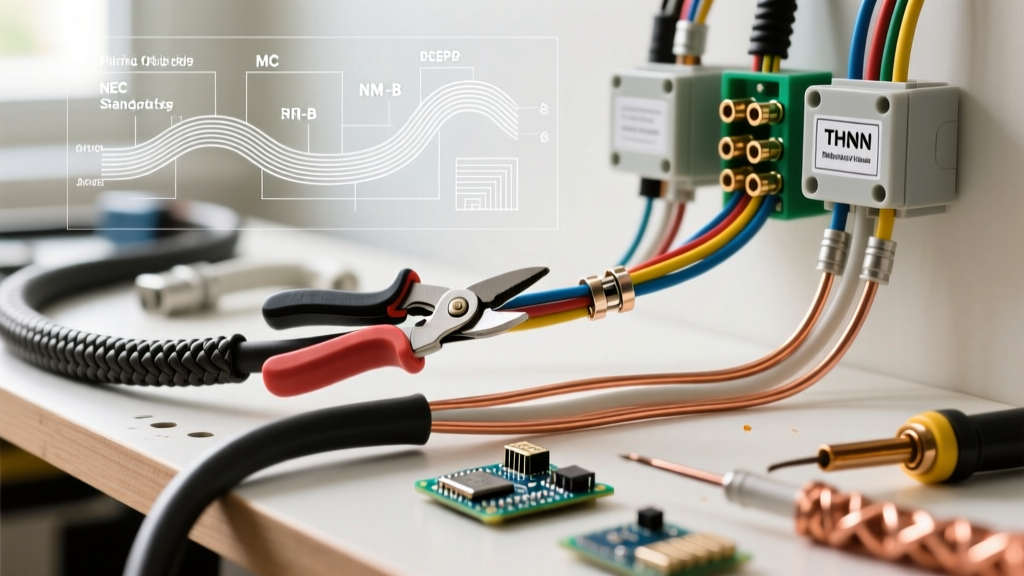
- THHN/THWN-2: Thermoplastic, High Heat, Nylon-coated. The nylon jacket provides excellent resistance to oil, gasoline, and physical abrasion, making it ideal for pulling through PVC or EMT conduit. Rated for 90°C in dry locations and 75°C in wet locations.
- XHHW-2: Cross-linked polyethylene (XLPE). This thermoset insulation offers superior resistance to high temperatures, moisture, and chemical exposure. It lacks the slippery nylon coat of THHN, which can make pulling slightly harder, but its dielectric strength is vastly superior. According to the Copper Development Association, XLPE insulation significantly reduces the risk of short circuits under extreme thermal stress.
- NM-B (Non-Metallic Sheathed): Commonly known by the brand name Romex. While the individual THHN conductors inside are rated for 90°C, NEC Article 334.80 strictly mandates that the ampacity of NM-B cable be calculated using the 60°C column, regardless of the 90°C rating of the internal wires.
- UF-B (Underground Feeder): Features a solid PVC jacket encapsulating the conductors. Rated for 60°C ampacity and direct burial, but highly susceptible to UV degradation if left exposed to sunlight.
| Cable Type | Insulation Material | Max Temp Rating | NEC Ampacity Limit | Primary Application |
|---|---|---|---|---|
| THHN/THWN-2 | PVC with Nylon Jacket | 90°C (Dry) / 75°C (Wet) | 90°C Column (Derating applies) | Conduit, Raceways, Commercial |
| XHHW-2 | Cross-linked Polyethylene | 90°C (Dry & Wet) | 90°C Column (Derating applies) | Wet locations, High-heat industrial |
| NM-B | PVC Jacket, THHN inner | 90°C (Internal) | Strictly 60°C Column | Interior residential framing |
| UF-B | Solid PVC Encapsulated | 60°C | 60°C Column | Direct burial, Outdoor feeders |
The Hidden Danger of Ampacity Derating
One of the most frequently violated safety principles in commercial and multi-family wiring is ignoring ampacity adjustment factors. When you bundle multiple current-carrying conductors in a single raceway, they generate cumulative heat. If this heat cannot dissipate, the insulation melts.
A Real-World Derating Scenario
Imagine you are pulling nine 12 AWG THHN current-carrying conductors through a 1/2-inch EMT conduit in an attic where the ambient temperature reaches 110°F (43°C). You might assume that because 12 AWG THHN is rated for 30A at 90°C, you can safely use 20A breakers. Let us run the NEC math:
- Base Ampacity: 12 AWG at 90°C = 30A.
- Adjustment Factor (NEC Table 310.15(C)(1)): 9 current-carrying conductors require a 70% derating multiplier. (30A × 0.70 = 21A).
- Temperature Correction (NEC Table 310.15(B)(1)): At 110°F ambient, the 90°C column requires an 87% correction factor. (21A × 0.87 = 18.27A).
CRITICAL SAFETY FAILURE: Your final derated ampacity is 18.27A. Because this is below the 20A rating of your breaker, and NEC 240.4(B) does not permit rounding up the breaker size when the conductor's derated ampacity falls below standard overcurrent device ratings, this installation is a severe fire hazard. You must upsize to 10 AWG THHN or pull a separate conduit.
Physical Protection and Framing Clearances
Physical damage to an electric wiring cable compromises the dielectric barrier, leading to ground faults and arc flashes. NEC Article 300.4 outlines strict protection requirements, particularly in wood-frame construction.
The 1.25-Inch Rule and Nail Plates
When routing NM-B or MC cable through wood studs, joists, or rafters, the edge of the boring hole must be at least 1.25 inches from the nearest edge of the framing member. If structural constraints force you to drill closer than 1.25 inches, NEC 300.4(A)(1) mandates the installation of a steel nail plate. These plates must be at least 1/16 inch thick to prevent drywall screws or framing nails from piercing the cable jacket. Products like the Arlington Industries NP1 nail plates are industry standards for this application.
Bending Radius and Stapling Pitfalls
Over-tightening cable staples is a notorious DIY and apprentice mistake. Crushing the NM-B jacket alters the internal geometry, pushing the hot and neutral conductors closer together and degrading the paper separator.
- Stapling: Use only listed, insulated cable staples (e.g., Gardner Bender GS-1019B or Romex Stack-It clips). Never use standard pneumatic staple guns meant for roofing or sheathing.
- Bending Radius: NEC 334.24 requires that the bending radius of NM cable not be less than five times the diameter of the cable. For standard 12/2 NM-B, this means a minimum bend radius of roughly 1.25 inches. Sharp kinks will fracture the copper strands, creating a high-resistance hot spot.
Termination Torque and Aluminum Safety
The safety of an electric wiring cable ends where the termination begins. Loose connections cause arcing, oxidation, and thermal runaway. Since the 2017 NEC cycle, Article 110.14(D) has strictly required that terminations be tightened to the manufacturer's specified torque values using a calibrated torque screwdriver or wrench.
For example, a standard 20A residential receptacle typically requires 14 lb-in of torque. Using a tool like the Klein Tools 32500TORQ ensures exact compliance. This is especially critical when using AA-8000 series aluminum alloy conductors for heavy feeders. Aluminum is highly susceptible to cold creep and thermal expansion; if not torqued precisely and treated with an antioxidant paste like Noalox, the connection will loosen over time, leading to catastrophic panel fires. For comprehensive workplace safety standards regarding electrical terminations, always refer to OSHA Electrical Safety Guidelines.
Pre-Energization Safety Inspection Checklist
Before closing up walls or energizing a panel, run through this mandatory safety checklist to verify your electric wiring cable installation:
- Verify Conductor Count & Derating: Confirm that bundled conductors in raceways have been mathematically derated for both count and ambient temperature.
- Inspect Nail Plates: Walk the framing and ensure every cable within 1.25 inches of a stud edge is protected by a 1/16-inch steel plate.
- Check Staple Tension: Run your hand over secured NM-B cables. The staple should hold the cable snugly against the wood without visibly deforming or indenting the outer PVC jacket.
- Confirm Bend Radii: Inspect panel entries and tight corner turns to ensure no cable is kinked or bent tighter than 5x its diameter.
- Torque Verification: Ensure all breaker lugs, neutral bars, and device screws have been tightened with a calibrated torque tool to the manufacturer's exact lb-in specification.
- Jacket Integrity: Look for razor nicks or abrasions on THHN/XHHW-2 jackets caused by pulling through conduit with sharp burrs. Re-pull or replace damaged sections immediately.
Conclusion
Safe electrical wiring is not about memorizing a single chart; it is about understanding the thermal, physical, and chemical limits of the materials you are installing. By respecting NEC derating factors, enforcing strict physical clearance rules, and utilizing calibrated torque tools, you ensure that your electric wiring cable infrastructure remains safe, efficient, and code-compliant for decades.