
Designing and executing log cabin electrical wiring for commercial properties—such as boutique mountain lodges, multi-unit glamping resorts, and corporate retreat centers—requires a radical departure from standard residential practices. While a single-family log home presents unique challenges regarding timber shrinkage and routing, a commercial log cabin development amplifies these issues while introducing strict commercial building codes, high-density load requirements, and advanced fire safety mandates. As of 2026, the surge in eco-tourism and luxury off-grid resorts has pushed the demand for commercial-grade electrical infrastructure in timber structures to an all-time high.
This commercial wiring guide dissects the technical realities of engineering electrical systems for large-scale timber builds. From accommodating massive log settling to integrating Level 3 EV charging stations and commercial kitchen loads, we provide the actionable frameworks senior electricians and project managers need to deliver safe, code-compliant, and future-proof resort wiring.
Navigating NEC Codes for Commercial Timber Structures
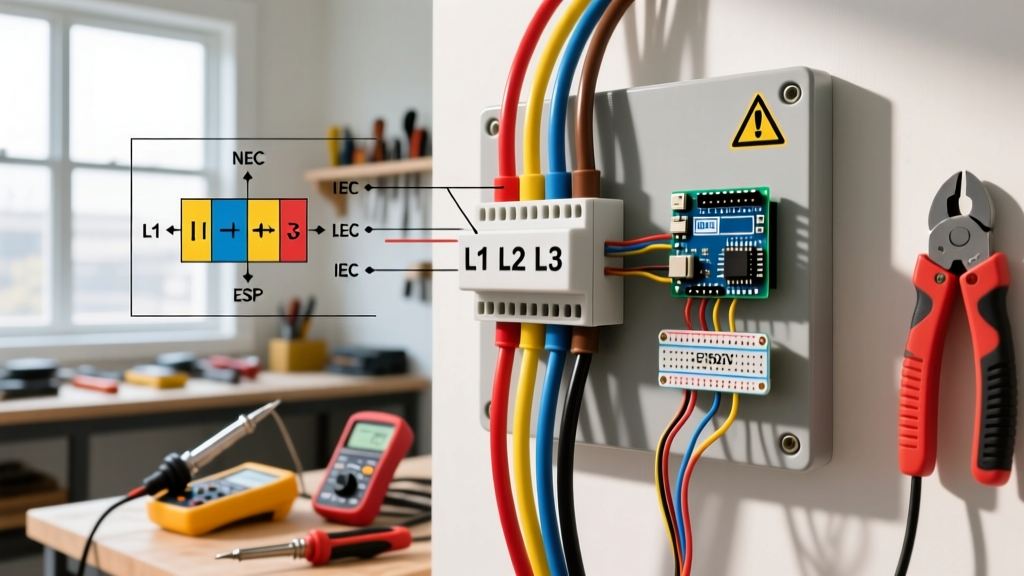
When transitioning from residential to commercial occupancy, the National Electrical Code (NEC) shifts its expectations regarding life safety, load diversity, and equipment durability. For commercial log cabins, you are no longer operating solely under Article 210 (Branch Circuits); you must integrate commercial feeder and service requirements.
- NEC Article 225 (Outside Branch Circuits and Feeders): Critical for resort layouts where power is distributed from a central utility pad-mounted transformer to individual cabins via underground or overhead feeds. Timber-heavy environments require strict adherence to clearance rules to prevent branch contact with settling or swaying logs.
- NEC Article 230 (Services): Commercial lodges often require 480Y/277V 3-phase service to support large commercial HVAC chillers and snow-melt systems, stepped down via local transformers to 120/240V for individual cabin units.
- Emergency Egress and Standby Power: Under NFPA 101 (Life Safety Code), commercial hospitality venues require battery-backed egress lighting and designated emergency circuits. Integrating Lithonia Lighting ELB series LED emergency backups into heavy timber ceilings requires specialized flush-mount housings that do not compromise the structural integrity of the roof trusses.
Expert Insight: Always consult the local Authority Having Jurisdiction (AHJ) early in the design phase. Many mountain municipalities have specific amendments regarding combustible construction and concealed wiring in heavy timber frames that exceed baseline NEC requirements.
Engineering for Log Settling: Conduit and Routing Strategies
The most catastrophic failure mode in log cabin electrical wiring is ignoring wood shrinkage. Green logs can settle up to 3/4-inch per foot of wall height over the first three years, while kiln-dried logs typically settle 1/4-inch to 3/8-inch per foot. If you staple standard NM-B (Romex) cable directly to a settling log stud, the differential movement between the timber and the anchored electrical boxes will shear the conductors or rip the boxes from the wall.
The Vertical Chase and Slip-Joint Method
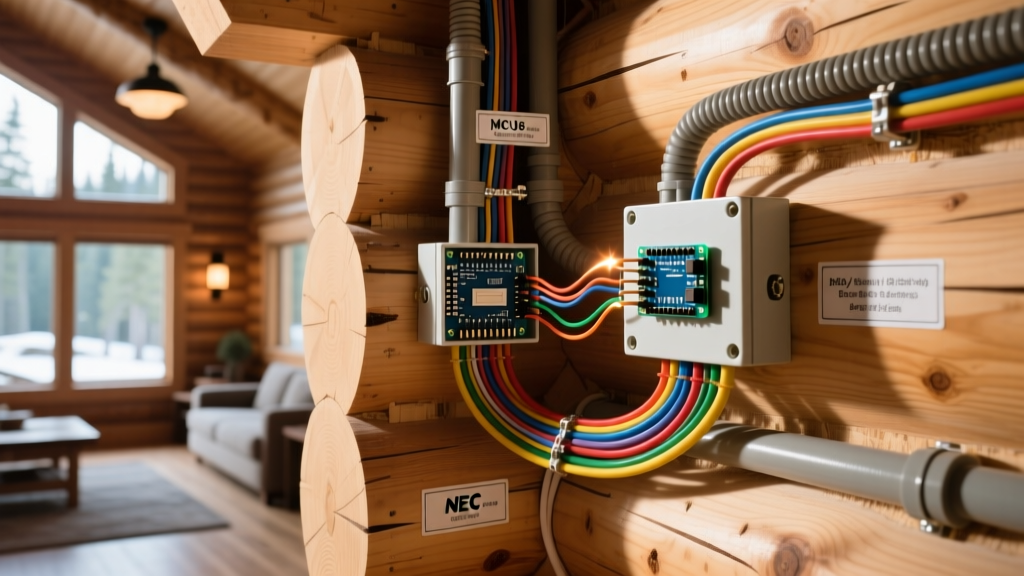
For commercial builds, we mandate the use of Rigid Metal Conduit (RMC) or Intermediate Metal Conduit (IMC) routed through oversized vertical chases drilled into the log posts or interior timber partitions. This protects the wiring from physical damage and allows for future circuit upgrades without destroying the millwork.
- Drill Oversized Chases: For a 3/4-inch EMT or RMC run, drill a 1.5-inch vertical chase through the center of the timber post. This provides 3/8-inch of clearance on all sides for the conduit to remain perfectly plumb while the log shrinks around it.
- Install Expansion Fittings: At every floor transition or where the conduit enters a fixed junction box, install an expansion coupling. The O-Z/Gedney EYS-1025 expansion joint accommodates up to 1.25 inches of movement, perfectly aligning with the maximum expected settling of a two-story commercial lodge.
- Use Saddle Boxes with Slotted Mounts: When mounting receptacles or switches to horizontal log beams, use boxes with elongated mounting slots. Secure them with lag screws placed in the center of the slot, allowing the box to slide downward as the beam settles.
High-Capacity Load Calculations for Resort Amenities
Commercial log cabins are not just sleeping quarters; they are high-amenity hospitality suites. Standard residential load calculations (NEC Article 220) will severely underestimate the peak demand of a modern luxury resort cabin. You must account for simultaneous operation of heavy inductive loads and continuous-use hospitality appliances.
| Amenity / Equipment | Typical Voltage / Phase | Estimated Amperage (Continuous/Peak) | NEC Sizing Considerations |
|---|---|---|---|
| Level 2 EV Charger (e.g., Tesla Universal Wall Connector) | 240V / 1-Phase | 48A (Requires 60A Breaker) | 125% continuous load multiplier; requires #4 AWG THHN in conduit. |
| Commercial Hot Tub (e.g., Jacuzzi J-400 Series) | 240V / 1-Phase | 40A - 50A | GFCI protection mandatory; strict equipotential bonding per NEC 680.26. |
| Mini-Split Inverter HVAC (Multi-Zone) | 208V-230V / 1-Phase | 15A - 25A (Locked Rotor up to 60A) | HACR rated breaker required; account for startup voltage drop on long feeders. |
| Electric Sauna Heater (e.g., Harvia Cilindro) | 240V / 1-Phase | 40A - 50A | High-temperature wiring (THHN) required in the ceiling plenum above the sauna. |
According to data regarding commercial EV infrastructure scaling, integrating multiple Level 2 chargers across a resort property requires implementing a smart load-management system (like the Enel X JuiceNet Pro commercial platform) to prevent tripping the main site transformer during peak evening check-in hours.
Fire Safety, AFCI, and Penetration Sealing
Timber structures present unique fire dynamics. While heavy timber (Type IV construction) chars predictably and maintains structural integrity, the concealed spaces within log walls and roof trusses can act as chimneys during a fire if not properly sealed.
Intumescent Firestopping
Every electrical penetration through a commercial log cabin's fire-rated assemblies (such as the shaft enclosures for elevators or commercial laundry chutes) must be sealed with an approved firestop system. We specify Hilti CP 606 Flexible Firestop Sealant. Unlike rigid mortars, CP 606 remains elastomeric, allowing it to stretch and compress as the logs undergo seasonal hygroscopic expansion and long-term settling without breaking the fire seal.
Arc Fault Protection in Hospitality Suites
NEC Article 210.12 requires Arc-Fault Circuit-Interrupter (AFCI) protection for all 120V, 15A and 20A branch circuits supplying outlets in sleeping quarters. In a commercial lodge, maintenance staff frequently swap out furniture and vacuum aggressively, increasing the risk of damaged cords behind heavy timber headboards. Utilizing dual-function AFCI/GFCI breakers, such as the Eaton BR220DF, provides comprehensive protection against both parallel arcing faults and ground faults, reducing liability for resort operators.
2026 Cost Analysis: Commercial Cabin Wiring
Budgeting for commercial log cabin electrical wiring requires understanding the premium placed on specialized labor and materials. Standard residential wiring in stick-frame homes averages $8 to $12 per square foot. Commercial timber builds operate on an entirely different cost matrix.
- Material Premium (+35%): The requirement for RMC conduit, oversized junction boxes, commercial-grade weatherproof enclosures (e.g., Hubbell 2600 Series), and heavy-duty panelboards (e.g., Schneider Electric PowerPact) drives up material costs significantly.
- Labor Premium (+60%): Drilling 1.5-inch chases through 12-inch diameter solid pine logs requires specialized auger bits, heavy-duty drills, and immense physical labor. Furthermore, bending and threading rigid conduit on-site in mountainous terrain adds substantial man-hours.
- Average Commercial Cost: Expect to budget between $22.00 and $34.00 per square foot for the complete electrical rough-in and trim-out of a high-end commercial log cabin resort in 2026, excluding the utility drop and main site transformers.
Expert Troubleshooting: Edge Cases in Timber Builds
Even with meticulous planning, commercial electricians encounter edge cases unique to log construction. Here is how to handle the most common field issues:
1. Condensation and Moisture Ingress in Exterior Conduits
The Problem: Conduits run from a heated cabin interior to an exterior deck (for hot tub or exterior lighting feeds) experience massive temperature differentials. This causes condensation to form inside the conduit, which then freezes, thaws, and degrades wire insulation over time.
The Solution: Adhere strictly to NEC Article 300.7 regarding raceways exposed to different temperatures. Install an O-Z/Gedney EFS explosion-proof seal fitting (used here purely for its airtight properties, not hazardous location requirements) or a dedicated conduit breathing drain at the lowest point of the exterior run to allow moisture to escape.
2. Grounding Electrode Systems in Solid Rock
The Problem: Many mountain resorts are built on granite shelves where driving standard 8-foot copper ground rods is impossible, compromising the grounding electrode system required by NEC Article 250.
The Solution: Utilize a Grounding Electrode Conductor (GEC) bonded directly to the structural steel reinforcement of the concrete footings (Ufer Ground) before the foundation is poured. If a Ufer ground is missed, install a Ground Enhancement Material (GEM) trench system using conductive concrete to achieve the mandated 25-ohm resistance threshold.
Mastering commercial log cabin electrical wiring is about anticipating movement, respecting the harshness of the environment, and applying commercial-grade rigor to rustic aesthetics. By engineering for settlement, calculating for luxury amenities, and sealing against fire, electrical contractors can deliver resort infrastructure that is as resilient as the timber it inhabits. For further reading on commercial site safety during these complex installations, refer to the OSHA electrical safety guidelines to ensure your crew remains protected during heavy timber rough-ins.