
Beyond the Breaker Box: Defining Commercial Electrical Wiring 101
Transitioning from residential to light commercial electrical work requires a fundamental shift in how you approach power distribution. Commercial electrical wiring 101 isn't merely about scaling up residential concepts; it is a distinct discipline governed by different physics, heavier mechanical requirements, and stricter adherence to the National Electrical Code (NEC). While a residential electrician might spend their day running non-metallic (NM) Romex cable through wooden studs, a commercial wireman is pulling XHHW-2 conductors through steel raceways, balancing three-phase loads, and mitigating harmonic distortion.
This guide strips away the fluff and dives deep into the core architecture of commercial facility power, providing exact specifications, material costs, and code-compliant installation frameworks for 2026.
The Power Source: Single-Phase vs. Three-Phase Systems
The most glaring difference in commercial environments is the reliance on three-phase power. While single-phase is sufficient for residential HVAC and lighting, commercial facilities utilize three-phase systems to run heavy induction motors, large rooftop units (RTUs), and high-density server racks efficiently.
| System Type | Standard Voltages | Conductor Setup | Primary Commercial Use Case | Avg. Installation Cost (per ft) |
|---|---|---|---|---|
| Single-Phase | 120/240V Split | 2 Hot, 1 Neutral, 1 Ground | Small retail, office lighting, basic receptacles | $3.50 - $5.00 |
| Three-Phase Wye | 208Y/120V | 3 Hot, 1 Neutral, 1 Ground | Standard commercial offices, mid-size HVAC | $6.20 - $8.50 |
| Three-Phase Wye | 480Y/277V | 3 Hot, 1 Neutral, 1 Ground | Industrial, large warehouses, heavy machinery | $8.00 - $12.50 |
Expert Insight: When working with 208Y/120V systems, never assume a 208V motor will draw the same amperage as a 230V motor. According to Ohm's Law and motor nameplate data, a 5HP motor will draw approximately 15% more current at 208V than at 230V. Always size your overcurrent protection and conductors based on the exact voltage supplied to the terminal.
Raceway Systems: EMT, IMC, and Conduit Fill Limits
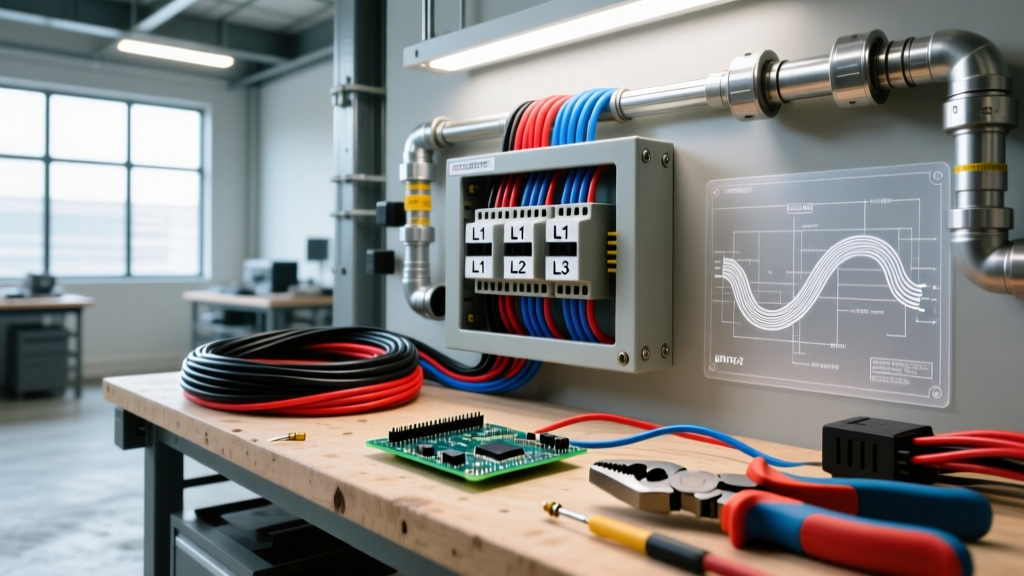
In commercial construction, you will rarely see exposed NM cable. The NEC mandates robust physical protection for conductors in commercial spaces, primarily achieved through metal raceways.
Electrical Metallic Tubing (EMT)
EMT is the undisputed king of interior commercial wiring. It is lightweight, cost-effective (a 10-foot stick of 3/4-inch EMT costs roughly $1.85 to $2.40), and easy to bend using a hand bender or hydraulic shoe bender. However, EMT is not threaded; it relies on set-screw or compression couplings.
- Set-Screw Couplings: Cheaper and faster to install, but prone to loosening under heavy vibration (e.g., near large air handlers).
- Compression Couplings: Require a tightening nut that compresses a ferrule around the conduit. They provide a superior, permanent ground path and are highly recommended for all commercial vibration zones.
NEC Chapter 9: The 40% Fill Rule
One of the most common failures in commercial inspections is conduit overfill. According to NFPA 70 (NEC) Chapter 9, Table 1, when pulling three or more conductors through a raceway, the conductors cannot exceed 40% of the conduit's internal cross-sectional area. For a standard 3/4-inch EMT, the internal area is 0.533 square inches. Therefore, your maximum wire fill is 0.213 square inches. Trying to jam six 10 AWG THHN wires into a 1/2-inch EMT will result in damaged insulation and a failed inspection.
Conductor Selection: THHN vs. XHHW-2
While residential wiring relies heavily on pre-assembled NM-B cable, commercial wiring requires pulling individual conductors. The two dominant insulation types are THHN and XHHW-2.
Material Science Note: THHN (Thermoplastic High Heat-resistant Nylon-coated) features a slick nylon outer jacket that makes it incredibly easy to pull through long conduit runs. However, that nylon jacket is highly susceptible to degradation in wet environments and certain chemical exposures.
For modern commercial facilities, XHHW-2 (Cross-Linked Polyethylene) is increasingly the preferred choice. XHHW-2 lacks the nylon jacket, utilizing a thermoset XLPE insulation instead. This provides superior resistance to moisture, chemicals, and high temperatures. Furthermore, XHHW-2 has a smaller overall outside diameter than THHN for the same AWG size, allowing you to fit more conductors into the same trade-size conduit, potentially saving thousands of dollars in conduit and labor on large-scale projects.
Panelboards and Overcurrent Protection Architecture
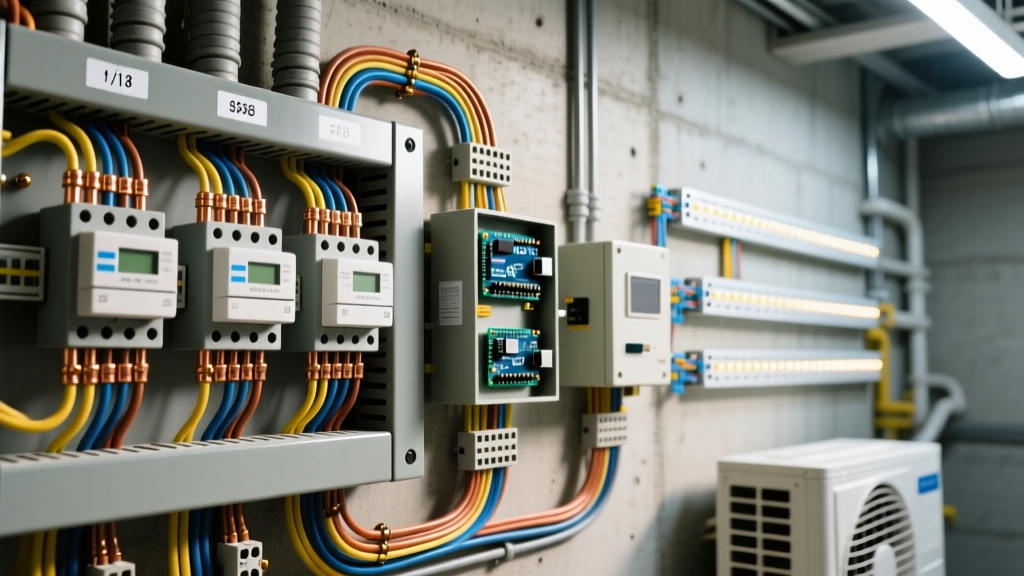
Commercial panelboards are engineered for durability, high interrupting capacities (AIC), and continuous duty. Unlike the plug-in breakers found in residential load centers, commercial panels predominantly use bolt-on or tubular bus architectures.
Bolt-On vs. Plug-In Breakers
In a commercial environment, thermal expansion and contraction, combined with harmonic vibrations, can cause plug-in breakers to lose tension on the bus stabs, leading to catastrophic arcing. Bolt-on breakers, such as the Eaton FD Frame or Square D PowerPact H-Frame (rated up to 150A and 600V), are physically bolted to the bus bar. This ensures a permanent, high-torque connection that will not degrade over a 20-year lifecycle.
Interrupting Capacity (AIC)
Commercial utility transformers can deliver massive fault currents. While a residential breaker might have an AIC rating of 10,000 Amps (10kA), commercial main breakers frequently require 65kA, 100kA, or even 200kA ratings. Always verify the available fault current at the service entrance with the local utility provider before specifying panelboard hardware.
Harmonic Loads and K-Rated Transformers
A critical, often overlooked aspect of commercial electrical wiring 101 is harmonic distortion. Modern commercial facilities are saturated with non-linear loads: variable frequency drives (VFDs), LED lighting drivers, and switched-mode power supplies in IT equipment.
These non-linear loads do not draw current in a smooth sine wave. Instead, they generate harmonic currents. The most problematic are triplen harmonics (3rd, 9th, 15th). Unlike balanced fundamental currents that cancel out on the neutral bus, triplen harmonics add together arithmetically on the neutral. It is entirely possible in a heavily LED-lit commercial office for the neutral conductor to carry more current than the phase conductors, leading to neutral bus bar overheating and transformer fires.
The Solution: Specify K-Rated Transformers (typically K-13 or K-20) for commercial distribution. These transformers feature oversized neutral terminals, electrostatic shielding, and specialized core designs to handle the excess heat generated by harmonic currents without derating.
Grounding, Bonding, and Safety Compliance
Commercial grounding goes far beyond driving a copper rod into the earth. The NEC requires a robust Equipment Grounding Conductor (EGC) run inside the raceway with the circuit conductors. Relying solely on the EMT conduit as a ground path is a dangerous practice and a direct violation of OSHA 1910.303 general electrical requirements for safety.
If a set-screw coupling vibrates loose, the EMT loses its ground continuity. An internal copper EGC ensures that if a phase conductor faults to a metal appliance chassis, the fault current has a low-impedance path back to the source, instantly tripping the breaker and preventing lethal electric shock.
Real-World Troubleshooting: Thermal Imaging
When troubleshooting commercial panels, never rely solely on a multimeter. Loose neutral lugs and overloaded phase bus bars often show no voltage anomalies until they fail catastrophically. Utilizing a thermal imaging camera (like the Fluke TiS60+) during a preventative maintenance sweep will instantly reveal hotspots. A lug running 20°F hotter than adjacent phases indicates oxidation, improper torque, or harmonic overload, allowing you to schedule a shutdown before a fire occurs.
Summary of Commercial Best Practices
- Calculate, Don't Guess: Always perform a voltage drop calculation. The NEC recommends a maximum 3% drop on branch circuits and 5% total from service to load. Upsize conductors for long runs to heavy RTUs.
- Respect the Bend Radius: NEC 358.24 limits EMT to no more than 360 degrees of total bends between pull points. Exceeding this makes pulling wire impossible without damaging the insulation.
- Torque to Spec: Use a calibrated inch-pound torque screwdriver for all breaker and bus bar terminations. The 2017 and subsequent NEC editions mandate specific torque values; 'hand tight' is no longer code-compliant.
- Mitigate Harmonics: Always account for non-linear loads by oversizing neutrals or utilizing K-rated transformers in commercial distribution.
Mastering commercial electrical wiring 101 requires moving past the 'hot-neutral-ground' mindset and embracing system-level engineering. By understanding three-phase physics, strict conduit fill mathematics, and the thermal realities of harmonic loads, you can design and install commercial systems that are safe, efficient, and built to last decades.