
The Unique Hazards of 208 Electrical Wiring
Working with 208 electrical wiring is a daily reality for commercial and industrial electricians. Unlike the 120/240V split-phase systems found in residential homes, 208V power is typically derived from a 120/208V 3-phase Wye-connected transformer. This configuration delivers 120V from any phase to neutral, and 208V between any two phases. While it is the backbone of North American commercial power, it introduces unique safety hazards, arc flash risks, and equipment compatibility traps that can lead to catastrophic failures if misunderstood.
⚠️ The 208V vs. 240V Equipment Trap: A common and dangerous mistake is treating 208V and 240V as interchangeable. For purely resistive loads like commercial baseboard heaters, power output is calculated using the formula P = V² / R. If you connect a 240V-rated heater to a 208V circuit, the heat output drops to exactly 75% of its rating (208² / 240² = 0.75). Conversely, connecting a 240V-only motor to a 208V supply without proper nameplate verification will cause the motor to draw excessive current, overheat, and eventually burn out, creating a severe fire hazard.Mandatory PPE and CAT-Rated Tooling for 208V Systems
Safety starts before you ever open a panelboard. The NFPA 70E standard dictates strict Personal Protective Equipment (PPE) requirements based on the available fault current and clearing time of the overcurrent device. For standard 208V commercial panel work, you are typically looking at an Arc Flash PPE Category 2 requirement, which mandates a minimum arc rating of 8 cal/cm².
Furthermore, your testing equipment must be rated for the environment. A standard CAT II multimeter is useless and dangerous in a commercial 3-phase environment. You must use a CAT III or CAT IV rated meter capable of handling high-energy transients.
| Safety Category | Specification / Model Example | Estimated Cost (2026) | Application in 208V Systems |
|---|---|---|---|
| Arc Flash PPE (Cat 2) | 8 cal/cm² FR Suit & Balaclava (e.g., Oberon or Salisbury) | $350 - $500 | Panel inspections, breaker resetting, busbar voltage testing |
| Digital Multimeter | Fluke 87V Industrial (CAT III 1000V / CAT IV 600V) | $480 - $520 | Phase-to-phase and phase-to-neutral voltage verification |
| Non-Contact Voltage Tester | Fluke 2AC-II VoltAlert (CAT IV 1000V) | $35 - $45 | Initial LOTO verification (must be followed by DMM testing) |
| Insulated Hand Tools | Klein Tools 1000V Rated Lineman Pliers & Screwdrivers | $80 - $150 (per tool) | Terminating lugs, torqueing breakers on live-adjacent panels |
Step-by-Step Lockout/Tagout (LOTO) & Voltage Verification
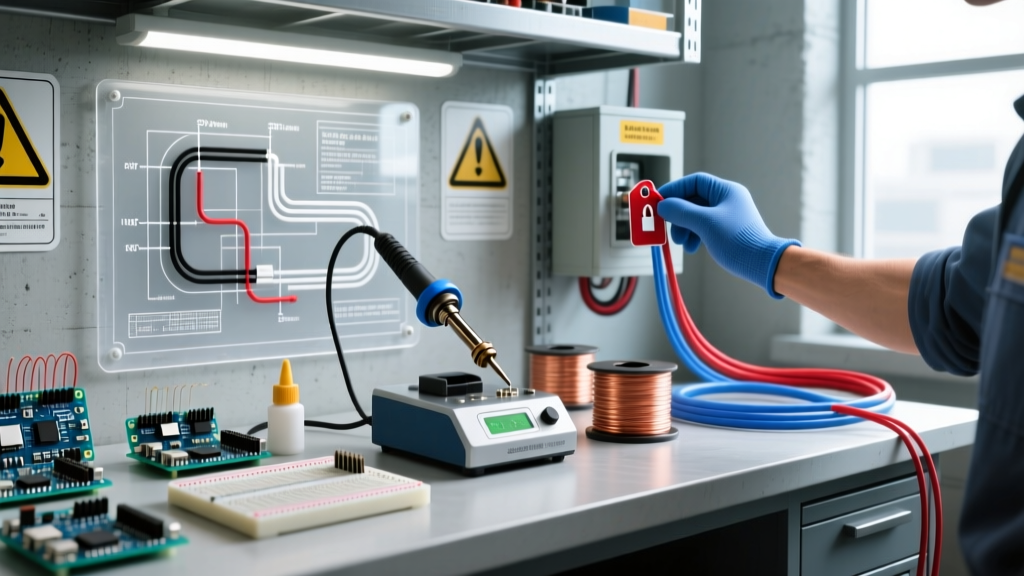
According to OSHA's Control of Hazardous Energy guidelines, verifying the absence of voltage is a non-negotiable step in 208 electrical wiring maintenance. Relying solely on indicator lights or smart panel displays is a fatal error, as control circuits can remain energized even when main power is severed.
- Identify All Sources: Trace the 208V feeder back to the main distribution panel. Identify the specific 3-pole breaker or disconnect switch.
- Notify Affected Personnel: Inform facility managers and machine operators that power will be severed.
- Disconnect and Lock: Switch the breaker to OFF. Apply a physical padlock and a durable tag with your name, date, and reason for LOTO.
- Test the Tester: Verify your CAT III/IV multimeter is functioning correctly by testing it on a known live 120V source (Live-Dead-Live testing method).
- Verify Zero Energy: Test Phase A to B, B to C, and A to C (expecting 0V). Then test Phase A, B, and C individually to Ground and Neutral. 208V systems with high capacitance may require a grounding stick to bleed off residual voltage.
- Apply Grounding Cables: For high-ampacity feeders (e.g., 400A+), apply temporary safety grounds to protect against accidental backfeed or induced voltages.
NEC 2026 Compliance: Neutral Sizing and Harmonics
One of the most misunderstood aspects of 208Y/120V systems is neutral conductor sizing. In a perfectly balanced 3-phase linear load, the neutral current is theoretically zero. However, modern commercial buildings are dominated by non-linear loads—LED drivers, variable frequency drives (VFDs), and server power supplies.
NEC Article 310.15(C)(1): When dealing with non-linear loads on a 3-phase, 4-wire Wye system, the neutral conductor must be counted as a current-carrying conductor for ampacity derating purposes. Furthermore, triplen harmonics (3rd, 9th, 15th) add algebraically on the neutral, meaning the neutral current can actually exceed the phase current.
Real-World Edge Case: The Overheated Neutral
In a recent 2025 commercial remodel, an electrical contractor ran #10 AWG copper for a 30A 208V 3-phase circuit feeding a row of commercial LED grow lights. Because they assumed a balanced linear load, they used a standard 4-wire cable where the neutral was the same size as the phases. The triplen harmonics from the cheap LED drivers caused 38 amps of current to stack on the neutral. The neutral wire melted inside the conduit, causing a ground fault and a localized fire. Best Practice: Always upsize the neutral by at least one AWG gauge (or double it) when wiring 208V circuits dedicated to heavy non-linear electronic loads, and use a true-RMS clamp meter to measure neutral current during commissioning.
Troubleshooting Common 208V Failure Modes
When 208 electrical wiring systems fail, it is rarely random. Here are the most common edge cases and failure modes encountered in the field:
- Voltage Drop on Long Feeder Runs: NEC recommends a maximum 3% voltage drop on branch circuits. On a 208V system, 3% is just 6.24V. If you are running a 50A circuit 250 feet to a rooftop HVAC unit, #6 AWG copper will result in a 4.5% drop. The HVAC compressor will struggle to start, drawing locked-rotor amperage (LRA) and tripping the breaker. Fix: Upsize to #4 AWG copper.
- High-Leg Delta Confusion: While 208V is typically Wye, older industrial facilities might have a 240V High-Leg Delta system. If you mistakenly measure 208V from the 'high leg' (Phase B) to neutral on a 240V Delta system and assume it's a standard 208V Wye, connecting 120V appliances will result in immediate destruction of the appliance and a severe shock hazard. Always measure all three phases to ground before identifying the system type.
- Loose Neutral Connections: In a 208Y/120V panel, a loose main neutral bond will cause severe voltage unbalance. 120V circuits on one phase may spike to 180V (destroying electronics), while the other drops to 60V. Always use a calibrated torque screwdriver (e.g., CDI 401SM) to torque neutral lugs to the manufacturer's exact inch-pound specification.
Frequently Asked Questions
Can I use a 2-pole breaker for a 208V single-phase load?
Yes. In a 3-phase panel, a 2-pole breaker connects to two adjacent phases, yielding 208V. However, you must ensure the breaker is rated for the system's kAIC (kilo-Ampere Interrupting Capacity). In modern commercial panels with high available fault currents, standard 10kAIC breakers may be insufficient; you may need 22kAIC or 65kAIC rated breakers (like the Eaton BAB or Square D QOB series) to safely clear a dead short without the breaker exploding.
Why does my 208V motor nameplate say 208-230V?
Dual-rated motors are designed to handle the lower voltage of commercial Wye systems (208V) and the higher voltage of residential or industrial split-phase/delta systems (230V/240V). However, per NFPA 70E and NEMA standards, if you run a 208-230V motor on a 208V system, the motor's maximum allowable voltage drop is reduced. You must ensure the voltage at the motor terminals under full load does not drop below 197V (roughly 5% below 208V), otherwise the motor insulation will degrade rapidly due to heat.
Do I need a ground wire if I'm using metal conduit for 208V wiring?
While NEC Article 250 allows certain types of listed metal conduit (like rigid metal conduit or EMT with listed fittings) to serve as an Equipment Grounding Conductor (EGC), best practice in 2026 is to always pull a dedicated copper EGC wire. Vibration, corrosion, and loose set-screw couplings can compromise the ground path of metal conduit over time, creating a deadly shock hazard during a phase-to-ground fault. Always pull a dedicated green EGC sized per NEC Table 250.122.