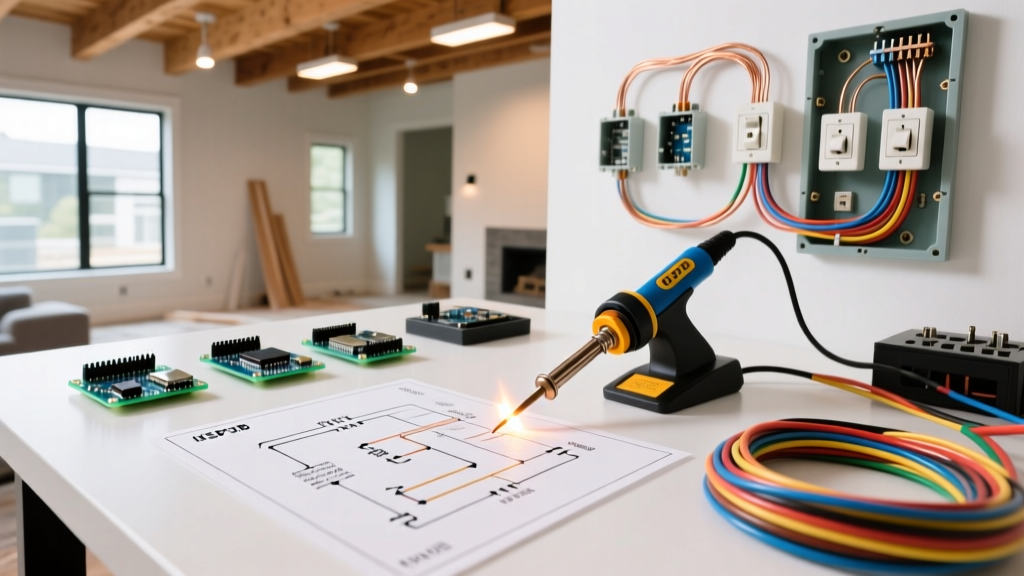

The True Cost of Basic Electric Wiring in 2026
Planning a home renovation, finishing a basement, or adding a new circuit requires a precise understanding of material and labor expenses. In 2026, the cost of basic electric wiring has stabilized following the copper market fluctuations of the early 2020s, but regional labor shortages and updated National Electrical Code (NEC) mandates continue to influence total project pricing. Whether you are budgeting for a DIY rough-in or hiring a licensed contractor, accurate cost estimation is critical to avoid mid-project financial surprises.
This comprehensive guide breaks down the exact costs of non-metallic sheathed cables, conduit systems, load center components, and professional labor rates. We will also explore hidden edge cases—like aluminum remediation and AFCI upgrade requirements—that frequently inflate residential wiring budgets.
Material Cost Breakdown: Wire, Cable, and Components
The backbone of any residential wiring project is the cable itself. For standard interior, dry-location applications, Non-Metallic Sheathed Cable (NM-B), commonly referred to by the brand name Romex, remains the industry standard. Prices below reflect 2026 market averages for premium brands like Southwire and Cerro Wire, featuring SIMpull or NoLube jacket technologies that reduce friction during installation.
Non-Metallic Sheathed Cable (NM-B) Pricing
| Cable Type | Gauge / Conductors | Ampacity | Primary Use Case | 2026 Price (250ft Roll) |
|---|---|---|---|---|
| 14/2 NM-B (with ground) | 14 AWG | 15 Amps | Lighting circuits, switches | $95.00 - $115.00 |
| 12/2 NM-B (with ground) | 12 AWG | 20 Amps | Standard receptacles, kitchen small appliance | $125.00 - $150.00 |
| 10/3 NM-B (with ground) | 10 AWG | 30 Amps | Electric dryers, window AC units | $175.00 - $210.00 |
| 6/3 NM-B (with ground) | 6 AWG | 55 Amps | Electric ranges, subpanel feeds | $380.00 - $450.00 |
Conduit and THHN/THWN Wire for Exposed Runs
For unfinished basements, garages, or commercial spaces where NM-B cable is prohibited by NEC Article 334.10 due to physical damage risks, you must use conduit and individual stranded wires. In 2026, 3/4-inch EMT (Electrical Metallic Tubing) conduit costs approximately $1.85 per 10-foot stick, while Schedule 40 PVC conduit averages $1.20 per 10-foot stick. Stranded THHN/THWN copper wire (12 AWG) costs roughly $0.45 to $0.60 per foot, depending on the color and insulation rating. Always factor in the cost of fittings, connectors, and strap supports, which typically add 15% to the raw conduit material cost.
Breakers and Load Centers
The service panel is the heart of your electrical system. Standard 200-Amp main breaker panels from reputable manufacturers like Square D (Homeline series) or Eaton (BR series) range from $140 to $220 in 2026. Standard single-pole 15A or 20A breakers cost between $6.00 and $9.00 each. However, modern code compliance heavily impacts this budget. Dual-function (AFCI/GFCI) breakers, now mandatory for many living spaces and wet areas, cost between $48.00 and $65.00 per unit. A standard 20-circuit panel upgrade can easily require $400 to $600 just in specialized breakers.
Labor Rates and Time Estimates for Standard Wiring Tasks
According to the Bureau of Labor Statistics (BLS), the median hourly wage for electricians hovers around $32.00. However, the billing rate charged by electrical contractors to homeowners typically ranges from $85.00 to $150.00 per hour in 2026. This markup covers business overhead, commercial auto insurance, liability policies, tool depreciation, and master electrician supervision.
Typical Timeframes for Common Wiring Tasks
- Rough-in a 12x12 Bedroom: Running wire for 4 receptacles, 1 switched overhead light, and 1 closet light. (Estimated time: 4 to 6 hours)
- Fish a New Circuit Through Finished Drywall: Dropping a wire from an attic to a first-floor outlet without tearing open walls. (Estimated time: 2 to 4 hours)
- Install a 50-Amp EV Charger Circuit: Running 6 AWG wire from the main panel to a garage NEMA 14-50 receptacle. (Estimated time: 3 to 5 hours)
- Swap a Standard Breaker to an AFCI/GFCI: Diagnosing the circuit, swapping the breaker, and testing. (Estimated time: 1 to 1.5 hours)
Project-Based Cost Estimator (Residential)
To help you budget effectively, here is a synthesized cost matrix for common residential wiring projects in 2026. These estimates assume standard accessibility (e.g., open studs or accessible attics/crawlspaces) and do not include drywall repair or painting.
| Project Scope | Estimated Materials | Estimated Labor | Total Project Cost |
|---|---|---|---|
| Add Single 20A Receptacle Circuit (Open Studs) | $60 - $90 | $250 - $400 | $310 - $490 |
| Finish Basement Wiring (800 sq ft, 6 circuits) | $650 - $900 | $2,400 - $3,800 | $3,050 - $4,700 |
| Rewire 12x12 Kitchen (GFCI small appliance circuits) | $350 - $550 | $1,800 - $2,800 | $2,150 - $3,350 |
| Install 200A Subpanel (Detached Garage, Trenching) | $800 - $1,200 | $2,500 - $4,000 | $3,300 - $5,200 |
Code Compliance and Permit Fees (NEC 2023/2026)
Ignoring local electrical codes is not just a safety hazard; it is a financial liability that can void home insurance policies and derail real estate transactions. The National Fire Protection Association (NFPA) publishes the NEC, which local jurisdictions adopt on a staggered basis. As of 2026, most municipalities are enforcing the 2023 NEC or newer localized amendments.
Crucial Code Update: Under NEC Article 210.12, Arc-Fault Circuit Interrupter (AFCI) protection is required in virtually all living spaces, including bedrooms, living rooms, and closets. Furthermore, Article 210.8 mandates Ground-Fault Circuit Interrupter (GFCI) protection for all 125-volt through 250-volt receptacles in garages, outdoors, and within 6 feet of any sink. Failing to budget for these specialized breakers or receptacles will result in failed inspections.
Permit Costs: Electrical permits are typically calculated based on the project valuation or the number of circuits being installed. Expect to pay a base fee of $50 to $100, plus $15 to $30 per additional circuit. For a whole-house rewire, permit fees can range from $300 to $800. Always verify with your local Authority Having Jurisdiction (AHJ) before starting work.
Hidden Costs and Edge Cases in Wiring Projects
Budget overruns rarely happen because of standard wire and breaker costs; they happen because of unforeseen site conditions. When estimating your basic electric wiring project, factor in these common edge cases:
1. Aluminum Wiring Remediation
Homes built between the mid-1960s and early 1970s often feature solid aluminum branch circuit wiring. Aluminum oxidizes and expands/contracts differently than copper, leading to loose connections and fire hazards. The Consumer Product Safety Commission (CPSC) strongly recommends remediation. Pigtailing aluminum wires to copper using specialized COPALUM crimps or AlumiConn lug connectors costs approximately $45 to $75 per receptacle or switch point. A 2,000 sq ft home can easily incur $4,000 to $7,000 in remediation costs.
2. Panel Capacity and Upgrades
If your existing load center lacks physical breaker spaces or is maxed out on its amperage bus bar (e.g., a 100-Amp panel in a modern home with EV chargers and heat pumps), you cannot simply add new circuits. Upgrading from a 100-Amp to a 200-Amp service, or installing a 400-Amp meter collar with dual 200-Amp panels, requires utility coordination, new weatherheads, and heavy-gauge SER cable. Panel upgrades range from $2,200 to $4,500 in 2026.
3. Low-Voltage and Smart Home Integration
Modern basic electric wiring rough-ins almost always overlap with low-voltage needs. Running Cat6a Ethernet cables for Power over Ethernet (PoE) security cameras and wireless access points, or pulling 16/2 thermostat wire for smart HVAC controls, adds material and labor. Budget an additional $150 to $250 per drop for structured wiring during the rough-in phase, as retrofitting these cables later requires destructive drywall work.
DIY vs. Professional Installation: Where is the Line?
While replacing a light fixture or swapping a standard receptacle is a manageable DIY task for a competent homeowner, basic electric wiring involving new branch circuits, panel modifications, or service upgrades should be left to licensed professionals. The cost of a licensed electrician is ultimately an investment in safety, code compliance, and home insurability. If you choose to DIY minor extensions, ensure you pull the required homeowner permits, schedule the rough-in and final inspections, and strictly adhere to NEC box-fill calculations (Article 314.16) to prevent overcrowded junction boxes.