
The Hidden Hazards of Mid-Century Electrical Systems
The post-WWII housing boom of the 1950s fundamentally changed American residential construction, introducing drywall, standardized dimensional lumber, and a massive shift in electrical infrastructure. However, 1950s electrical wiring was designed for a completely different era of power consumption. The average 1955 home required a mere 60-amp service to power a few incandescent lights, a radio, and a basic icebox refrigerator. Today, that same footprint routinely demands 200 amps to support HVAC systems, electric vehicle chargers, and high-wattage kitchen appliances. According to the National Fire Protection Association (NFPA), electrical failures or malfunctions are consistently among the leading causes of home structure fires, with aging infrastructure being a primary culprit.
Unlike the open-air heat dissipation of earlier knob-and-tube systems, 1950s electrical wiring heavily utilized early Non-Metallic (NM) sheathed cables. Often generically referred to as early Romex or Loomwire, these cables featured an asphalt-impregnated cotton or rayon outer braid. Over seven decades, exposure to attic heat and the thermal load of modern 15-amp continuous circuits causes this cloth sheathing to become extremely brittle. When contractors attempt to fish new lines or homeowners aggressively pull cables through joists during DIY remodels, the insulation cracks and flakes off, exposing bare copper and creating severe arc-fault and short-circuit risks.
Diagnostic Matrix: Evaluating 1950s Infrastructure
To systematically evaluate a mid-century property, electrical professionals and home inspectors rely on a structured diagnostic approach. Below is a hazard identification matrix tailored specifically to 1950s construction.
| Hazard Category | Visual / Physical Cue | Diagnostic Testing Method | Risk Level |
|---|---|---|---|
| Cloth-Sheathed NM Degradation | Brittle, black/brown fabric braid at junction boxes; rubber dust in outlets. | Visual inspection at panel knockouts and attic junctions; insulation resistance testing (Megger). | High (Fire) |
| Bootleg Grounds | 3-prong receptacles installed on 2-wire ungrounded circuits. | Multimeter testing (Hot-to-Ground vs. Hot-to-Neutral voltage drop); 3-light tester. | Critical (Shock) |
| Undersized Service Panels | 60A or 100A main breaker; fuse boxes with Edison-base fuses. | Load calculation (NEC Article 220); thermal imaging of bus bars under load. | High (Overload) |
| Obsolete Breaker Panels | FPE Stab-Lok, Zinsco, or early Challenger branded panels. | Visual ID of panel manufacturer label and breaker bus bar design. | Critical (Fire) |
The Lethal Threat of Bootleg Grounds
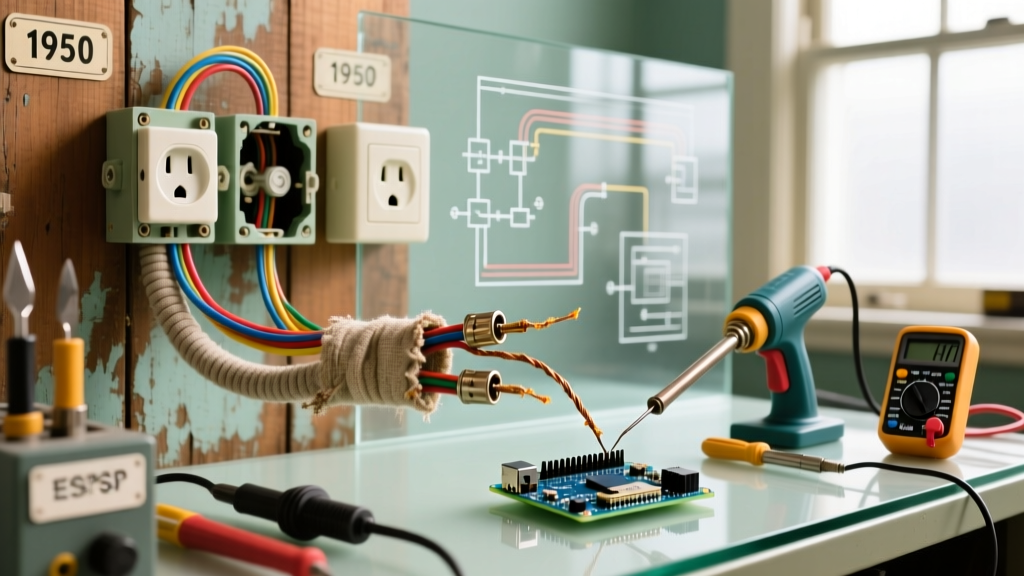
One of the most dangerous legacy issues found in flipped or poorly maintained 1950s homes is the 'bootleg ground.' Because 1950s electrical wiring was almost exclusively installed as 2-wire ungrounded cable (lacking a bare copper equipment grounding conductor), original receptacles were 2-prong NEMA 1-15R types. When 3-prong appliances became standard, unscrupulous contractors or DIYers often replaced the 2-prong outlets with 3-prong receptacles without actually running a ground wire. Worse, some installed a jumper wire between the neutral screw and the ground screw inside the receptacle.
If the neutral wire ever becomes disconnected upstream, the metal chassis of any plugged-in appliance (like a toaster or washing machine) becomes fully energized at 120 volts, presenting a lethal shock hazard. The U.S. Consumer Product Safety Commission (CPSC) strongly warns against relying on visual inspections alone for older homes.
Step-by-Step Bootleg Ground Verification
Never trust a standard 3-light receptacle tester in a 1950s home. Follow this precise multimeter protocol:
- Test Hot to Neutral: Insert multimeter probes into the smaller (hot) and larger (neutral) slots. You should read approximately 120V.
- Test Hot to Ground: Move the neutral probe to the round ground slot. If you read 120V, a ground path exists. If you read 0V, the outlet is ungrounded.
- Test Neutral to Ground: Place probes in the large neutral slot and the round ground slot. A reading of 0V to 2V is normal. If you read 120V here, you have a reversed polarity or a severe bootleg ground fault.
- The Ultimate Test: Use a specialized plug-in circuit analyzer with a 'bootleg ground' detection feature, or physically remove the receptacle cover to verify the presence of an actual bare/green grounding conductor attached to the green screw.
Navigating NEC Code Requirements for Retrofits
When a full rewire is financially unfeasible, the National Electrical Code (NEC) provides specific retrofit pathways to make 1950s electrical wiring safer without tearing open plaster or drywall walls. Under NEC Article 406.4(D)(2)(b), you are legally permitted to replace an ungrounded 2-prong receptacle with a 3-prong receptacle if it is protected by a Ground Fault Circuit Interrupter (GFCI).
Expert Code Insight: When installing a GFCI on an ungrounded 1950s circuit, you must apply the included 'No Equipment Ground' and 'GFCI Protected' stickers to the faceplate. This satisfies code for shock protection, but it does not provide an equipment ground. Surge protectors and sensitive electronics (like high-end gaming PCs or medical equipment) will not function correctly or safely without a true ground path.
Furthermore, NEC Article 210.12 mandates Arc-Fault Circuit Interrupter (AFCI) protection for virtually all living space circuits. Because 1950s cloth-sheathed wiring is highly susceptible to series arcing as the insulation degrades, installing combination-type AFCI breakers at the panel is the single most effective way to prevent electrical fires in these older systems without replacing the branch wiring.
Panel Upgrades and the FPE Stab-Lok Crisis
The 1950s marked the transitional era from Edison-base fuse panels to early thermal-magnetic circuit breakers. Unfortunately, this era birthed some of the most notoriously dangerous electrical panels in history. The Federal Pacific Electric (FPE) Stab-Lok panel, introduced in 1956, was installed in millions of homes. Extensive testing and field data have shown that FPE breakers frequently fail to trip during overload conditions, and the bus bar connections are prone to overheating. The Electrical Safety Foundation International (ESFI) and independent electrical engineers universally recommend immediate replacement of any FPE, Zinsco, or Challenger panels.
Upgrading a 60-amp 1950s service to a modern 200-amp, 40-circuit main breaker panel typically costs between $2,800 and $4,500 in 2026, depending on local utility connection fees and the need to upgrade the weatherhead and meter base. This upgrade is non-negotiable for obtaining homeowner's insurance on a mid-century property in most states.
2026 Cost Realities: Mitigation vs. Full Rewire
Homeowners and real estate investors must weigh the costs of targeted safety mitigation against a complete gut-and-rewire. Here is a realistic breakdown of 2026 market pricing for a standard 1,500-square-foot single-story 1950s ranch home:
- Targeted Mitigation ($3,500 - $6,000): Includes 200A panel upgrade, installation of whole-home AFCI/GFCI breakers, replacement of all bootleg-ground receptacles with properly labeled GFCIs, and bonding of the plumbing system.
- Heavy-Up & Circuit Extensions ($8,000 - $12,000): Includes the panel upgrade plus running new 20-amp grounded circuits to the kitchen, laundry, and bathrooms, leaving the original 1950s lighting circuits intact but protected by AFCIs.
- Full Gut and Rewire ($14,000 - $22,000): Complete removal of all 1950s cloth NM and knob-and-tube wiring, installation of modern THHN/THWN-2 copper wire in conduit or new NM-B cable, drywall cutting, and subsequent drywall patching and finishing. (Note: Drywall repair alone can add $4,000 to this estimate).
Final Safety Best Practices
Working with or living around 1950s electrical wiring requires a paradigm shift from modern electrical assumptions. Never assume a black wire is hot and a white wire is neutral; mid-century color coding was often ignored or degraded by heat. Always use a non-contact voltage tester and a calibrated multimeter before touching any conductor. If you are purchasing a mid-century home, mandate a specialized electrical inspection beyond the standard general home inspection, specifically requesting thermal imaging of the panel and verification of grounding topology. By respecting the limitations of mid-century materials and applying modern NEC protections, you can safely preserve the architectural charm of a 1950s home without compromising the safety of its occupants.