
Decoding the Electrical Wiring Blue Wire in Residential Projects
If you have ever pulled off a switch plate or opened a ceiling fan canopy, you might have encountered an unexpected conductor: the electrical wiring blue wire. Unlike the standard black, white, and bare copper conductors found in typical non-metallic (NM-B) sheathed cable, blue wires serve highly specific roles in residential electrical systems. Understanding exactly when and why a blue wire is used is critical for passing inspections, avoiding short circuits, and successfully completing smart home upgrades.
In the United States, the National Electrical Code (NEC) strictly dictates the colors for grounded (white/gray) and grounding (green/bare) conductors. However, ungrounded (hot) conductors can be any color except white, gray, or green. While black and red are the default hot colors in standard Romex, the blue wire steps in when circuits demand more complex routing, such as multi-way switching, isolated fixture control, or smart home communication.
Primary Applications for Blue Wire in Home Wiring
When planning a home remodel or troubleshooting an existing circuit, you will typically encounter the electrical wiring blue wire in three specific scenarios. Each requires a distinct approach to termination and continuity.
1. Three-Way and Four-Way Switch Travelers
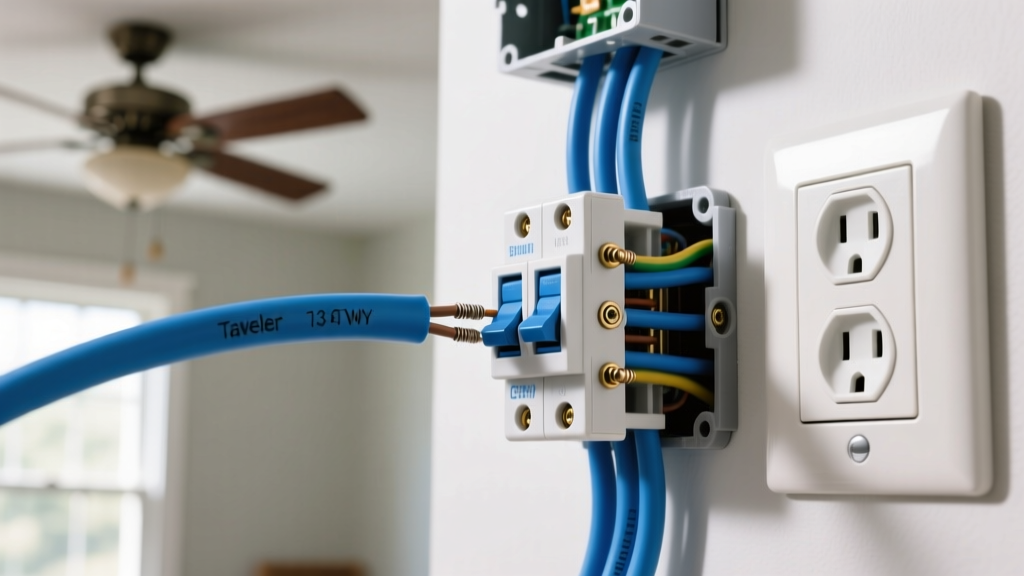
In a standard 3-way switch setup, two "traveler" wires carry the hot current between switches. When wiring through conduit using individual THHN/THWN-2 conductors, electricians frequently use black and red for standard hots, and blue for the traveler. This color-coding prevents confusion at the junction box. If you are pulling wire through 1/2-inch EMT conduit for a new hallway light, using a spool of Southwire 14 AWG Blue THHN (typically around $45 for a 250-foot coil at major hardware stores) ensures your travelers are instantly identifiable to anyone working on the panel later.
2. Ceiling Fan and Light Kit Isolation
Standard 14/2 or 12/2 NM-B cable only provides one hot wire, meaning a ceiling fan and its attached light kit must be controlled by the same wall switch or pull chains. To achieve independent wall control, electricians run 14/3 or specialized 14/4 cable. In many manufactured fan-control cables, the electrical wiring blue wire acts as the isolated switched hot for the light kit, while the black wire powers the fan motor. Connecting the blue wire to the wrong terminal will result in the fan and light toggling inversely or shorting the dimmer module.
3. Smart Switch and Automation Retrofits
The rise of smart home technology has made the blue wire more common in retrofit projects. Advanced smart switches, such as the Lutron Caseta Wireless Dimmer (PD-6WCL), more specifically, 3-way smart companion switches, often utilize a blue wire as a communication or dedicated traveler line. Unlike traditional mechanical travelers that carry 120V AC, some smart system blue wires carry low-voltage DC signals or act as a switched return leg. Miswiring a smart switch's blue communication wire to a 120V line will instantly destroy the internal microprocessor, resulting in a $60 to $80 replacement cost.
NEC Color Code Standards and Conduit Rules
It is a common misconception that the NEC mandates blue for a specific phase in residential wiring. According to NEC Article 310.15, the code only strictly enforces white/gray for neutrals and green/bare for grounds. Ungrounded conductors (hots) can be blue, black, red, orange, or yellow.
However, if your home project involves pulling individual wires through metallic or PVC conduit, adhering to industry-standard color conventions is a best practice for safety and future troubleshooting.
| Wire Color | Standard Function | Typical Gauge / Application |
|---|---|---|
| Black | Primary Hot (Line/Load) | 14 AWG to 10 AWG (15A - 30A circuits) |
| Red | Secondary Hot / Traveler | 14 AWG to 12 AWG (3-way switches, 240V baseboard) |
| Blue | Traveler / Isolated Hot / Switched Leg | 14 AWG to 12 AWG (Multi-way switches, fan lights) |
| White | Grounded Conductor (Neutral) | All gauges (Must be re-identified with black tape if used as hot) |
| Green / Bare | Equipment Grounding Conductor | All gauges (Never used for current-carrying hot) |
Step-by-Step: Wiring a 3-Way Switch Using Blue Travelers
When running a new circuit through conduit to a pair of 3-way switches, utilizing a blue wire for one of the travelers simplifies the termination process. Here is the professional workflow for a 15-amp lighting circuit.
- Pull the Conductors: From the panel to Switch Box A, pull a black (hot), white (neutral), and bare/green (ground). From Switch Box A to Switch Box B, pull a white (neutral), bare (ground), a red (traveler 1), and a blue (traveler 2).
- Terminate Switch Box A: Connect the incoming black hot wire to the "Common" (dark colored) screw on the first 3-way switch. Connect the red and blue wires to the brass-colored traveler screws. The order of red and blue on the brass screws does not matter electrically, but keeping them consistent across boxes aids future troubleshooting.
- Terminate Switch Box B: Connect the red and blue traveler wires to the brass traveler screws on the second 3-way switch. Connect the black wire (which continues up to the light fixture) to the Common screw.
- Splice Neutrals: Wire-nut the white neutral wires together in both boxes, ensuring they bypass the switches entirely and run straight to the light fixture.
Smart Home Edge Cases: When Blue is NOT a 120V Hot
One of the most frequent and costly mistakes DIYers make during smart home upgrades is assuming every blue wire carries 120V AC. In systems like the Insteon SwitchLinc or certain Leviton Decora Smart companion modules, the blue wire is sometimes utilized as a low-voltage communication link between a master switch and a remote auxiliary switch.
If you are replacing an old mechanical 3-way switch with a smart ecosystem, you must consult the manufacturer's wiring diagram. If the diagram specifies that the blue wire connects to a "Traveler/Comm" terminal, using a non-contact voltage tester (like the Fluke 2AC-II) on that blue wire while the master switch is toggling might yield confusing results, as it may carry pulsed DC rather than continuous AC. Always verify the exact model number of your smart switch and cross-reference the included schematic before capping or connecting blue wires.
Troubleshooting Common Blue Wire Failures
Even with perfect installation, circuits utilizing the electrical wiring blue wire can develop specific faults over time. Recognizing these edge cases will save you hours of diagnostic work.
- Phantom Voltages on Travelers: When using a high-impedance digital multimeter (like the Klein Tools MM400), you may read 40V to 60V on the blue traveler wire when the circuit is off. This is induced "phantom voltage" from the adjacent live black or red wire in the same conduit or NM sheath. Use a low-impedance (LoZ) meter setting to confirm the wire is actually dead before working on it.
- Backstab Connection Burnout: If a previous homeowner wired a 3-way switch using the push-in "backstab" holes on a cheap $2 builder-grade switch, the blue traveler wire may have arced and lost continuity. Always extract backstabbed wires, straighten them with lineman's pliers, and terminate them under the side-screw plates using a clockwise loop.
- LED Flickering on Isolated Fan Circuits: If your ceiling fan's blue wire is connected to a standard incandescent dimmer, the LED light kit will likely strobe or hum. The blue wire must be routed to an ELV (Electronic Low Voltage) or MLV (Magnetic Low Voltage) compatible dimmer, such as the Lutron Diva DVELV-300P, to ensure smooth current regulation.
Safety and Code Compliance
Before opening any junction box or switch plate, turn off the circuit at the main breaker panel and verify the absence of voltage with a reliable two-prong tester or non-contact voltage pen. Remember that in multi-wire branch circuits (MWBC) or complex 3-way loops, turning off a single breaker may not de-energize all travelers in the box. For comprehensive safety guidelines and updates on residential conductor identification, always refer to the National Fire Protection Association (NFPA) NEC database and consult your local authority having jurisdiction (AHJ) regarding regional amendments. For further reading on residential wiring best practices, the Electrical Safety Foundation International (ESFI) provides excellent resources on home electrical safety and DIY limitations.