
The Foundation of Safe Panel Wiring
When wiring residential electrical panel systems, the margin for error is exactly zero. A mismatched wire gauge can lead to thermal runaway, melting insulation, and catastrophic structure fires, while swapped color codes can turn a routine breaker replacement into a fatal shock hazard for future electricians. As we navigate the 2026 enforcement landscape, local inspectors are strictly adhering to the National Electrical Code (NEC) regarding conductor ampacity, terminal temperature ratings, and calibrated torque specifications.
This comprehensive reference guide cuts through the noise, providing exact wire gauge matrices, NEC-mandated color codes, and the critical termination rules you need to wire a residential load center safely and legally. Whether you are upgrading to a 200-amp main service or running a dedicated 50-amp circuit for an EV charger, precision is your primary tool.
Code Reference: According to the National Fire Protection Association (NFPA 70), all conductor sizing and overcurrent protection must align with NEC Article 240 and Article 310 to prevent circuit overload and fire hazards.
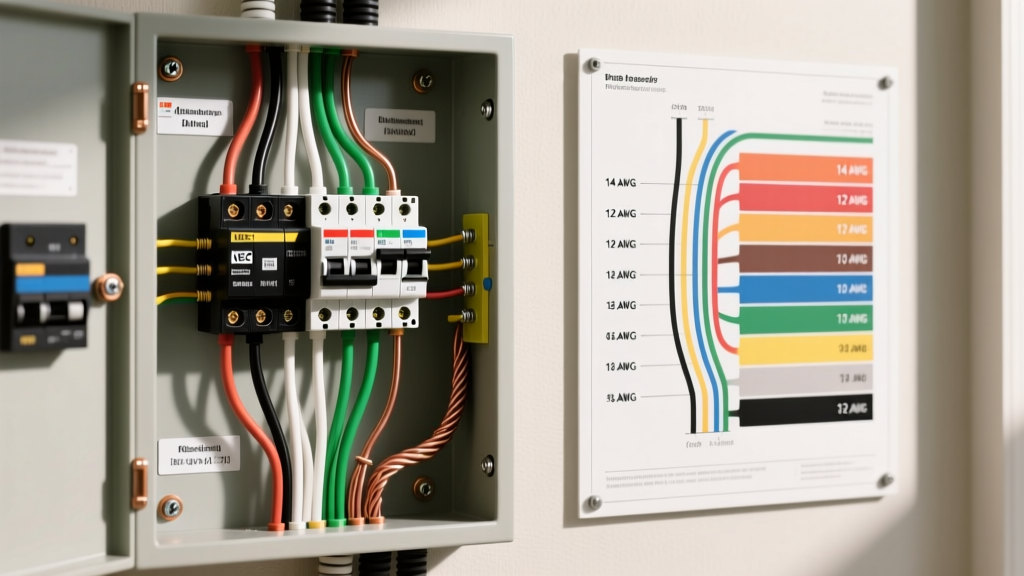
The NEC Color Code Matrix
Standardizing wire colors is not just a best practice; it is a strict legal requirement under NEC Article 200 (Use and Identification of Grounded Conductors) and Article 250 (Grounding and Bonding). Misidentifying a neutral wire as a hot wire, or using a ground wire as a current-carrying neutral, is one of the most dangerous mistakes made during DIY panel wiring.
| Function | NEC Allowed Colors | Prohibited Colors | Common Application |
|---|---|---|---|
| Hot (Ungrounded) | Black, Red, Blue, Yellow, Orange | White, Gray, Green, Bare | 120V/240V branch circuits, appliance feeds |
| Neutral (Grounded) | White, Gray, or White with colored stripe | Green, Bare, Black, Red | Return path for 120V circuits, 240V/120V appliances |
| Ground (Equipment) | Bare Copper, Green, Green/Yellow stripe | White, Gray, Black, Red | Fault current path, equipment bonding |
Pro-Tip for Multi-Wire Branch Circuits (MWBC): When wiring a 240V/120V split-phase circuit (like a dryer or range) or an MWBC sharing a neutral, NEC 210.5 requires you to identify the second hot wire. If your primary hot is black, use red for the second phase. Never use white or gray for a hot wire unless it is permanently re-identified with black tape or paint at both the panel and the termination point, as per NEC 200.7(C).
Wire Gauge and Ampacity Reference Chart
Selecting the correct American Wire Gauge (AWG) depends on the breaker size, the conductor material (copper vs. aluminum), and the temperature rating of the breaker terminals.
The 60°C vs. 75°C Terminal Rule: Most modern THHN/THWN-2 wire is rated for 90°C. However, NEC 110.14(C)(1)(a) dictates that for circuits rated 100 amps or less, or conductors sized 14 AWG through 1 AWG, you must use the 60°C column of the ampacity table unless the breaker is specifically listed and marked for 75°C terminations. Most standard residential plug-on or bolt-in breakers are rated 75°C, but relying on the 60°C column for standard branch circuits ensures universal compliance and safety.
| Breaker Size | Copper Wire (AWG) | Aluminum Wire (AWG) | Typical Residential Use Case |
|---|---|---|---|
| 15 Amp | 14 AWG | 12 AWG | General lighting, receptacles |
| 20 Amp | 12 AWG | 10 AWG | Kitchen small appliance, bathroom GFCI |
| 30 Amp | 10 AWG | 8 AWG | Dryer receptacles, heavy machinery |
| 40 Amp | 8 AWG | 6 AWG | Electric range, older HVAC condensers |
| 50 Amp | 6 AWG | 4 AWG | EV Level 2 chargers, subpanel feeds |
| 60 Amp | 6 AWG (or 4 AWG)* | 4 AWG | Subpanel feeds, large HVAC units |
| 100 Amp | 3 AWG | 1 AWG | Small subpanels, older main services |
| 200 Amp | 2/0 AWG | 4/0 AWG | Standard modern residential main service |
*Note on 60A Breakers: Under NEC 240.4(D), 6 AWG copper is restricted to 60 amps for small conductors. However, if using the 60°C column, 6 AWG copper is only rated for 55 amps. To be strictly compliant and avoid inspection failures on a 60A breaker, many electricians upgrade to 4 AWG copper.
Main Feeders: Copper vs. Aluminum Conductors
When wiring the main lugs of a 200-amp residential electrical panel, the cost of copper has driven the industry toward Aluminum Service Entrance Round (SER) cable. Aluminum is perfectly safe and code-compliant for main feeders, provided you follow specific preparation protocols to prevent oxidation and thermal expansion issues.
- Use Anti-Oxidant Paste: Aluminum oxidizes rapidly when exposed to air, creating a high-resistance layer that generates heat. You must apply a UL-listed anti-oxidant compound (like Noalox) to the stripped aluminum conductor before inserting it into the main lug.
- Brush the Conductor: Use a wire brush designed specifically for aluminum to break the initial oxide layer through the anti-oxidant paste layer before torquing the lug.
- Check the Lug Rating: Ensure the main breaker lugs are rated for aluminum (most modern dual-rated lugs are marked 'CU/AL' or 'AL/CU').
The Fatal Flaw: Neutral and Ground Bonding
The most common code violation found during panel inspections is improper neutral-to-ground bonding. According to OSHA Wiring Design and Protection standards and NEC 250.24, the neutral (grounded conductor) and the ground (equipment grounding conductor) must only be bonded together at the first point of disconnect—typically the main service panel.
If you are wiring a subpanel, the neutral bar must be completely isolated from the panel enclosure (by removing the green bonding screw or strap), and a separate equipment grounding bar must be installed and bonded to the enclosure. Bonding the neutral and ground in a subpanel creates a parallel neutral path, allowing normal return current to flow through the ground wire, which can electrify appliance chassis and plumbing.
Torque Specifications: The Code Enforcement Reality
As of recent code cycles, carrying firmly into 2026, NEC 110.14(D) requires that all terminations be tightened to the manufacturer's specified torque values using a calibrated torque tool. 'Hand tight' or 'snug' is no longer acceptable and will fail inspection. Under-torqued lugs arc and overheat; over-torqued lugs strip or snap the conductor strands.
- Locate the Torque Markings: Check the breaker label or the panel schematic sticker inside the door. Standard 15A-50A breakers typically require 35 to 50 inch-pounds (in-lbs) of torque.
- Use a Calibrated Torque Screwdriver: Do not use a standard screwdriver. Invest in an insulated, click-type torque screwdriver (e.g., Wiha or Klein Tools) that covers the 20-80 in-lb range.
- Verify Main Lug Torque: Main service lugs for 4/0 aluminum or 2/0 copper often require significantly higher torque, typically between 150 and 250 in-lbs, requiring a dedicated torque wrench.
Frequently Asked Questions
Can I use 14 AWG wire on a 20-amp breaker?
No. NEC 240.4(D) strictly limits 14 AWG copper wire to a maximum 15-amp overcurrent protective device. Using 14 AWG on a 20-amp breaker creates a severe fire hazard, as the wire will melt before the breaker trips.
Do I need to use a white wire for neutral in a 240V-only circuit?
If the circuit is strictly 240V (like a baseboard heater or a dedicated well pump) and does not require a neutral, you do not need to run a white wire. You only need two hot wires and a ground. However, if you are running a 120/240V circuit (like a dryer), the white neutral is mandatory.
What size wire do I need for a 100-amp subpanel?
For a 100-amp subpanel fed by copper, you need 3 AWG THHN/THWN-2 conductors. If using aluminum SER cable, you must step up to 1 AWG. Always ensure you run four wires: two hots, one isolated neutral, and one equipment ground.