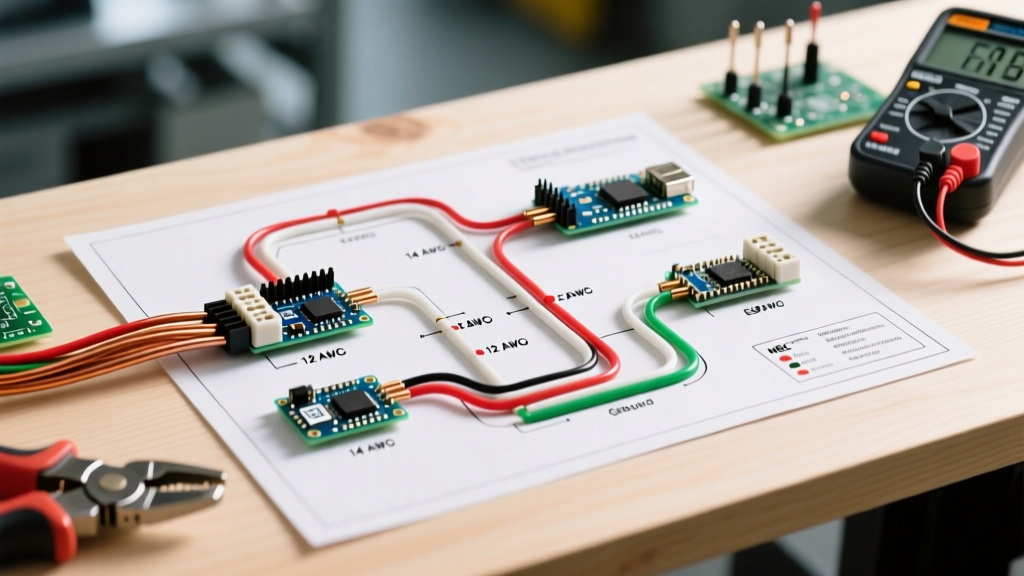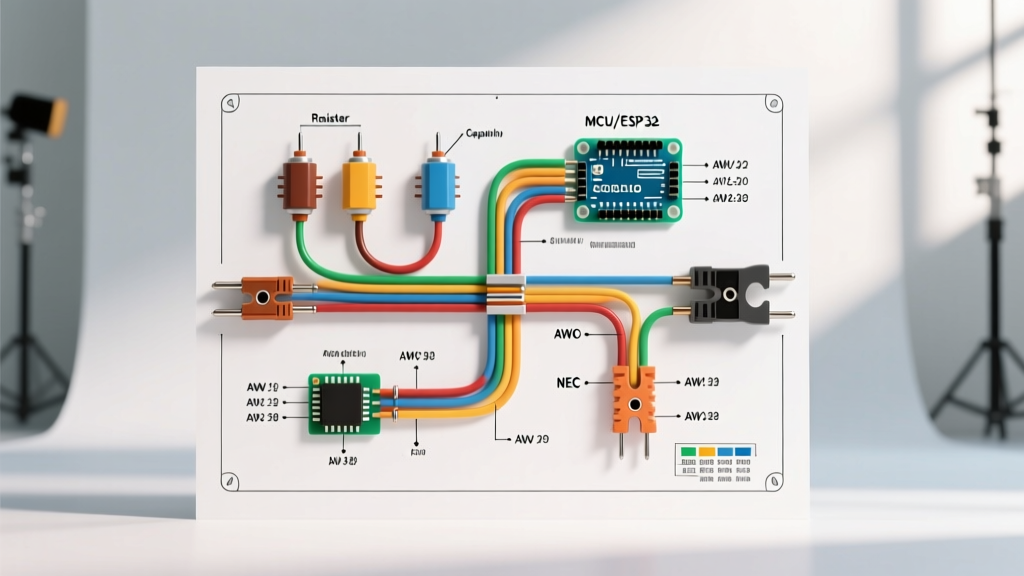

Introduction to Appliance Wiring on House Blueprints
When interpreting a basic electrical wiring diagram house blueprint, the transition from general 120V lighting circuits to high-draw 240V appliance circuits requires a distinct shift in how you read the schematic. General lighting and standard receptacles are typically grouped on 15A or 20A multi-outlet branch circuits. However, major appliances—such as electric ranges, clothes dryers, and HVAC condenser units—demand dedicated, high-amperage branch circuits with specific wire gauges, double-pole breakers, and specialized NEMA receptacles.
This guide bridges the gap between reading your home's architectural electrical plans and executing the physical wiring for large appliances. We will cover symbol decoding, National Electrical Code (NEC) compliance for 2026, voltage drop calculations, and exact component specifications to ensure your appliance installation is safe, legal, and functional.
Decoding the Appliance Symbol Legend
Every professional electrical floor plan includes a legend. When tracing appliance circuits on a basic electrical wiring diagram house plan, look for these standard architectural symbols. Understanding these prevents the costly mistake of wiring a 50A range circuit to a 30A dryer outlet.
| Symbol | Appliance / Equipment | Standard Circuit Spec | Receptacle Type |
|---|---|---|---|
| R or RNG | Electric Range / Oven | 50A, 240V, 2-Pole | NEMA 14-50R |
| D or DRY | Electric Clothes Dryer | 30A, 240V, 2-Pole | NEMA 14-30R |
| DW | Dishwasher | 20A, 120V, 1-Pole (GFCI) | Hardwired or NEMA 5-20R |
| GD | Garbage Disposal | 15A or 20A, 120V | Hardwired or NEMA 5-15R |
| AC or HP | HVAC Condenser / Heat Pump | 30A - 60A, 240V, 2-Pole | Hardwired (Whip) |
Sizing 240V Dedicated Branch Circuits
The most critical data point on your wiring diagram is the amperage rating of the dedicated circuit. According to NFPA 70: National Electrical Code (NEC) Article 422, branch circuits supplying household electric ranges, wall-mounted ovens, counter-mounted cooking units, and other household cooking appliances must be sized based on the manufacturer's nameplate rating and NEC Table 220.55 demand factors.
Below is a practical specification matrix for the three most common 240V residential appliances, updated with 2026 material pricing and standard component models.
| Appliance Type | Breaker Model (Example) | Wire Gauge & Type | Receptacle / Connection | Est. 2026 Material Cost |
|---|---|---|---|---|
| Electric Range | Siemens Q250 (50A) | 6 AWG Cu (6/3 NM-B) | Leviton 278-S00 (14-50R) | $180 - $240 |
| Electric Dryer | Square D HOM230 (30A) | 10 AWG Cu (10/3 NM-B) | Leviton 277-S00 (14-30R) | $90 - $130 |
| HVAC Condenser | Eaton BR240 (40A) | 8 AWG Cu (8/3 NM-B) | Hardwired via Liquid-Tight Whip | $140 - $190 |
Critical NEC Compliance: Grounding and the 4-Prong Transition
One of the most common failure modes in DIY appliance wiring stems from misinterpreting older house diagrams that feature 3-wire (120/240V) setups. Modern NEC standards strictly mandate 4-wire configurations (two hots, one neutral, one equipment grounding conductor) for new installations.
Removing the Neutral-to-Ground Bond
If you are wiring a new range or dryer using a modern 4-prong cord (NEMA 14-50P or 14-30P), you must remove the neutral-to-ground bonding strap or screw on the appliance's terminal block. In a 3-wire system, the neutral carried both the unbalanced 120V return current and served as the safety ground. In a 4-wire system, the neutral and ground are isolated at the appliance. Failing to remove this bond on a 4-wire circuit creates a parallel neutral path, which can energize the appliance chassis if the neutral wire fails—a lethal shock hazard.
Expert Warning: Never upgrade a 3-prong receptacle to a 4-prong receptacle without pulling a new 4-wire cable (e.g., replacing old 10/2 NM with 10/3 NM-B) back to the main panel. Bootlegging a ground from a nearby water pipe violates NEC Article 250 and compromises the entire grounding electrode system.
Voltage Drop and Long-Run Edge Cases
A basic electrical wiring diagram house plan rarely accounts for the physical routing distance of the wire through studs, joists, and crawlspaces. If the physical run from your main service panel to the appliance receptacle exceeds 50 feet, you must calculate voltage drop.
The NEC recommends a maximum voltage drop of 3% for branch circuits. For a 50A electric range on a 240V circuit using 6 AWG copper wire, a 75-foot run will result in a voltage drop of approximately 3.8%, which can cause the range's control boards to malfunction or heating elements to underperform.
The Fix: For runs between 50 and 100 feet, upsize your wire by one gauge. Use 4 AWG copper (4/3 NM-B) for a 50A range circuit, and 8 AWG copper for a 30A dryer circuit. While 4/3 NM-B Romex costs roughly $6.50 per foot in 2026 (compared to $4.50 for 6/3), the investment prevents nuisance tripping and extends the lifespan of the appliance's solid-state relays.
Sourcing 2026 Materials: Smart Panels and AFCI/GFCI Requirements
The U.S. Department of Energy continuously updates efficiency standards for appliances, which indirectly impacts how they interact with home electrical systems. Modern appliances with variable-frequency drives (VFDs) and smart Wi-Fi boards are highly sensitive to dirty power and require pristine grounding.
Kitchen Countertop and Dishwasher GFCI Mandates
While 240V ranges and dryers generally do not require GFCI protection unless specified by the manufacturer, 120V kitchen appliances do. Recent NEC cycles have expanded Ground-Fault Circuit Interrupter (GFCI) requirements. Dishwashers, regardless of whether they are hardwired or cord-and-plug connected, now require GFCI protection. When wiring a dishwasher/disposal split-receptacle under the sink, use a 20A dual-pole GFCI breaker (e.g., Square D HOM220GFIC) or install a GFCI dead-front upstream to protect the downstream load.
Frequently Asked Questions (FAQ)
Can I use aluminum wire for my electric range circuit?
Yes, but you must adjust the gauge. While 6 AWG copper is rated for 55A (and protected at 50A), you must use 4 AWG aluminum (4-4-4-6 SER or 4/3 AL NM-B) for a 50A circuit. Aluminum expands and contracts more than copper, so you must apply an anti-oxidant compound like Noalox to the terminal lugs and torque them to the manufacturer's exact inch-pound specifications to prevent arcing and fire.
My house diagram shows a 40A breaker for the HVAC, but the nameplate says 35A MCA. Which do I follow?
Always follow the manufacturer's nameplate. MCA (Minimum Circuit Ampacity) dictates the wire size, while the MOCP (Maximum Overcurrent Protection) dictates the breaker size. If the MCA is 35A, you must use wire rated for at least 35A (8 AWG copper). If the MOCP is 40A, you install a 40A breaker. Never exceed the MOCP listed on the condenser's data plate.
How do I identify the neutral wire on a 240V appliance diagram?
On a standard 4-wire NEMA 14-50 or 14-30 receptacle, the neutral is the straight vertical blade (or the 'L' shaped blade on a 14-30). In the NM-B cable, the neutral is the white insulated wire. However, when wiring a 240V-only appliance like a baseboard heater or a pure 240V HVAC condenser that does not require 120V for control circuits, a neutral is not required, and you will only use the two hot wires and the bare copper ground.