
Understanding the Wiring Diagram for Christmas Tree Lights
Whether you are repairing a vintage incandescent strand, building a custom architectural display, or troubleshooting a modern addressable pixel mega-tree, understanding the wiring diagram for Christmas tree lights is essential for safety and functionality. While most commercial strands are sealed units, DIY enthusiasts, lighting technicians, and custom installers frequently need to cut, splice, and extend these circuits. In 2026, with the dominance of low-voltage LED technology and smart pixel controllers, the internal wiring of holiday lighting has evolved significantly. This guide breaks down the exact wire gauges, insulation types, and color codes you need to work safely and effectively with holiday lighting circuits.
Anatomy of a Light Strand: Series vs. Parallel Wiring
Before selecting a wire gauge, you must understand the underlying circuit topology. The wiring diagram for Christmas tree lights generally falls into two categories:
- Standard LED/Incandescent Strands (Series-Parallel): Most commercial 100-light LED strands operate on a series-parallel topology. The 100 lights are divided into two parallel halves, each containing 50 LEDs wired in series. If one LED fails open, only that half of the strand goes dark. The plug contains a full-wave bridge rectifier (four diodes) that converts 120V AC to pulsating DC, typically dropping the voltage to around 31V DC for the LED series.
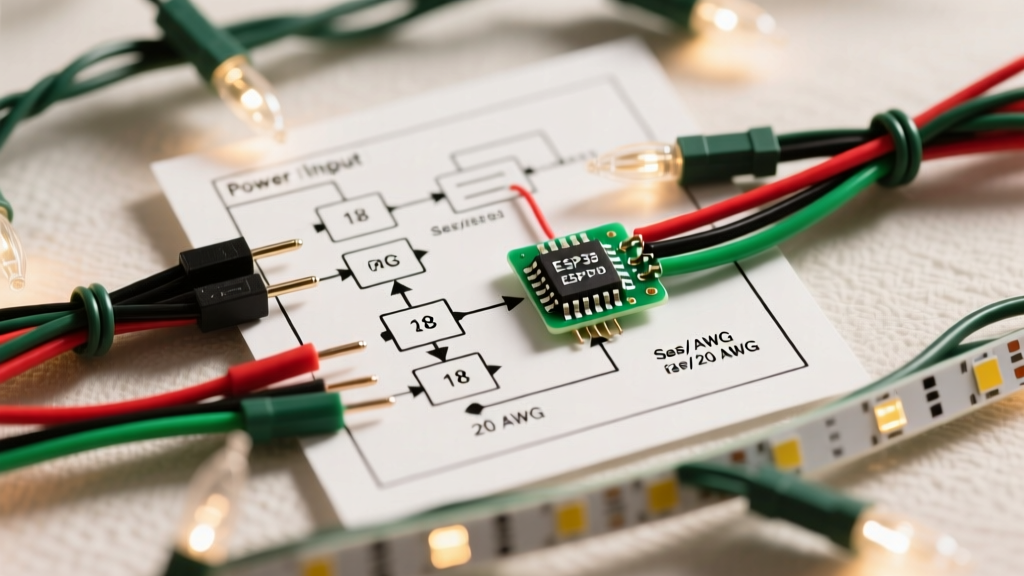
- Addressable Pixel Trees (Parallel Data, Parallel Power): Custom mega-trees use 12mm nodes (like WS2811 or UCS1903). Each node contains an RGB LED and an integrated circuit (IC). The wiring diagram here is strictly parallel for power (VCC and GND) and a daisy-chained parallel data line (DIN to DOUT).
Wire Gauge Reference Chart for Holiday Lighting
Using the incorrect American Wire Gauge (AWG) is a leading cause of melted insulation and electrical fires. Commercial strands use specific zip-cord styles, primarily SPT-1 and SPT-2. Below is the definitive wire gauge and insulation reference chart for 2026 holiday lighting projects.
| Wire Gauge (AWG) | Insulation Type | Max Ampacity (70°C) | Primary Application | Approx. Cost (2026) |
|---|---|---|---|---|
| 20 AWG | SPT-1 (0.030" thick) | 5 Amps | Standard indoor LED strands, low-wattage incandescent | $0.12 / ft |
| 18 AWG | SPT-1 (0.030" thick) | 7 Amps | Heavy-duty indoor/outdoor commercial LED strands | $0.15 / ft |
| 18 AWG | SPT-2 (0.045" thick) | 10 Amps | Outdoor extension cords, high-wattage C9/C7 bulb cords | $0.22 / ft |
| 16 AWG | SJTW (Jacketed) | 13 Amps | Main feeder lines for large outdoor light displays | $0.45 / ft |
| 12 AWG | THHN / Stranded | 20 Amps | Pixel tree power injection trunks (5V/12V high current) | $0.65 / ft |
Expert Insight: Never use standard 20 AWG SPT-1 wire for outdoor architectural lighting exposed to direct UV and physical abrasion. The thin 0.030-inch insulation degrades rapidly in freezing temperatures. Always upgrade to 18 AWG SPT-2 or UV-rated SJTW jacketed cable for permanent outdoor installations.
Decoding Wire Color Codes in Christmas Lighting
Unlike standard residential AC wiring (where black is hot, white is neutral, and bare/green is ground), holiday lighting color codes vary wildly depending on whether you are dealing with standard AC strands or low-voltage DC pixel nodes.
Standard 2-Wire AC Strands
In standard commercial strands, the external insulation color is purely aesthetic (Green for trees, White for rooflines, Black for dark backgrounds). Inside the SPT-1 zip cord, both copper conductors are identical. However, one side of the zip cord features subtle ribbed insulation, while the other is smooth.
- Smooth Conductor: Connects to the hot/fused side of the plug (the smaller prong).
- Ribbed Conductor: Connects to the neutral side (the wider prong) and eventually loops back to the rectifier bridge.
Addressable Pixel Nodes (3-Wire DC)
For 12mm WS2811 or UCS1903 pixel nodes used in custom mega-trees, the color coding is strictly standardized across the industry to prevent catastrophic controller failure:
- Red Wire: VCC / Positive Voltage (Typically 12V DC, sometimes 5V DC).
- White or Black Wire: GND / Negative Ground.
- Green or Yellow Wire: DATA (DIN/DOUT). Carries the 5V logic signal from the controller.
Warning: Swapping the Red (VCC) and Green (Data) wires on a pixel node will instantly send 12V into the 5V logic gate of the WS2811 IC, permanently destroying the node and potentially back-feeding voltage into your Falcon or Kulp controller data port.
Step-by-Step Repair: Splicing and Soldering
When a section of your custom display fails, or you need to extend a strand to wrap a wider column, twisting wires and using electrical tape is a severe fire hazard. The Electrical Safety Foundation International (ESFI) strongly advises against temporary, unsealed repairs on holiday lighting. Follow this professional splicing method:
- Strip the Insulation: Use a precision wire stripper to remove exactly 1/4 inch of insulation from the 20 AWG or 18 AWG SPT wire. Do not nick the copper stranding.
- Pre-Tin the Wires: Apply a small amount of 63/37 rosin-core solder to each exposed copper end using a temperature-controlled soldering iron set to 350°C (662°F).
- Prepare Heat Shrink: Slide a piece of dual-wall adhesive-lined heat shrink tubing (3:1 shrink ratio, sized 3/32" or 1/8") onto the main wire before joining.
- Solder the Joint: Join the pre-tinned wires in an inline splice (not a twisted pigtail) and apply heat until the solder flows smoothly.
- Seal and Shrink: Slide the adhesive heat shrink over the joint and apply heat with a heat gun. The internal adhesive will melt and seal out moisture, which is critical for preventing green corrosion on the copper strands during winter weather.
Advanced Wiring: Power Injection for Pixel Trees
If your wiring diagram for Christmas tree lights involves addressable pixels, you must account for voltage drop. A 12V WS2811 pixel drawing 60mA at full white brightness will cause a noticeable voltage drop after about 50 nodes. By node 75, the voltage may drop below 9V, causing the pixels to flicker or display incorrect colors (often turning red or green at the end of the run).
To solve this, custom builders use Power Injection. This involves running a heavy-gauge wire (typically 12 AWG or 14 AWG) parallel to the pixel strand from a secondary power supply, tapping into the VCC (Red) and GND (White) wires every 50 nodes.
Crucial Rule for Power Injection: Never connect the Data wire (Green) from the controller to the power injection supply. Only inject VCC and GND. Furthermore, ensure all power supplies share a common ground so the 5V data signal from the controller has a stable reference voltage across the entire tree.
Safety Standards and NEC Considerations
When designing permanent or semi-permanent holiday lighting wiring diagrams, you must adhere to the National Electrical Code (NEC). According to NFPA guidelines on winter holiday safety, temporary holiday lighting should not be left up for more than 90 days. However, if you are hardwiring a display, NEC Article 210.20 applies.
Because holiday lights are considered a continuous load (operating for 3 hours or more), you must apply the 80% rule to your circuit breakers. A standard 15-Amp residential circuit can only safely handle 12 Amps of continuous holiday lighting load.
- Calculate Your Load: A standard 100-light LED strand draws roughly 0.08 Amps. You can safely put about 150 of these strands on a single 15-Amp circuit.
- Incandescent Warning: A traditional 100-light incandescent C7 strand draws nearly 4 Amps. You can only safely chain 3 of these strands together on a 15-Amp circuit before risking a breaker trip or melted SPT-1 wiring.
For comprehensive safety standards regarding seasonal decorative products, manufacturers must comply with UL Standard 588, which dictates the minimum wire gauge, fuse requirements in the plug, and strain-relief testing for all commercial holiday lighting sold in North America. Always verify that your replacement wire and components meet or exceed these UL specifications to ensure a safe, spectacular, and fire-free holiday display.