
Bridging the Gap: Holiday Lighting and Your Breaker Panel
Every winter, electrical contractors and advanced DIYers face the same challenge: scaling up holiday lighting displays without overloading residential branch circuits. While most consumers only think about plugging cords into exterior receptacles, understanding the internal wiring diagram for Christmas light string systems—and how they interact with your main breaker panel—is critical for safety and performance. According to the National Fire Protection Association (NFPA), electrical failures or malfunctions in holiday lighting and decorations are a leading cause of seasonal home fires.
This guide approaches holiday lighting from a Panel & Breaker perspective. We will dissect the internal schematics of commercial and residential light strings, calculate continuous breaker loads per NEC Article 210, and outline how to hardwire permanent architectural roofline lighting directly to your electrical panel using modern DIN-rail smart relays.
Anatomy & Wiring Diagram for Christmas Light String Setups
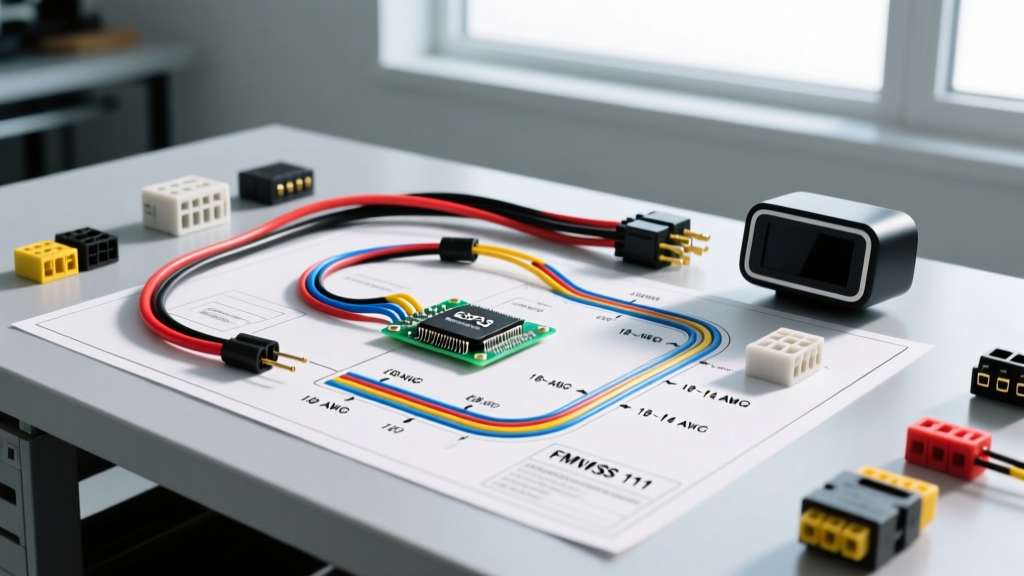
Before calculating breaker loads, you must understand what is happening inside the plug and wire. A standard 120V LED light string does not feed raw alternating current (AC) to the bulbs. Instead, it utilizes a specific internal wiring diagram to convert and manage power.
The Full-Wave Rectifier Schematic
LEDs are diodes; they require direct current (DC) to operate and will flicker at 60Hz if fed raw AC. To solve this, manufacturers embed a full-wave rectifier bridge (comprising four diodes) inside the plastic housing of the male plug.
- Step 1: 120V AC enters the plug and passes through a 5A or 3A glass fuse (protecting the 20-22 AWG copper wire).
- Step 2: The current hits the rectifier bridge, which flips the negative AC wave into a positive pulsing DC wave (yielding ~108V pulsating DC).
- Step 3: The pulsing DC travels down the 2-wire or 3-wire bus to the LEDs.
In a 3-wire commercial string, the third wire acts as a redundant return path or a dedicated controller line for RGB pixel nodes. If one bulb fails in a 2-wire series-parallel block, the rectifier ensures the remaining blocks stay illuminated, though the voltage across the remaining bulbs increases slightly, accelerating their degradation.
Breaker Panel Load Calculations: LED vs. Incandescent
The most common mistake in large-scale holiday displays is daisy-chaining too many strings on a single 15A or 20A exterior receptacle circuit. The U.S. Department of Energy notes that LED holiday lights use up to 75% less energy than incandescent lighting, but you must still respect the National Electrical Code (NEC) continuous load rules.
Under NEC Article 210.20(A), if a lighting load is expected to operate for 3 hours or more (which holiday lights always do), the branch circuit must be derated to 80% of its maximum capacity. Therefore, a 15A breaker can only safely handle 12A (1440W) continuously, and a 20A breaker can handle 16A (1920W) continuously.
| String Type (25ft / 25 Bulbs) | Watts per String | Amps per String | Max on 15A Breaker (1440W) | Max on 20A Breaker (1920W) |
|---|---|---|---|---|
| Incandescent C9 (7W Bulbs) | 175W | 1.45A | 8 Strings | 11 Strings |
| Standard LED C9 (0.05A) | 4.0W | 0.033A | 360 Strings* | 480 Strings* |
| Commercial 12V Pixel Nodes (PSU) | Varies (e.g., 350W) | 2.91A (at 120V) | 4 PSUs | 5 PSUs |
*Note: While the breaker can handle hundreds of LED strings, manufacturer warranties and the 20-22 AWG wire gauge of the strings themselves usually limit safe daisy-chaining to 40-50 strings end-to-end to prevent voltage drop and overheating at the male plug prongs.
Hardwiring Permanent Roofline Lights to Your Panel
For permanent architectural trim lighting (e.g., 12V or 24V RGBW pixel nodes), relying on outdoor receptacles and plug-in transformers is an outdated and unsafe practice. Moisture ingress and UV degradation will destroy plug connections within two seasons. The modern 2026 standard is to hardwire the system directly at the breaker panel.
Step-by-Step Panel Integration
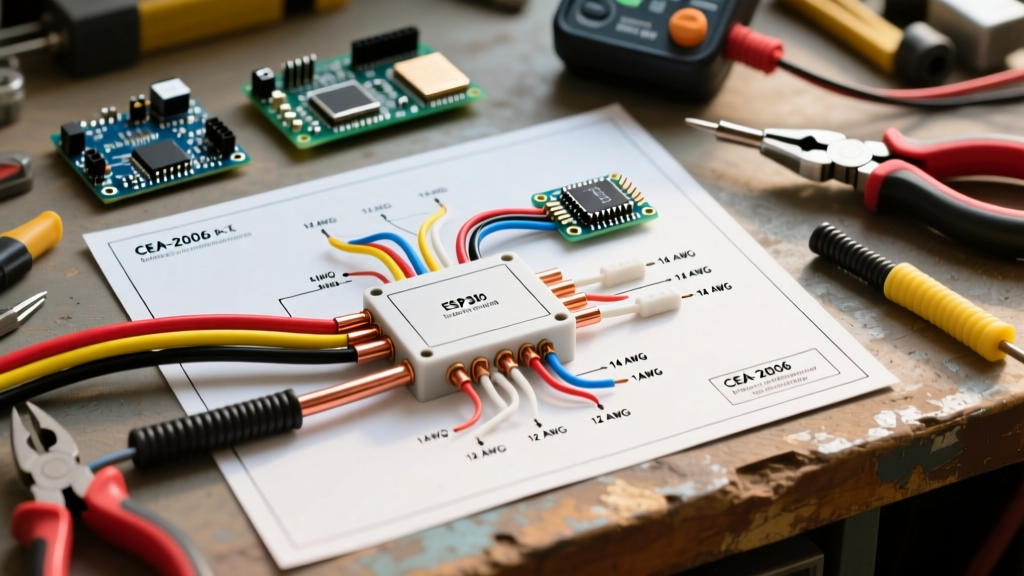
- Install a Dedicated Circuit: Run a new 12 AWG THHN wire through EMT conduit (or 12/2 UF-B cable if buried/trenched) from an available slot in your main panel to an exterior weatherproof junction box mounted near the roofline.
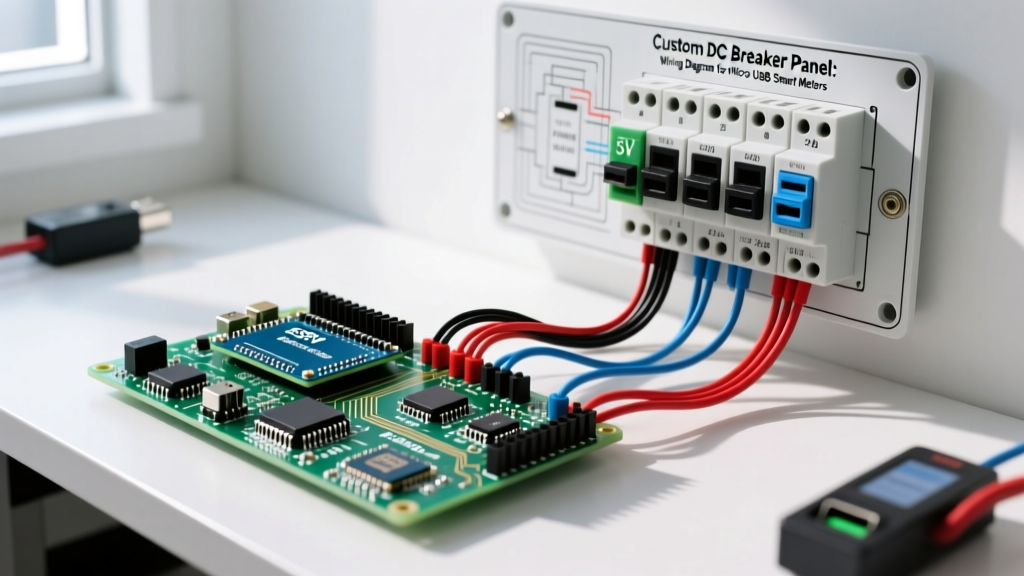
- Use a DIN-Rail Smart Relay: Instead of a standard wall switch, install a heavy-duty smart relay like the Shelly Pro 1PM or a 20A-rated Wi-Fi smart breaker directly inside your electrical panel. This allows you to control the exterior junction box from your smartphone and monitor real-time wattage draw.
- Wire the Mean Well Power Supply: Inside the exterior NEMA 4X junction box, wire the 120V AC load side of the smart relay to an industrial-grade DC power supply (e.g., Mean Well HLG-240H-24A).
- Low-Voltage Distribution: Run 14 AWG or 12 AWG outdoor-rated landscape wire from the 24V DC terminals to your pixel controllers and injection points along the fascia.
Safety Warning: The Consumer Product Safety Commission (CPSC) strictly warns against modifying the male plugs of UL-listed light strings. If you are hardwiring a system, you must use commercial-grade, un-terminated bulk wire spools and custom connectors, or cut the plug off a commercial string only if it is explicitly rated for field modification and hardwiring.
GFCI Protection: Breaker vs. Receptacle Nuisance Tripping
NEC Article 210.8(F) mandates Ground Fault Circuit Interrupter (GFCI) protection for all 15A and 20A, 125V outdoor receptacles. However, electricians frequently encounter 'nuisance tripping' when plugging large arrays of LED Christmas lights into GFCI-protected exterior outlets.
Why Do LED Strings Trip GFCI Breakers?
GFCI devices monitor the current imbalance between the hot and neutral wires, tripping if a leakage of 4mA to 6mA is detected. LED strings with full-wave rectifiers contain internal capacitors to smooth the pulsing DC. As these capacitors age, or if moisture penetrates the unsealed rectifier housing in the plug, a tiny amount of capacitive leakage to ground occurs. When you daisy-chain 20+ strings, the cumulative micro-leakage can exceed the 5mA threshold, tripping the GFCI even though there is no actual shock hazard.
The Panel Solution: If nuisance tripping occurs on a dedicated outdoor holiday lighting circuit, replace the standard GFCI receptacle with a GFCI Circuit Breaker in the main panel. Panel-mounted GFCI breakers are generally less susceptible to environmental temperature swings and moisture than outdoor receptacles. Furthermore, ensure all exterior wire splices are sealed with 3M Scotchcast resin-filled wire connectors or marine-grade heat shrink to eliminate ground-leakage paths.
Voltage Drop Calculations for Long Runs
When wiring commercial strings across wide commercial facades or wrapping massive trees, voltage drop becomes a critical failure point. The internal wiring diagram for Christmas light string setups relies on 20 AWG or 22 AWG wire, which has high resistance over distance.
Use the standard single-phase voltage drop formula: VD = (2 × K × I × L) / CM
- K = 12.9 (Copper resistivity at 75°C)
- I = Current in Amps
- L = One-way length in feet
- CM = Circular mils of the wire (22 AWG = 642 CM)
If you run a 250-foot continuous string of incandescent lights drawing 1.45A on 22 AWG wire, the voltage drop is roughly 14.6V. The lights at the end of the run will receive only 105V, resulting in dimming, excessive heat generation at the plug connections, and premature rectifier failure. Rule of thumb: Never exceed 150 linear feet of continuous 22 AWG string wiring without injecting power from a secondary branch circuit receptacle.
Expert FAQ: Panel & Holiday Lighting
Can I put holiday lighting on the same breaker as my exterior security cameras?
No. Security cameras and Wi-Fi access points require clean, uninterrupted power. The inrush current from large LED power supplies, combined with the harmonic distortion from cheap rectifiers, can degrade the power quality on the circuit. Always use a dedicated breaker for high-draw seasonal lighting.
Are smart plugs safe for outdoor holiday lighting?
Standard indoor smart plugs are a severe fire and shock hazard outdoors. If you must use a plug-in controller, it must be rated for outdoor use (NEMA 3R or 4), feature a weatherproof gasket seal, and be plugged into a GFCI-protected receptacle with an 'in-use' weatherproof bubble cover. For 2026 installations, hardwired DIN-rail panel relays are the vastly superior and safer choice.
What size fuse is inside a standard LED Christmas light plug?
Most UL-listed residential LED strings use a 3A or 5A, 125V glass cartridge fuse (typically 5x20mm). This fuse is sized to protect the thin 22 AWG wire from melting in the event of a dead short, long before the 15A or 20A branch circuit breaker in your panel has time to trip.