
The Electronics Maker’s Pivot: Why Jewelry Soldering is Different
As an electronics hobbyist or DIYer, you are likely accustomed to the precision of a Hakko FX-888D or Weller WES51 station. However, when searching for a jewelry soldering kit for beginners, you must immediately abandon the concept of the conductive soldering iron. Electronics solder (typically Sn63/Pb37 or SAC305) melts between 361°F and 430°F. Jewelry soldering relies on silver-bearing alloys that flow between 1,325°F (Easy) and 1,450°F (Hard). A standard 60W iron cannot overcome the thermal mass of a silver ring shank or a heavy brass bezel; you need directed convective and radiant heat via a gas torch.
In this 2026 guide, we bridge the gap between the electronics workbench and the jeweler's bench. We will break down the exact components, costs, and failure modes of budget versus premium jewelry soldering setups, ensuring you invest in tools that actually yield structural metallurgical bonds rather than ruined workpieces.
Thermal Dynamics: The Core Challenge
Silver and gold are highly thermally conductive. When you apply a butane flame to one side of a sterling silver ring, the heat rapidly dissipates throughout the entire object. If the overall mass does not reach the flow temperature of the solder, the flux will burn out, the metal will oxidize, and the joint will fail. This is why heat control and retention are the true metrics of a good jewelry soldering kit, not just the torch itself.
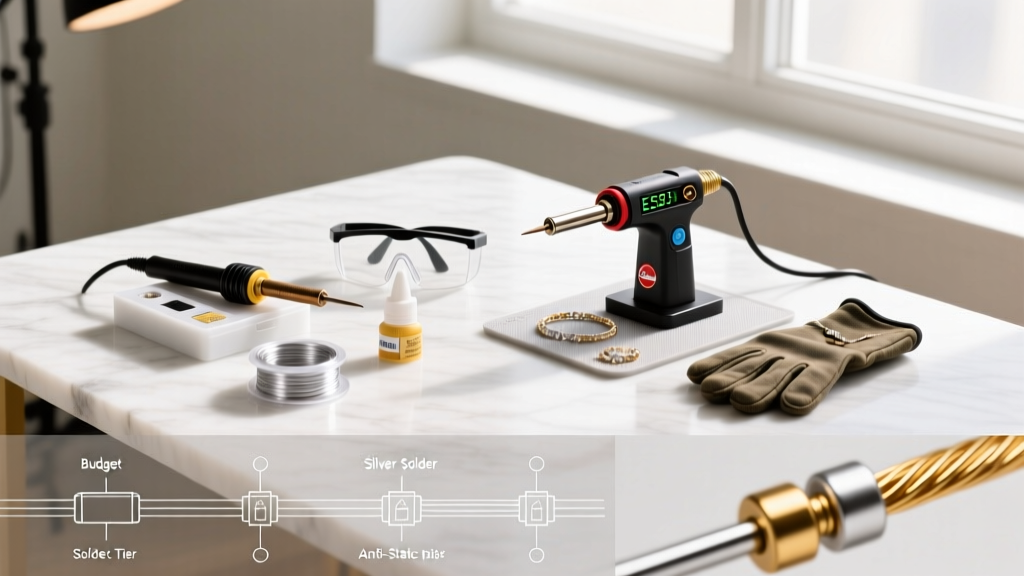
Budget Jewelry Soldering Kit for Beginners (Under $120)
The budget route is ideal for hobbyists repairing simple chain links, resizing basic bands, or experimenting with scrap metal. It relies on accessible hardware store materials and entry-level micro-torches.
The Core Components
- Torch: Blazer GB2001 Butane Micro-Torch (~$60). Capable of reaching 2,500°F, it provides a concentrated, wind-resistant flame suitable for small bezels and jump rings.
- Solder: Harris Stay-Silv 5 or generic Easy Silver Solder wire (~$25). Stick to cadmium-free formulations to avoid toxic fume inhalation.
- Flux: Borax cone and ceramic dish (~$12). You grind the cone with water to create a paste that prevents oxidation.
- Soldering Surface: Natural charcoal block (~$12). Charcoal reflects heat back into the workpiece, acting as a natural kiln.
- Pickle (Oxide Remover): Citric acid powder mixed with warm water in a glass jar (~$10).
Total Estimated Cost: $119
The Budget Limitation
The primary failure mode of the budget kit is thermal runaway on large pieces. The Blazer GB2001 lacks the BTU output to solder a heavy men's signet ring or a thick copper cuff. Furthermore, natural charcoal blocks degrade quickly, cracking and catching fire if not kept slightly damp, requiring frequent replacement.
Premium Jewelry Soldering Kit for Beginners ($350 - $500)
The premium kit is an investment in metallurgical consistency, safety, and ergonomic workflow. It replaces consumable, messy components with engineered ceramics and precise gas mixtures.
Upgrading the Thermal Engine
- Torch: Smith Silversmith Torch (Acetylene/Air) (~$280). This torch uses a Venturi effect to mix acetylene with ambient air, producing a remarkably soft, bushy flame that heats the entire piece evenly without melting delicate edges.
- Solder: Rio Grande Hard/Medium/Easy sheet solder (~$60). Using graded sheet solder allows you to perform multiple sequential soldering steps (e.g., sizing a ring, then attaching a bezel) without melting previous joints.
- Flux: Prip's Flux or Aquaflux (~$25). These liquid fluxes leave a thinner, more glassy coating than borax, reducing cleanup time.
- Soldering Surface: Kilkenny Ceramic Honeycomb Board (~$45). Impervious to thermal shock, it reflects heat perfectly and never catches fire.
- Pickle: Sparex #2 (Sodium Bisulfate) in a dedicated 1.5qt slow cooker (~$60).
- Handling: GRS Benchmate and Titanium cross-locking tweezers (~$80).
Total Estimated Cost: $550
Head-to-Head: Budget vs. Premium Component Matrix
| Component | Budget Setup (Under $120) | Premium Setup ($350+) | Performance Delta |
|---|---|---|---|
| Heat Source | Butane Micro-Torch | Acetylene/Air Torch | Acetylene provides 3x the BTU output and a softer, broader flame envelope. |
| Soldering Block | Natural Charcoal | Ceramic Honeycomb | Ceramic is non-consumable, fireproof, and reflects heat more uniformly. |
| Flux | Borax Cone (Paste) | Prip's Flux (Liquid) | Liquid flux prevents clumping and reduces post-solder pickling time by 40%. |
| Pickle Solution | Citric Acid (Room Temp) | Sparex #2 (Heated to 140°F) | Heated sodium bisulfate strips fire-scale in 2 minutes vs. 15 minutes. |
| Tweezers | Steel Reverse-Tweezers | Titanium / Copper Locking | Titanium does not absorb heat from the workpiece or contaminate the pickle. |
The Pickle Pot Trap: A Galvanic Nightmare
The most common catastrophic failure for beginners using a jewelry soldering kit occurs not at the torch, but in the pickle pot. Pickle is the warm acidic bath used to dissolve copper oxides (fire-scale) after soldering.
Critical E-E-A-T Warning: Never introduce steel or iron into your pickle pot. If a steel tweezer or a steel binding wire touches the acidic solution while copper is present, it triggers a galvanic reaction. The steel acts as an anode, and the dissolved copper instantly electroplates onto your silver jewelry, turning it a bright, stubborn copper color.
To fix this copper-plating error, you must abrade the piece with a brass brush or re-pickle it in a fresh solution of pure Sparex #2 using only copper, plastic, or wooden tweezers. Premium kits mitigate this by including dedicated copper or titanium cross-locking tweezers, which are chemically inert in the sodium bisulfate bath.
Safety and Ventilation: Non-Negotiable Protocols
Jewelry soldering introduces hazards rarely encountered in PCB assembly. According to safety archives maintained by the Ganoksin jewelry community, the primary risks are fluoride off-gassing from fluxes and heavy metal inhalation.
The Cadmium Threat
Cheap, unbranded silver solders imported from overseas marketplaces often contain cadmium to artificially lower the melting point. When heated past 1,000°F, cadmium vaporizes into cadmium oxide, a highly toxic gas that causes severe respiratory damage. Always verify that your solder is explicitly labeled 'Cadmium-Free'. For heavy metal exposure limits and workshop ventilation standards, always consult OSHA guidelines regarding local exhaust ventilation (LEV).
Fluoride Compounds
Fluoride-based fluxes (common in easy-flow solders) release hydrogen fluoride gas when heated. This gas is corrosive to lung tissue and will etch the glass lenses of your safety goggles over time. Polycarbonate safety glasses and a fume extractor rated for particulate and chemical vapor are mandatory for indoor setups.
Frequently Asked Questions
Can I use my electronics solder (rosin core) for jewelry?
No. Tin/lead or tin/copper electronics solder will not bond to sterling silver or gold. The thermal mass of jewelry will vaporize the rosin flux before the solder can wet the precious metal, resulting in a weak, dirty blob that will snap under minimal mechanical stress.
Do I need a kiln for jewelry soldering?
For basic fabrication and repairs, a torch is sufficient. However, if you plan to do complex granulation or enamel work, a programmable jewelry kiln (like the Paragon SC-2) is required to maintain uniform ambient temperatures of 1,300°F+ without oxidizing the surface.
Where should I buy my first kit?
While hardware stores carry basic brazing supplies, specialized suppliers like Rio Grande offer pre-packaged, cadmium-free solder kits and properly graded fluxes that are essential for clean, professional-grade jewelry joints.
Final Verdict: Which Kit Should You Choose?
If you are strictly repairing silver chain links or crafting simple wire-wrapped bezels, the budget butane kit will suffice, provided you respect the thermal limits of the torch. However, if your goal is to fabricate custom rings, set stones, and build a sustainable maker business, the premium acetylene and ceramic setup is not a luxury—it is a metallurgical requirement. The precision of a Smith Silversmith torch and the chemical safety of a properly managed Sparex pickle pot will save you hundreds of hours of frustration and ruined materials in your first year alone.