
The Metallurgical Reality: Why Irons Cannot Weld Metal
When makers and DIYers search for 'welding with a soldering iron,' they are usually colliding with a fundamental misunderstanding of metallurgy, or they are using the term colloquially to describe heavy-duty joining. To set the record straight for 2026: you cannot weld metal with a soldering iron.
According to the TWI Global welding authority, true welding requires the coalescence of base metals, meaning the base materials themselves must melt and fuse. Mild steel melts at approximately 1,370°C (2,500°F), and aluminum at 660°C (1,220°F). Even the most powerful benchtop soldering stations, like the JBC CD-2BQE (130W max output), max out around 450°C (842°F) at the tip. Therefore, attempting to weld steel or aluminum with an iron is physically impossible.
However, the search intent behind this phrase usually points to two very real, highly practical scenarios:
- Plastic Welding: Using a soldering iron to melt and fuse thermoplastic polymers (ABS, PLA, Nylon) where the iron *does* melt the base material.
- Heavy-Duty Sweat Soldering: Attempting to join massive copper conductors (like 2/0 AWG battery cables) where standard electronics irons fail, requiring high-thermal-mass tools that mimic the structural permanence of welding.
Below, we compare the exact tools required for these scenarios, breaking down failure modes, temperature thresholds, and real-world pricing.
Scenario 1: Plastic Welding With a Soldering Iron
Thermoplastics can absolutely be welded with a soldering iron because their melting points fall perfectly within the operating range of standard electronics irons. For instance, ABS plastic softens and melts between 210°C and 240°C, while Nylon requires roughly 260°C. When repairing a cracked 3D-printed drone frame or an automotive interior trim piece, the right tool selection dictates whether you get a structurally sound weld or a burnt, brittle mess.
Tool Comparison: Standard Irons vs. Dedicated Plastic Welders
| Tool Model | Type | Temp Range / Wattage | Best Application | Approx. Price (2026) |
|---|---|---|---|---|
| Hakko FX-888D | Digital Station | 200°C - 480°C (70W) | Precision PLA/ABS tacking and thin-wall repairs | $115 |
| Weller W60PK | Line-Voltage Iron | Fixed ~315°C (60W) | Thick ABS/Nylon welding (includes spatula tip) | $65 |
| Quick 861DW | Hot Air Station | 100°C - 500°C (1000W) | Large surface area plastic blending and shrink tubing | $260 |
| HG P130 Hot Stapler | Staple Welder | N/A (Resistive Heating) | Structural reinforcement of cracked ABS bumpers | $45 |
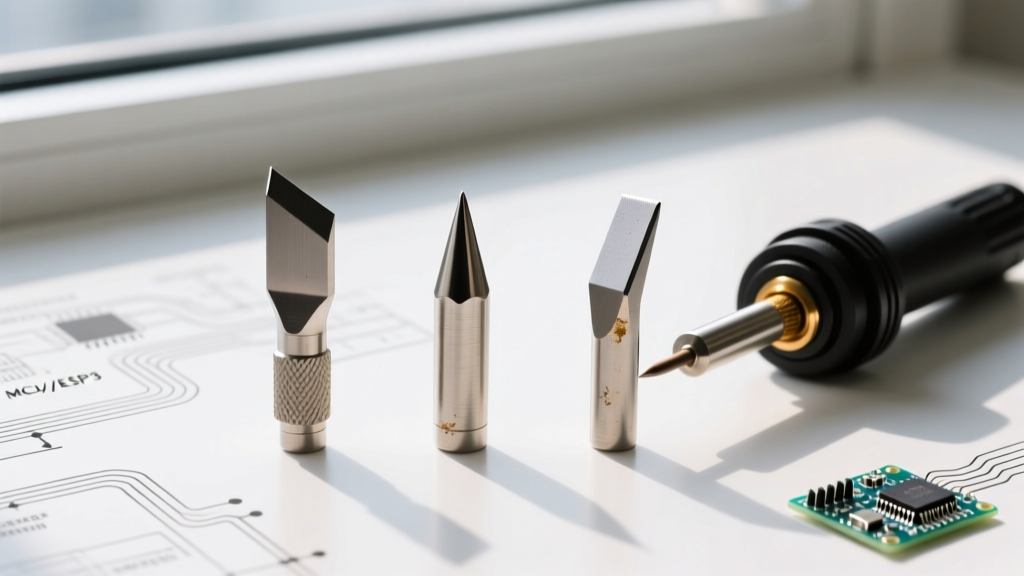
The Expert Edge Case: If you use a standard conical tip (like the Hakko T18-B) to weld ABS, the tip will sink into the plastic, creating a trench rather than a weld bead. You must swap to a spatula or chisel tip (e.g., Hakko T18-D24) to distribute heat evenly across the joint line. Furthermore, melting plastics releases volatile organic compounds (VOCs) and toxic particulates; always use a localized fume extractor like the Hakko FA-400 when welding polymers.
Scenario 2: Heavy-Duty Metal Joining (When Soldering Mimics Welding)
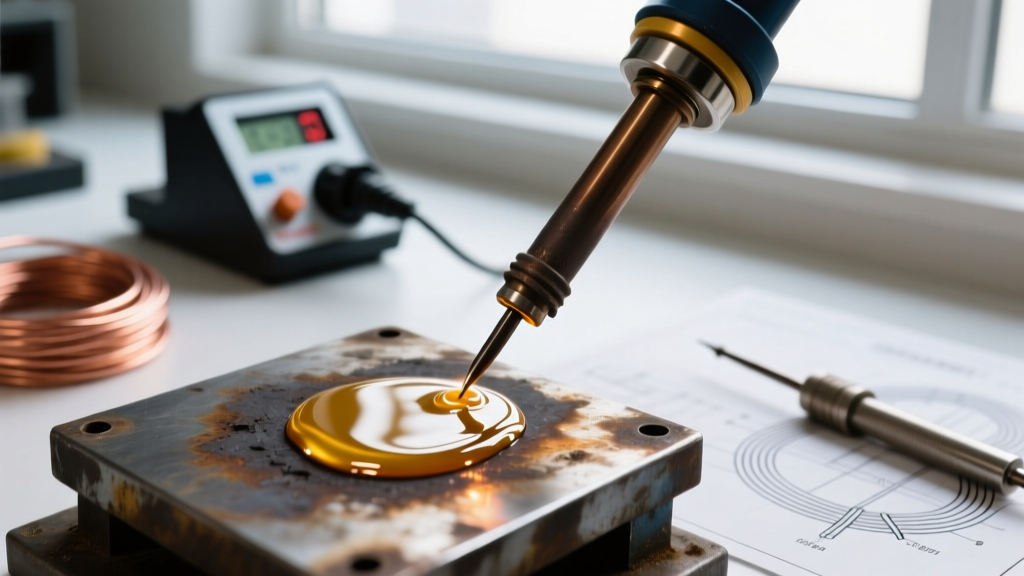
In automotive and marine electrical work, technicians often refer to joining massive copper lugs as 'welding' because the thermal mass required is so high that standard soldering techniques fail. If you try to join two 4/0 AWG copper battery cables with a standard 60W iron, the copper acts as a massive heatsink. The solder will cool before it can flow via capillary action, resulting in a cold joint—a high-resistance connection that will generate immense heat under load and eventually cause an electrical fire.
High-Thermal-Mass Tool Matrix
When you need a soldered joint that approaches the mechanical and electrical permanence of a micro-weld, you must abandon precision stations and move to high-wattage guns or specialty irons.
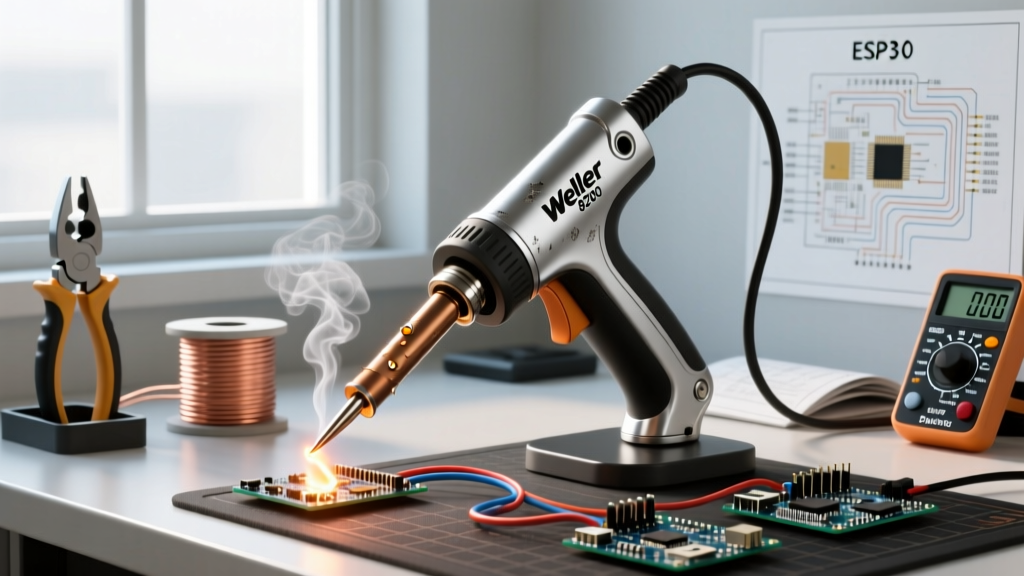
- Weller D550 Professional Soldering Gun (260W/200W): The industry standard for heavy copper. The transformer-based gun delivers massive instantaneous current to the tip. Failure mode: The heavy copper loop tip degrades quickly if left on, and the magnetic field can accidentally magnetize sensitive nearby components.
- American Beauty 300W Heavy Duty Iron (Model 3158-00): A solid-state, high-mass iron designed specifically for battery lugs and thick busbars. It holds thermal mass far better than the Weller gun, preventing voltage drop during prolonged heating of thick copper.
- Sunstone PUK Micro-TIG Welder ($1,200+): If you actually need to weld metal (e.g., joining copper wires without solder, or fusing nickel strips to battery cells), a Micro-TIG uses an arc to melt the base metal. This is true welding on a microscopic scale.
Code Compliance Warning: According to Miller Welds educational resources and general electrical codes, soldered connections in high-vibration environments (like automotive engine bays) are prone to fatigue cracking. For 4/0 AWG cables, a high-tonnage hex-crimp (using a tool like the Amzdeal 6-50mm² crimper) is mechanically superior and code-compliant compared to heavy soldering.
Step-by-Step: How to 'Weld' Cracked ABS Plastic With an Iron
If your intent is plastic repair, here is the exact methodology used by prototype engineers to achieve up to 70% of the original tensile strength of the base material.
- Preparation: Clean the ABS plastic with isopropyl alcohol. Use a Dremel or file to cut a 45-degree V-groove (bevel) along the entire crack line. This creates a channel for the filler material.
- Filler Selection: Do not use PLA or generic 3D printer filament. Use pure ABS welding rod, or cut thin strips from a scrap piece of the exact same plastic.
- Temperature Setting: Set your station (e.g., Hakko FX-888D) to 240°C (464°F). If using a line-voltage iron, let it heat for 3 full minutes.
- The Tack: Press the spatula tip perpendicular to the crack every half-inch to melt the base edges together, 'tacking' the piece in place so it doesn't shift.
- The Weld Bead: Hold the ABS filler rod in one hand and the iron in the other. Melt the rod and the base plastic simultaneously, pushing the molten plastic into the V-groove. Move at a steady pace of about 1 inch per 5 seconds.
- Smoothing: Immediately after laying a bead, wipe the spatula tip clean on a damp brass sponge, then lightly drag the flat of the tip over the bead to smooth it flush with the surface.
Expert Verdict: Match the Tool to the Physics
The phrase 'welding with a soldering iron' is a misnomer for metals, but a highly valid technique for thermoplastics. If you are working with metals, respect the thermodynamics: use a Weller D550 or American Beauty iron for heavy copper sweat-soldering, and step up to a Micro-TIG or laser welder if base-metal fusion is required. If you are working with plastics, swap your conical tip for a chisel tip, control your heat to prevent polymer degradation, and always prioritize active fume extraction to protect your respiratory health.