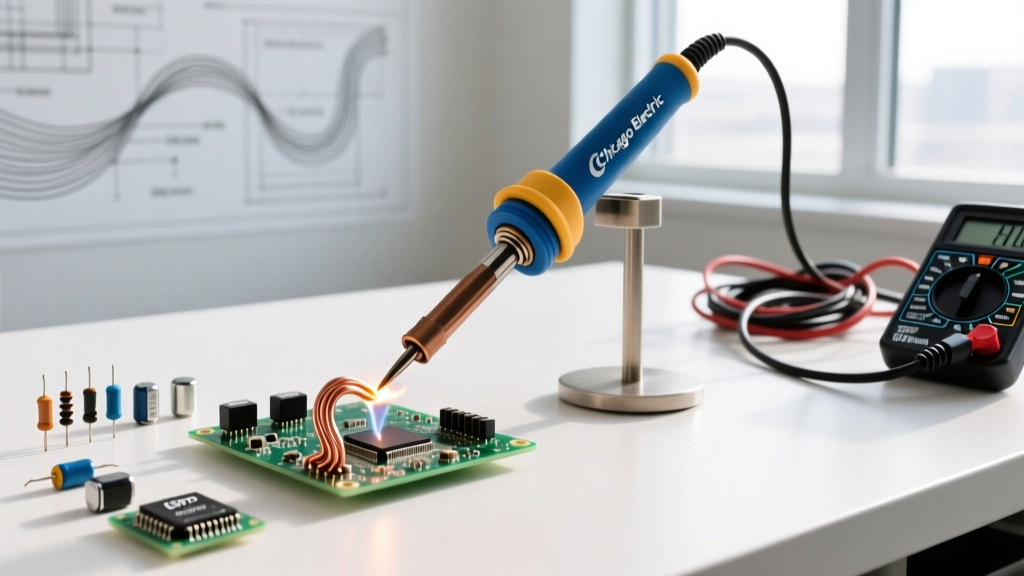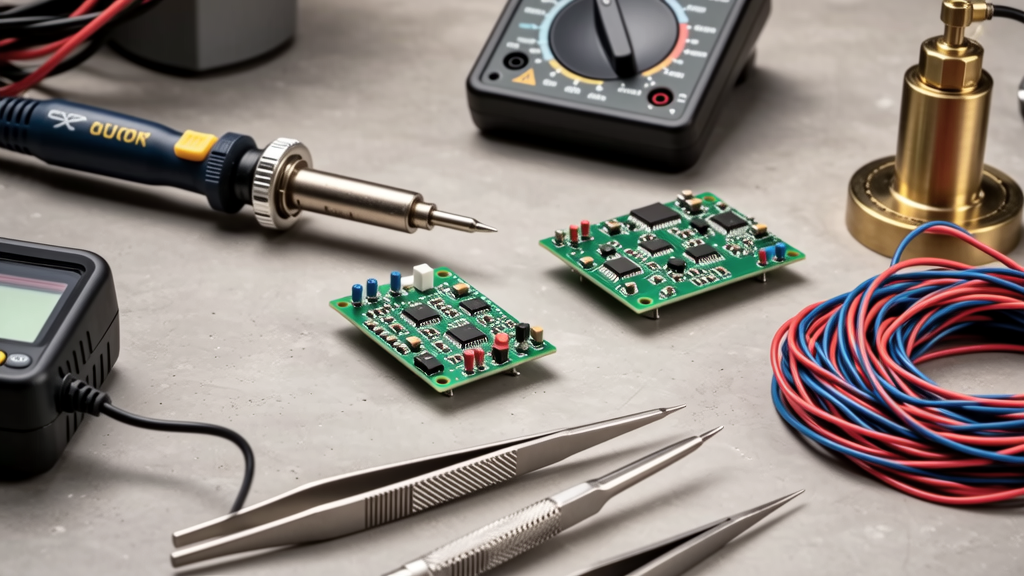
Systems storage ideas for soldering workbenches should treat the iron, stand, tip box, flux, solder, power supply, and tools as one system rather than separate clutter. A well designed layout reduces tip oxidation, prevents accidental burns, keeps calibration accessories close, and shortens setup time for rework and through-hole work. After more than ten years using Hakko, Weller, JBC, Pace, and Metcal stations in production, repair, and R&D benches, the most reliable setups use three zones: a clean 30 cm hot zone, a dry chemical shelf, and a modular parts tray system. This article covers bench zoning, tip cartridge storage, flux and solder organization, fume-safe drawers, mobile carts, and inventory rules that keep stations ready between jobs.
Why soldering systems need dedicated storage
When a soldering station is scattered, the station fails quietly. A cold iron left on a bench collects dust, a tip sitting in oxidized flux gets pitted, and a drawer full of mixed solder spools makes operators guess diameters. I have seen a Hakko FX-951 cartridge appear dead because it was stored next to a wet sponge for days, and I have seen JBC CDE-200 tips lose wetting after sitting in a tool tray with no protective tinning. Good storage is not decoration; it is process control.
The first principle is separation. Hot items, wet items, dry consumables, and electronics need different storage environments. A 300 degrees Celsius iron stand can warp thin plastic organizers, while flux fumes can corrode nearby connectors and switches. A 0.5 mm micro solder wire can unspool into a mess if it is not held by a spool holder. A 2.5 mm lead-free Kester spool is heavy enough to crush small parts if stacked carelessly. Systems storage begins by matching each item to a container, shelf, or hook that prevents that failure.
Bench layout and zone-based systems storage
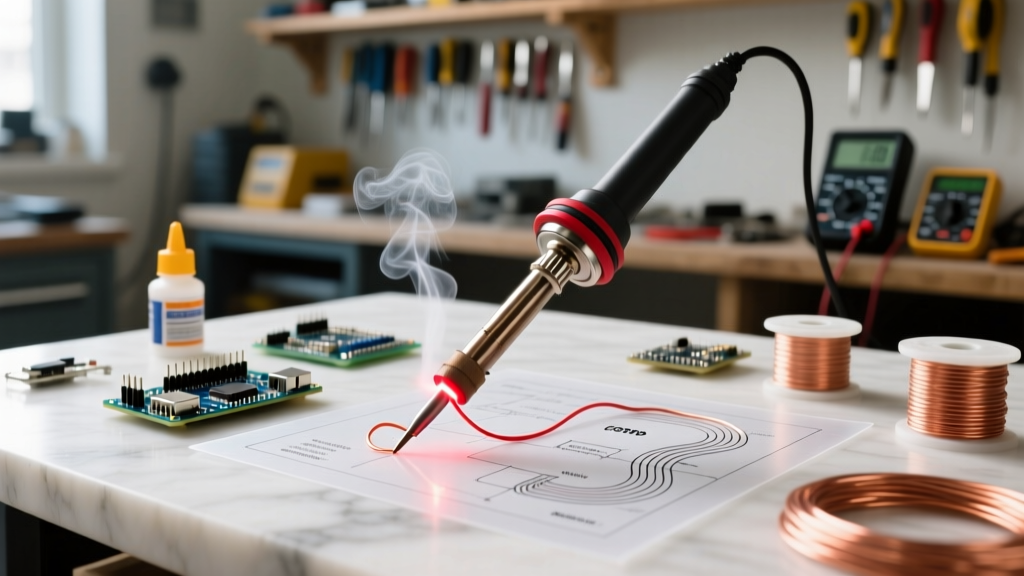
Use a three-zone bench map. The hot zone is where the iron rests, where cleaning occurs, and where the tip is tinned. Keep this zone within 15 to 30 centimeters of the operator's dominant hand. The consumable zone holds solder spools, flux pens, desoldering braid, and tip tinner. The parts and tools zone holds tweezers, vacuum pickup tools, magnification, PCB holders, and ESD straps. This zoning reduces cross-contamination and keeps the station repeatable.
The 30 cm hot-zone rule
For most Hakko, Weller, and Pace setups, a 30 cm hot-zone footprint is a practical rule. Place the iron stand in one corner, the tip cleaner in the center, and the tinning tool or wet sponge holder nearby. The iron handle should point away from the edge of the bench. If the bench is only 60 cm deep, mount the stand under a shelf and use a magnetic tip holder. If the bench is 80 cm deep or more, a freestanding stand is better because it can hold both iron and tip cartridges without crowding the edge.
Measure the actual stand diameter before buying organizers. A Weller WTCPN stand is compact, while a Metcal MX-521 station with a large handle can need a 120 mm by 120 mm base clearance. I keep a 10 mm margin between the stand and the tray edge so hot air from the element does not warp plastic bins. For solder fume extraction, the hose nozzle should be 5 to 8 cm from the work point, but the hose itself should be routed overhead or behind the stand so it does not become a storage obstruction.
Drawer and pegboard storage systems
Drawers work best for small, dry, frequently used items. I prefer shallow 40 mm to 60 mm drawers because they show the contents at a glance. A deep 100 mm drawer becomes a mixed bin of tweezers, solder, and O-rings within a week. Use expandable dividers for solder spools and small parts trays. For pegboards, use metal hooks and cups rather than plastic clips because flux and isopropyl alcohol vapors can degrade some plastics. A 10 mm pegboard hole spacing is common, but 5 mm systems offer finer control for small soldering accessories.
- Top drawer: iron, stand, tip cleaner, tweezers, magnifier, and ESD wrist strap.
- Middle drawer: solder spools, flux pens, desoldering pump, braid, and tip tinner.
- Bottom drawer: station calibration accessories, replacement handles, power cords, and spare cartridges.
Pegboards are excellent for visible storage but can collect dust if left open. A clear acrylic cover over a pegboard section is useful in dusty environments. I use pegboard for larger accessories: solder sucker, vacuum pickup pump, PCB holder, and cable organizers. Small consumables belong in drawers or trays because exposed spools can unspool and oxidize faster.
Tip storage ideas for soldering irons and cartridges
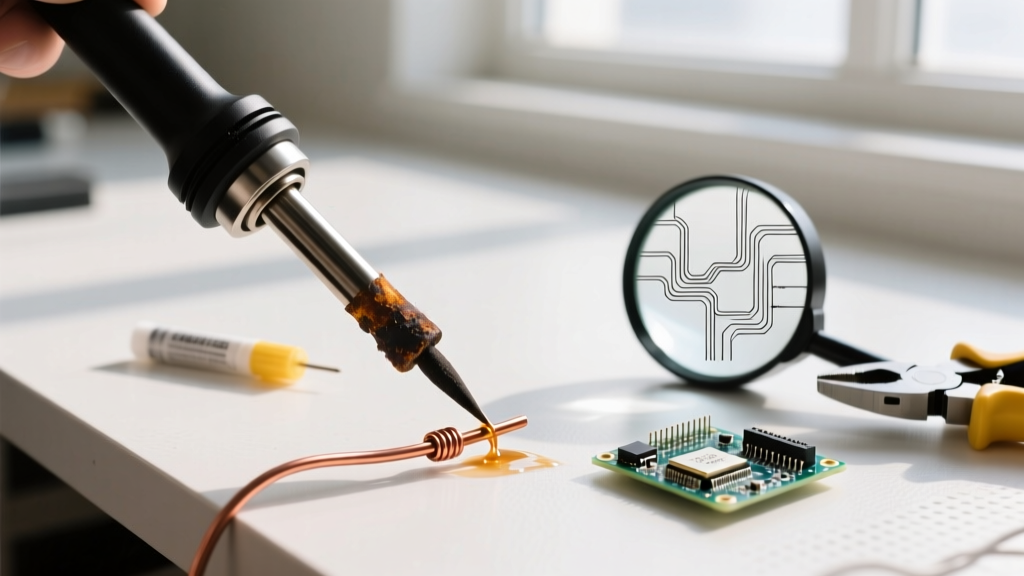
Tip storage is the most overlooked part of systems storage. Reusable tips and cartridge tips have different failure modes. A reusable tip can be stored in a brass wool holder if it is tinned, but it should not sit in a wet sponge overnight. A cartridge tip can be stored in its original plastic case or a dedicated tip box with foam slots. If you use a Hakko T12 style, a JBC cartridge, or a Weller 900 series tip, each has a slightly different geometry, so universal boxes can cause rattling and tip damage.
| Tip system | Recommended storage | Key measurement | Why it matters |
|---|---|---|---|
| Hakko T12 or FX-951 cartridge | Original cartridge case or foam slot box | Tip diameter 0.5 mm to 3.5 mm | Protects delicate wetting surface and prevents handle contact |
| JBC CDE-200 cartridge | Vertical cartridge rack with soft slot | Cartridge length roughly 60 mm | Reduces tip-to-tip contact and thermal shock |
| Weller 900 series reusable tip | Brass wool stand or metal tip rack | Tip shank fits 6 mm to 8 mm slot | Keeps tip tinned and avoids sponge moisture |
| Metcal MX-521 cartridge | Sealed cartridge drawer or foam insert | Tip size 0.5 mm micro to 2.5 mm chisel | Prevents oxidation of fine micro tips |
| Pace ST 50 cartridge | Holder with tip-down orientation | Handle clearance 100 mm | Protects sensor area and tip plating |
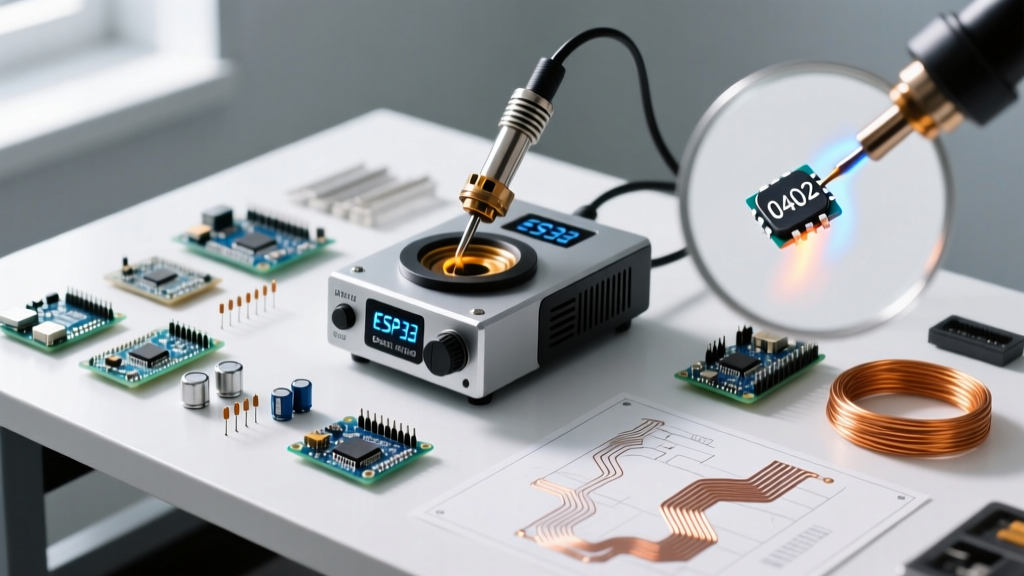
The table shows that storage should follow the tip family, not just the iron brand. A 0.5 mm micro tip used for 0402 chip resistors or fine-pitch QFP rework is more vulnerable than a 3.5 mm chisel tip used on connectors. Micro tips should be stored in capped or slotted holders. Chisel tips can tolerate a metal rack, but they still need a protective tin coating before storage. I keep a small tube of tip tinner near the rack so every tip can be refreshed before it goes into storage.
For multi-user benches, color-code tip boxes. Red can mean lead-free SAC305 tips, blue can mean leaded Sn63Pb37 tips, green can mean desoldering or repair-specific tips, and white can mean calibration or experimental tips. This avoids mixing incompatible tip families and makes inventory visible. In a lab where students or technicians share stations, this simple color system reduces tip damage and station downtime.
Cartridge versus reusable tip storage
Cartridge systems such as JBC, Hakko, Pace, and Metcal store better because the tip and heater are one unit. A cartridge can be dropped into a numbered foam insert and removed without touching the wetting surface. Reusable tips need more careful handling because the tip, collar, and handle can separate. I use a small metal cup for each reusable tip diameter: 1.5 mm, 2.4 mm, and 3.5 mm. The cup should be large enough to hold the tip without pressure on the working face.
For cartridge tips, a numbered tray is more efficient than a jumbled box. I keep four cartridges on active benches: one fine chisel for general SMT, one micro tip for 0402 and 0201 work, one conical for through-hole pads, and one wide chisel for ground planes. Each slot is labeled with the tip code. If a cartridge is removed for a job, the empty slot is obvious. This visual inventory is faster than searching through a drawer and prevents accidental purchases of duplicate tip sizes.
Flux, solder wire, and chemical storage systems
Solder and flux storage should be closed, labeled, and segregated by chemistry. Lead-free SAC305 solder, leaded Sn63Pb37 solder, no-clean flux, rosin flux, and water-soluble flux can all look similar in bottles or pens. I store each on a separate shelf tray with a label on the front. A 100 ml flux bottle should be kept upright in a small cup to prevent cap leakage. A flux pen should be stored in a vertical pen holder, not lying flat, because the tip can wick and dry unevenly if it sits in a drawer.
Solder spools need diameter-specific holders. A 0.5 mm micro solder wire can unspool into a bird nest if it is left loose. A 1.0 mm or 1.5 mm lead-free wire is manageable in a simple spool holder, but a 2.5 mm wire is stiff enough to spring out of a shallow tray. I use a 50 mm diameter spool holder for 2.5 mm wire and a 40 mm holder for 1.0 mm to 1.5 mm wire. For Kester or Chip Quik spools, a sealed bag with a desiccant packet is useful in humid climates because flux residue on the wire can oxidize and slow wetting.
Desoldering braid and solder sucker tips are another category. Braid is fragile and should be kept in a shallow tray, not squeezed under tools. Solder sucker tips, often 1.5 mm to 3.0 mm, can be stored in a small pegboard cup. I label the cup by size because a technician who grabs the wrong tip can clog the pump or damage a pad.
Moisture and fume-safe storage
Fume control is part of storage, not just extraction. Flux, alcohol wipes, cleaning sprays, and tip tinner can release vapors that damage nearby electronics and organizers. Store flammable liquids in a small ventilated cabinet, ideally away from the iron stand. If you use a fume extractor, route its hose so the nozzle can move freely but the hose does not rest on solder spools or plastic trays. A 70 mm fan hose is common for bench extractors, and the hose can be held by a 30 mm ring clip behind the stand.
Humidity affects solder and flux more than many people expect. In a bench above 70 percent relative humidity, flux pens can become tacky and solder wire can oxidize faster. I keep a small hygrometer in the storage drawer and store sensitive no-clean flux in sealed containers with silica gel. For lead-free solder, oxidation is a bigger problem than with leaded solder, so a fresh tin coating on the tip and clean storage conditions directly improve wetting.
Modular accessory and power systems storage
Modern stations often include multiple accessories: iron, hot air, tweezers, calibration device, spare handle, power cord, and USB data cable. A modular storage system should prevent cable tangling and accessory loss. I use a 120 mm by 80 mm parts tray for the iron and stand, a 90 mm tray for hot air nozzle sets, and a cable management clip for the power cord. The power cord should have 200 mm to 300 mm of slack behind the station so it does not pull the iron stand when someone moves the bench.
- Hot air nozzles: store by diameter, 5 mm, 8 mm, 10 mm, and 12 mm, in a foam block.
- Iron handles: keep one active handle and two spares in labeled slots.
- Calibration accessories: store in a rigid box because thermocouples and probes are sensitive.
- Power cords and adapters: use Velcro straps or a small cable box, not a drawer with loose plugs.
For stations with multiple irons, a vertical rack is better than a horizontal pile. A Hakko 936 or FX-951 station with two iron handles can use a double stand if the bench depth is at least 70 cm. For a Weller WT1000 or a Pace ST 50, the cord management matters because the iron can be left in the stand while the cord dangles. I route cords along the back edge of the bench with a 10 mm cable channel so the front 30 cm zone remains clear.
Electronics storage also matters. If the station has a calibration certificate, spare thermocouple, or firmware dongle, it should not be mixed with tip tinner or flux. I keep a small sealed box labeled Calibration and Service. This avoids contamination and makes maintenance records easy to find.
Mobile and small-space systems storage
Small benches, repair carts, and field soldering require a different storage philosophy. For a mobile repair cart, I use a three-tier system: top tier for active tools, middle tier for consumables, bottom tier for station and power. A 40 cm by 30 cm cart top is enough for one iron, one stand, one flux tray, and one solder holder. Add a magnetic knife strip or pegboard panel to the side for tweezers and cutters. The cart should have a lip or raised edge so tools do not fall when the cart is moved.
For a home lab, vertical storage is often better than drawers. A 40 cm wide wall panel with hooks can hold the iron stand, magnifier, solder sucker, and cable spool. Below it, a 20 cm shelf can hold flux and solder. This keeps the bench clear and makes the system visible. I have used this layout with Hakko, Aoyue, and Bossman stations in apartments where the bench was only 100 cm wide. The key is to store the iron stand at the front edge of the shelf so it cannot tip backward.
For travel kits, use a hard case with cut foam. A soldering iron kit should include the station, one active tip, two spare tips, a short solder spool, a flux pen, tip tinner, tweezers, and a small cleaning cloth. The foam should have a separate slot for the iron and stand so hot components cannot rest against plastic or cables. A 200 mm by 150 mm by 80 mm case is a practical size for a single-iron system with accessories.
Inventory and maintenance record storage
A storage system is only complete if it supports inventory. I keep a simple log for each station: iron serial number, station model, tip codes, last calibration date, last tip change date, and number of hours used. For Hakko, Weller, JBC, and Pace stations, tip life varies by temperature, solder composition, and duty cycle. A common rule is to check tip condition every 20 to 40 operating hours, then replace or re-tin as needed. A small card holder mounted near the station makes the log visible and reduces forgotten maintenance.
- Record the station model, such as FX-951, WT1000, CDE-200, ST 50, or MX-521.
- Record tip codes and quantities, not just tip diameter.
- Record solder type, diameter, flux chemistry, and lot number when available.
- Record calibration date, set temperature, and measured temperature if a thermocouple is used.
- Record tip replacements and the reason, such as oxidation, pitting, or poor wetting.
Digital inventory can be useful for teams. A shared spreadsheet with columns for tip code, location, minimum quantity, and reorder point works well. For a bench with ten users, set a minimum of two cartridges per active tip code. For a solo bench, one active cartridge and one spare is usually enough. A JBC cartridge can last hundreds of joints, but a fine micro tip used at 380 degrees Celsius with lead-free solder may fail sooner. Tracking usage prevents surprise downtime.
Storage labels should be printed or laminated. Handwritten labels fade when exposed to isopropyl alcohol and flux. I use a label maker with tape that is at least 12 mm wide. Each drawer front gets the category name, each shelf gets the chemistry, and each tip box gets the tip code. If you have a shared bench, add the user initials or team name to the label. This small detail reduces tip borrowing, which is one of the most common causes of damaged cartridges.
Practical storage rules that reduce tip damage
After years of bench work, the simplest rules produce the best results. Always tin a tip before putting it into storage. Never store a tip in a wet sponge overnight. Never store flux pens horizontally. Never mix lead-free and leaded solder in the same open tray. Never place a plastic organizer within 10 mm of a hot iron stand. Never route a fume hose over solder spools. Never leave a cartridge tip in a metal tray without a protective slot. These rules are not theoretical; they are based on failures that cost time and money.
Systems storage should make the correct action easy and the wrong action visible. A good setup lets a technician pick the right tip, grab the right flux, tin the tip, and start soldering in under 30 seconds. A bad setup hides consumables, exposes delicate tips, and causes avoidable oxidation. The best soldering bench is not the one with the most tools; it is the one where every part of the system has a place, a label, and a maintenance habit.