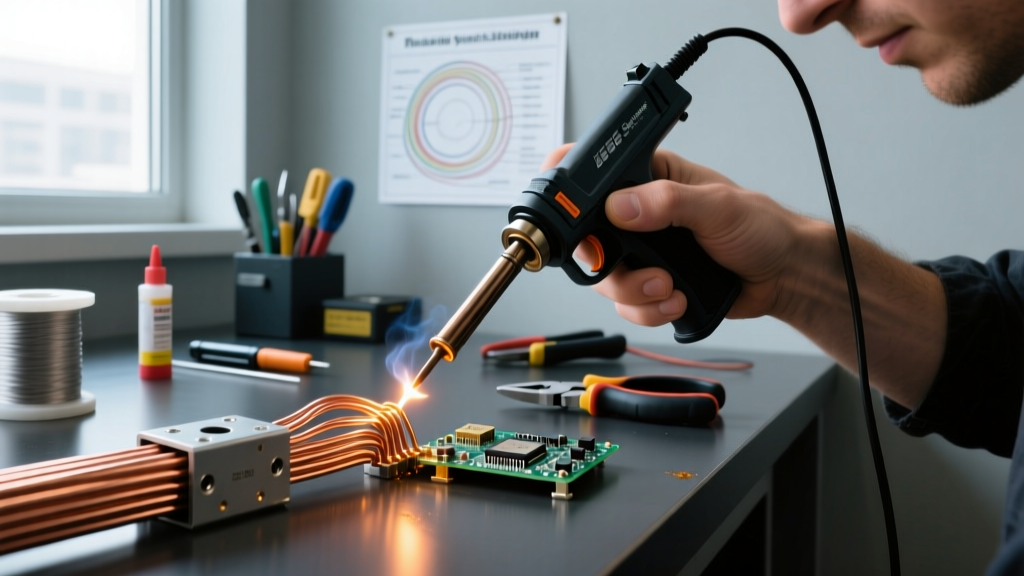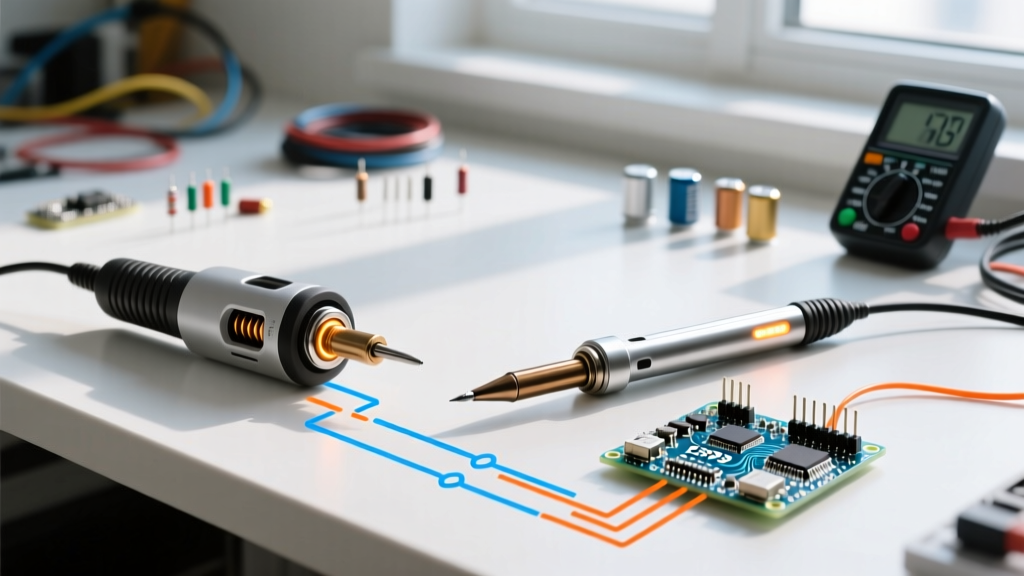

The Terminology Trap: Transformer Gun vs. Gun-Grip Iron
When hobbyists and technicians search for a small soldering gun in 2026, they are usually conflating two entirely different heating technologies. Understanding this distinction is the single most critical factor in preventing catastrophic damage to modern printed circuit boards (PCBs).
Historically, a true "soldering gun" relies on a step-down transformer. The secondary winding is a single loop of heavy-gauge copper wire that terminates at the soldering tip. When you pull the trigger, high current flows directly through the tip, heating it via electrical resistance in under two seconds. Conversely, modern "gun-grip" tools (often mistakenly called guns) are simply standard ceramic-heater soldering irons molded into a pistol-shaped ergonomic handle.
Below, we dissect the physics, failure modes, and practical applications of both form factors, comparing them against traditional pen-style digital stations.
2026 Head-to-Head Specification Matrix
| Feature | Weller 8200PK (Transformer Gun) | Hakko FX-601 (Gun-Grip Ceramic) | Weller WE1010NA (Pen Digital Station) |
|---|---|---|---|
| Heating Technology | Transformer / Tip Resistance | Ceramic Heating Element | Ceramic Heating Element |
| Max Wattage Output | 140W (Trigger fully depressed) | 67W | 70W |
| Thermal Recovery Time | Instantaneous (Current-driven) | ~8 seconds | ~4 seconds (PID controlled) |
| Magnetic Field Emission | High (60Hz AC Induction) | Negligible | Negligible |
| Average 2026 Retail Price | $42.00 - $48.00 | $85.00 - $92.00 | $115.00 - $125.00 |
| Ideal Use Case | Heavy gauge wire, chassis grounding | Large PCB pads, XT60 connectors | SMD, ICs, precision through-hole |
Weller 8200PK: The Classic Transformer Gun
The Weller 8200PK remains the undisputed king of the small soldering gun category. Weighing just over 1.5 lbs, it is remarkably compact for a transformer-based tool. Its dual-trigger design allows you to toggle between 100W and 140W. Because the tip itself is the heating element, there is zero thermal lag between the heater and the workpiece.
Real-World Performance & Failure Modes
While the 8200PK excels at melting heavy 10 AWG silicone wire or grounding tabs to metal chassis, it suffers from specific failure modes that technicians must manage:
- Trigger Switch Arcing: Because the tool switches high current on the primary side of the transformer, the internal microswitch is prone to carbon buildup. By year three of heavy use, you may experience intermittent heating requiring a switch replacement (Part #8200-SW).
- Tip Pitting and Oxidation: Transformer guns do not have closed-loop temperature control. If you leave the trigger in the 100W "low" position while not actively melting solder, the tip will overheat, burning off the iron plating and causing severe pitting.
- 60Hz Vibration Fatigue: The AC magnetic field causes the copper loop to vibrate at 60Hz. Over a two-hour wiring session, this subtle buzzing transfers to the user's wrist, causing micro-fatigue.
Hakko FX-601: The Ergonomic Gun-Grip Alternative
If you want the ergonomic benefits of a pistol grip without the destructive physics of a transformer, the Hakko FX-601 is the premier choice. It houses a 67W ceramic heater inside a gun-style body, utilizing a manual dial on the handle to adjust temperatures between 250°C and 450°C.
Dial Drift and Thermal Mass Limitations
The FX-601 is exceptional for soldering large RC battery connectors (like XT90s) or heavy copper pours on power supply PCBs. However, it is not a true "gun" in the electrical sense. Its primary vulnerability is dial drift. The internal potentiometer used for temperature adjustment is susceptible to wiper wear. After repeated adjustments with a gloved hand, the actual output temperature can drift by up to 15°C from the dial indicator. For precision SMD work, this lack of digital PID control makes it inferior to a standard pen-style station like the Weller WE1010NA.
The Danger Zone: Magnetic Induction and ESD
Using a true transformer-based small soldering gun on modern logic boards is a recipe for disaster. According to guidelines referenced by the ESD Association, ungrounded or magnetically active tools pose severe risks to sensitive components.
Expert Warning: The high-current AC loop of a transformer soldering gun generates a localized alternating magnetic field. If you bring an active 8200PK tip within 5mm of an unshielded Hall-effect sensor, an EEPROM chip, or a magnetic storage medium, the induced voltage spike can corrupt data or permanently destroy the silicon junction.
Furthermore, transformer guns lack a dedicated earth-ground path from the tip to the bench ground. If you are working on static-sensitive MOSFETs or CMOS logic, the stray capacitance can discharge through the component gate. For any PCB repair involving integrated circuits, you must abandon the soldering gun and use a grounded pen iron. For foundational through-hole techniques, resources like the SparkFun Soldering Tutorial emphasize the necessity of temperature-controlled, grounded tips to prevent thermal and electrical overstress.
When to Actually Use a Small Soldering Gun
Despite their limitations on PCBs, small soldering guns remain indispensable in specific 2026 DIY and repair scenarios:
- Automotive Wiring Harnesses: Splicing 14 AWG to 18 AWG wires in tight engine bay spaces where a pen iron lacks the thermal mass to overcome the copper's heat dissipation.
- Stained Glass and Jewelry: Tacking copper foil tape where rapid, localized heat application is required without a grounding mat.
- RC Vehicle Maintenance: Resoldering 12 AWG motor leads to ESC pads, where the 140W surge of the Weller 8200PK melts the solder joint in exactly 3.5 seconds, preventing heat from wicking up into the ESC's delicate internal MOSFETs.
Maintenance Protocol: Tinning and Storage
The most common reason users discard a perfectly good small soldering gun is improper tip maintenance. Transformer gun tips (like the Weller CT-100 series) are solid copper with a thin iron plating. They require a different shutdown protocol than ceramic irons:
- Never use a wet sponge. The extreme thermal shock of dropping from 700°F to 212°F in a millisecond will micro-fracture the iron plating, leading to rapid copper dissolution.
- Apply a massive solder blob before shutdown. While the tip is still hot, melt a large amount of 63/37 rosin-core solder over the entire working surface.
- Release the trigger and let it cool naturally. The solder blob will solidify, creating an airtight seal that prevents ambient oxygen from oxidizing the iron plating during storage.
- Clean on startup. When you next pull the trigger, wipe the molten solder blob on a dry brass wire sponge or a heavy kraft paper towel before applying fresh solder to your joint.
For more information on maintaining legacy and modern tools, always consult the manufacturer's safety and maintenance sheets, such as those provided on the Weller Tools official portal.
Frequently Asked Questions
Can I use a small soldering gun for plumbing?
No. While a 140W transformer gun can technically sweat small 1/4" copper refrigeration lines, it lacks the thermal mass for standard 1/2" or 3/4" household plumbing. You will experience cold joints, leading to catastrophic water leaks. Always use a dedicated propane or MAPP gas torch for plumbing applications.
Why does my soldering gun tip turn black instantly?
This is called "dry burning." If you pull the trigger without applying solder to the tip immediately, the bare iron plating reacts with oxygen in the air at 700°F, forming a layer of iron oxide. This black layer will not accept solder. You must carefully file it off with a fiberglass scratch pen and immediately re-tin it, though severe oxidation often requires a complete tip replacement.
Are butane soldering guns a viable alternative?
Butane tools (like the Dremel VersaTip) are technically torches, not guns. They are excellent for field work where AC power is unavailable, but they lack the precise thermal regulation required for electronics. They are best reserved for heat-shrink tubing, wire burning, and heavy outdoor grounding straps.