
The Core Physics: How Do Soldering Irons Work?
At its most fundamental level, a soldering iron is a localized thermal transfer device. It does not melt the solder directly; rather, it transfers kinetic heat energy into the copper pad and component lead. The solder alloy (such as SAC305, which melts at 217°C) acts as a thermodynamic bridge, absorbing heat from the iron's tip and the workpiece simultaneously to achieve wetting—the metallurgical bonding process where liquid solder dissolves a microscopic layer of the base metal to form an intermetallic compound (IMC).
However, the mechanism used to generate and regulate that heat varies wildly across the market. Understanding how different soldering irons work is critical for diagnosing cold joints, preventing thermal pad lift, and selecting the right tool for high-mass ground planes versus delicate 0201 SMD components.
The Thermal Bottleneck: Tip Architecture
Before examining the heating elements, you must understand the tip itself. A standard soldering tip is not solid iron. It is a composite structure:
- Copper Core: Provides high thermal mass and rapid heat conductivity (approx. 385 W/m·K).
- Iron Plating: A thin layer (typically 0.2mm to 0.8mm) that protects the soft copper from dissolving into the molten tin. Iron has poor thermal conductivity (approx. 80 W/m·K), creating a thermal bottleneck.
- Chromium/Nickel Underplate: Prevents the iron layer from oxidizing and flaking off.
The heating element's job is to push enough continuous wattage through this iron bottleneck to maintain the tip temperature when it contacts a cold, heat-sinking PCB ground plane. According to Hakko's technical documentation, thermal recovery time—the speed at which the heater replenishes lost joules—is the true metric of a station's capability, not just its peak wattage.
Comparing the 4 Main Heating Technologies
To determine the best tool for your workbench, we must break down the four dominant heating mechanisms used in modern electronics manufacturing.
1. Nichrome Wire Elements (The Legacy Standard)
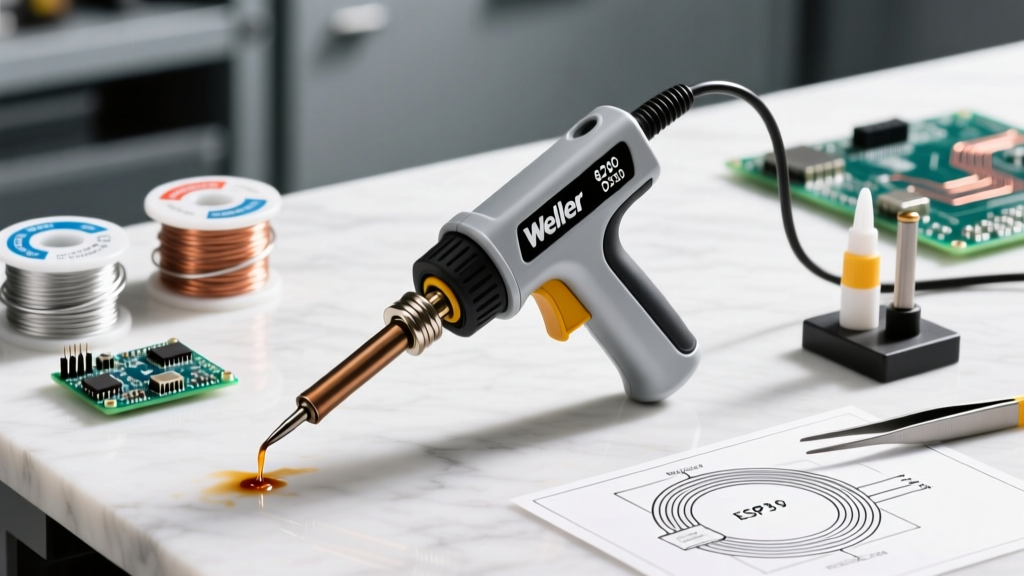
In entry-level irons (like the classic Weller WLC100), the heating element consists of a resistive nichrome wire wound around a ceramic or mica insulator. The tip slides over this insulator.
- How it works: Current passes through the wire, generating heat via electrical resistance. The heat must travel through the air gap and the insulator sleeve into the copper tip.
- The Flaw: The air gap and insulator create massive thermal resistance. These irons suffer from severe temperature droop when touching large ground planes, leading to cold joints and prolonged dwell times that damage flux.
- Best For: Occasional through-hole plumbing, heavy-gauge wire tinning, and hobbyists on a strict sub-$40 budget.
2. Ceramic Core Heaters (The Prosumer Workhorse)
Ceramic heaters, popularized by the Hakko FX-888D and Weller WE1010, represent the standard for reliable bench work. The heating element is printed directly onto a high-density ceramic rod that inserts directly into the hollow core of the soldering tip.
- How it works: The ceramic acts as both the electrical insulator and the thermal conductor. A thermocouple is embedded inside the ceramic rod to provide closed-loop PID temperature control. Because the heater is inside the tip, thermal transfer is highly efficient.
- The Flaw: Ceramic is brittle. Applying lateral pressure to the tip (e.g., using the iron as a pry bar) will snap the heating element instantly. Furthermore, the sensor is located in the base of the tip, not the working end, meaning there is still a slight thermal lag during heavy loads.
- Best For: General-purpose PCB assembly, rework, and daily bench use ($100–$150 price range).
3. Induction / Curie Point (The Production King)
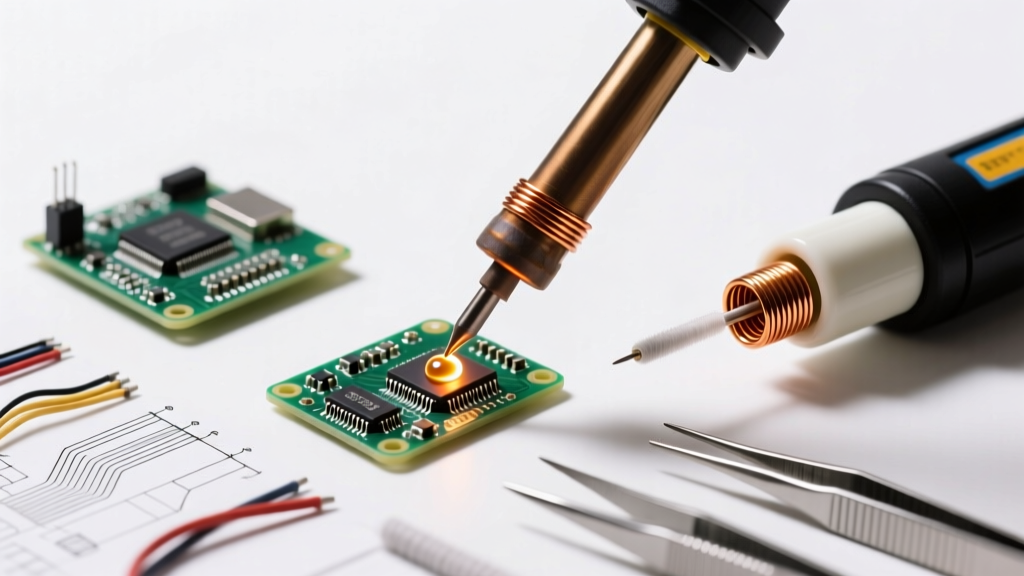
High-volume production environments rely on RF induction systems, most notably Metcal's SmartHeat technology. These systems do not use a traditional heating wire or thermocouple.
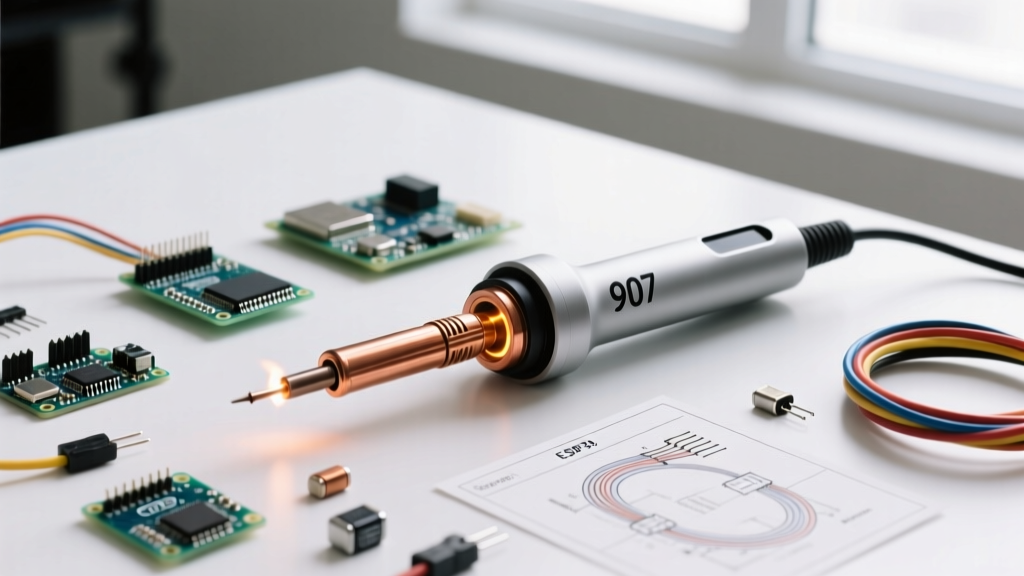
- How it works: A radio frequency generator (typically 13.56 MHz) sends an alternating current through a coil in the handpiece. This creates a magnetic field that induces eddy currents in the ferromagnetic outer layer of the soldering tip. The electrical resistance of the tip material converts these eddy currents into heat. As explained in Metcal's SmartHeat engineering overview, when the tip reaches its engineered Curie temperature (e.g., 350°C), it loses its magnetic properties. The eddy currents cease, and heating stops instantly. As the tip cools upon touching a PCB, magnetism returns, and heating resumes.
- The Flaw: You cannot adjust the temperature via a dial. To change temperatures, you must physically swap the tip to one with a different ferromagnetic alloy composition. The systems are also expensive ($500–$900).
- Best For: High-mass RF shielding, multi-layer server boards, and production lines where operator error must be eliminated.
4. Direct-Drive Smart Tips (The Modern Portable)
The most disruptive technology in the 2026 soldering landscape is the direct-drive smart tip, seen in the Pinecil V2, Miniware TS101, and Sequre S60.
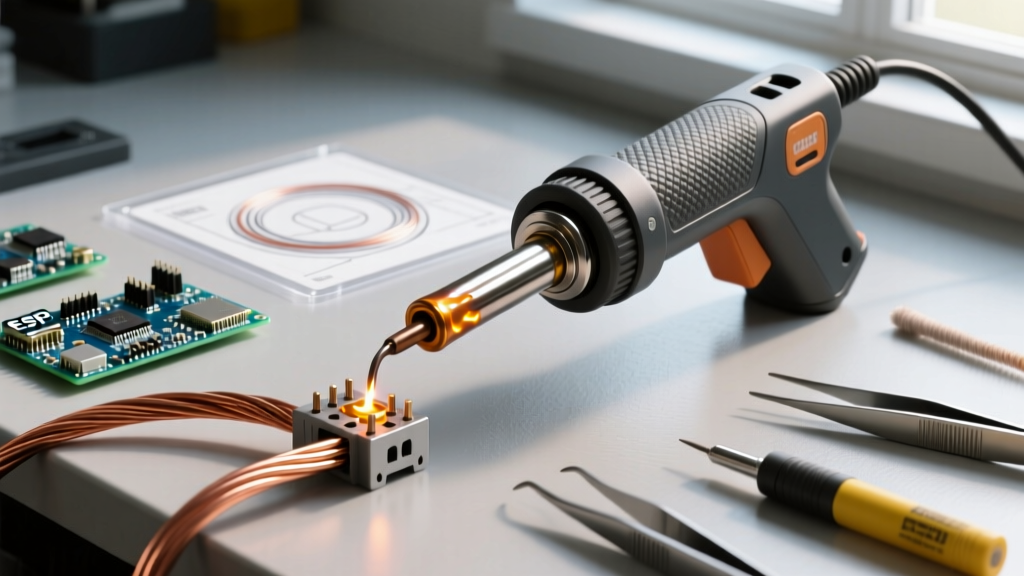
- How it works: The heating element and the thermocouple are manufactured directly inside the very front of the tip cartridge, mere millimeters from the working edge. A microcontroller in the handle runs a high-frequency PID algorithm, pulsing DC power (often via USB-C Power Delivery 3.1) directly into the tip. Because the sensor is at the tip's apex, thermal lag is virtually zero.
- The Flaw: The microcontroller and MOSFETs in the handle can overheat during sustained, high-wattage (100W+) sessions. They are also susceptible to USB-C PD negotiation failures if paired with low-quality power banks.
- Best For: Field repairs, drone builders, and space-constrained workbenches ($25–$60 for the iron, plus a PD power supply).
Technology Comparison Matrix
| Technology | Representative Model | Thermal Recovery (2oz Cu) | Sensor Location | Avg. Cost (2026) |
|---|---|---|---|---|
| Nichrome Wire | Weller WLC100 | Slow (15+ seconds) | N/A (Open Loop) | $35 - $50 |
| Ceramic Core | Hakko FX-888D | Moderate (3-5 seconds) | Base of Tip | $110 - $140 |
| RF Induction | Metcal MX-5200 | Instantaneous (Curie) | Entire Tip Surface | $600 - $850 |
| Smart Direct-Drive | Pinecil V2 (PD 3.1) | Fast (1-2 seconds) | Tip Apex | $26 + $20 PSU |
Critical Failure Modes by Technology
Understanding how these irons work also means understanding how they fail. Here are the edge cases you must watch for:
- Ceramic Sensor Drift: In ceramic heaters, repeated thermal cycling can cause the embedded thermocouple to degrade. The station will display 350°C, but the actual tip temperature may be 310°C, resulting in mysterious cold joints. Solution: Calibrate annually using a tip thermometer.
- Induction Tip Degradation: If an operator leaves an induction iron in a holder without a sleep sensor, the tip remains at Curie temperature continuously. Over weeks, this accelerates the oxidation of the iron plating, eventually causing the solder to ball up and refuse to wet. Solution: Always use auto-sleep stands.
- Smart Tip MOSFET Burnout: Pushing a 65W smart iron to its absolute limit on a massive ground plane can overheat the handle's internal switching MOSFET, leading to permanent handle failure. Solution: Use chisel tips with high thermal mass to do the heavy lifting, rather than relying solely on raw wattage.
Expert Insight: According to the soldering standards outlined in Pine64's open-source hardware documentation, the efficiency of a smart iron is heavily dependent on the gauge of the silicone wiring used internally. Upgrading to 18AWG high-strand-count silicone wire reduces voltage drop, allowing the PID controller to deliver peak current to the tip faster during thermal droop events.
Expert Verdict: Which Mechanism Should You Choose?
If you are asking "how do soldering irons work" to solve a specific bench problem, the answer dictates your purchase:
Choose Ceramic (Hakko FX-951 / FX-888D) if you want a reliable, set-and-forget bench station for daily through-hole and standard SMD work. The thermal mass and closed-loop control are more than sufficient for 90% of electronics repair.
Choose Smart Direct-Drive (Pinecil V2 / TS101) if you are a hobbyist, drone racer, or field technician. The ability to power a 65W+ iron from a laptop charger or LiPo battery, combined with apex-level thermal sensing, makes this the undisputed king of modern portable soldering.
Choose Induction (Metcal / JBC) if you are running a professional repair depot or manufacturing line. When dealing with 12-layer PCBs and heavy RF shields, the instantaneous Curie-point recovery of induction prevents pad delamination and ensures IPC-compliant intermetallic joints every single time.