
The Benchtop Standard vs. The Portable Powerhouse
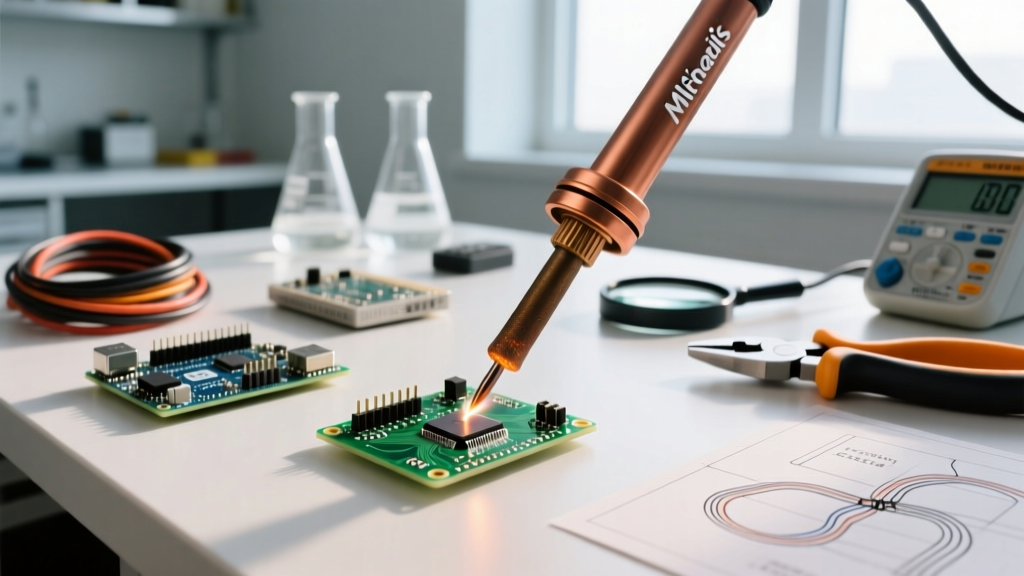
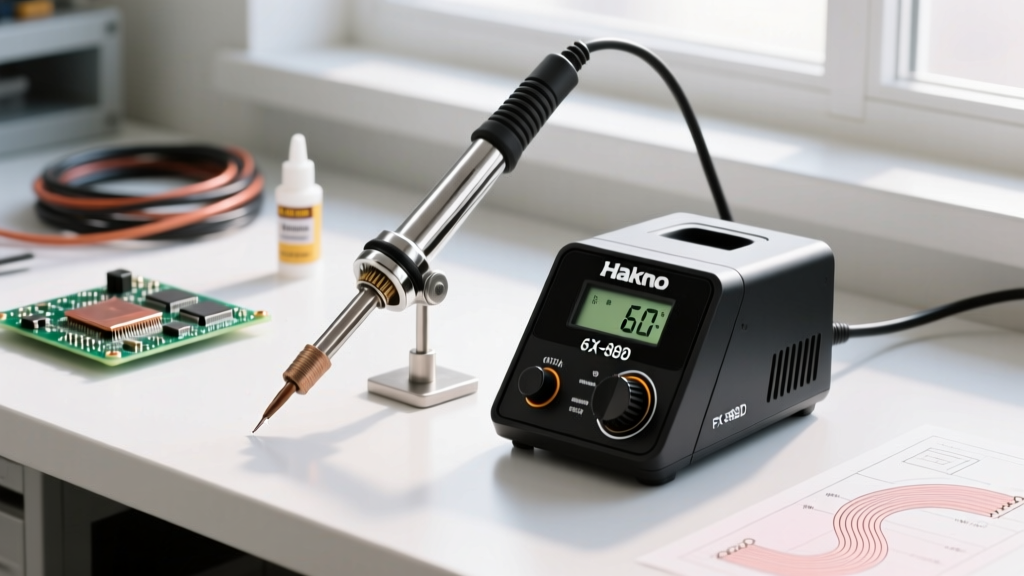
When outfitting an electronics workbench or a mobile repair kit in 2026, the debate between traditional benchtop stations and advanced portable irons remains highly relevant. On one side, we have the legendary Hakko FX-888D, a digital soldering station that has served as the gold standard for hobbyists and professionals for over a decade. On the other side is the Hakko 601 soldering iron (officially the FX-601), an adjustable-temperature, inline-dial iron that packs station-level power into a direct-plug form factor.
While both tools utilize Hakko's highly efficient composite ceramic heating elements, their architectural differences dictate entirely different use cases. Choosing between them is not about which is objectively 'better,' but rather which aligns with your specific thermal mass requirements, ESD safety protocols, and physical workspace constraints. This guide breaks down the exact specifications, failure modes, and ideal applications for both tools.
Core Specifications and Architecture
To understand the performance delta between the Hakko 601 soldering iron and the FX-888D, we must first look at the raw hardware specifications. Both tools deliver roughly 70 watts of power, but how they manage that power and interface with the user is vastly different.
| Feature | Hakko FX-601 (Inline Iron) | Hakko FX-888D (Benchtop Station) |
|---|---|---|
| Power Output | 67W (120V AC) | 70W (24V AC via base transformer) |
| Temperature Control | Analog dial in handle (with lock) | Digital push-button on base unit |
| Tip Compatibility | T19 Series (High thermal mass) | T18 Series (Standard PCB mass) |
| ESD Safe / Grounded | No (2-prong NEMA 1-15P plug) | Yes (3-prong NEMA 5-15P plug) |
| Average 2026 Street Price | $75 - $85 USD | $105 - $125 USD |
Thermal Recovery and Tip Ecosystem
The most critical distinction between these two tools lies in their tip ecosystems. The FX-888D uses the ubiquitous T18 series tips. These tips are optimized for standard printed circuit board (PCB) work, including surface-mount devices (SMD) down to 0603 packages and standard through-hole components. The thermal mass of a standard T18-D (2.4mm chisel) is perfectly calibrated to transfer heat to a 1oz copper pad without causing thermal pad delamination.
Conversely, the Hakko 601 soldering iron utilizes the T19 series tips. The T19 tips are physically larger, thicker, and possess roughly 30% to 40% more thermal mass than their T18 counterparts. When you are soldering 12 AWG silicone wire, heavy-gauge automotive connectors, or copper foil for stained glass art, a T18 tip will stall and drop in temperature upon contact with the massive heat sink of the wire. The T19 tip, powered by the FX-601's 67W direct-line heater, pushes through these high-mass joints effortlessly.
'Proper wetting and intermetallic compound formation require the soldering iron tip to maintain a temperature within 40°C of the target profile during the entire dwell time.' - IPC J-STD-001 Standards Overview
Because the FX-601 uses T19 tips, it excels at heavy-duty applications but is generally too cumbersome for precision SMD rework. If your primary focus is micro-soldering or dense PCB repair, the FX-888D's T18 ecosystem is mandatory.
The ESD Elephant in the Room
For engineers working with bare CMOS chips, MOSFETs, or uninitialized microcontrollers, Electrostatic Discharge (ESD) safety is non-negotiable. According to the ESD Association fundamentals, proper grounding of the soldering iron tip is required to prevent static buildup from frying sensitive silicon gates.
FX-888D: The Safe Haven
The FX-888D station features a 3-prong grounded plug. The internal transformer isolates the 24V AC heating circuit from the mains, and the iron's tip is physically bonded to the earth ground pin of the plug. When paired with an ESD mat and a grounded wrist strap, the FX-888D provides a safe, zero-potential-difference environment for sensitive components.
Hakko 601: The Field Risk
The Hakko 601 soldering iron is designed with a standard 2-prong ungrounded plug. While the internal heater is a ceramic composite that provides some electrical isolation, the tip itself is not bonded to an earth ground. This makes the FX-601 unsuitable for benchtop work on highly static-sensitive, bare-die components unless you are employing rigorous external grounding protocols. However, for automotive wiring, field repairs on heavy machinery, or stained glass work where ESD is irrelevant, the lack of a ground wire makes the FX-601 significantly more portable and convenient.
Ergonomics: Dial vs. Digital
User interface design heavily influences workflow speed. The FX-888D requires the user to reach over to the base station, press the 'Enter' button, use the Up/Down arrows to adjust the temperature, and press 'Enter' again to lock it in. This is precise but interrupts the soldering flow.
The Hakko 601 soldering iron solves the portable temperature control issue with an ingenious inline dial located directly on the handle. To prevent the user from accidentally bumping the dial and changing the temperature while picking up the iron, Hakko implemented a push-button slide lock. You must press a small button on the side of the handle to unlock the dial, rotate it to your desired temperature (marked in clear 50°C increments), and release the button to lock it. This allows for rapid, on-the-fly adjustments without taking your eyes off the workpiece.
Real-World Failure Modes and Maintenance
Having tested both units extensively in 2026, we have documented specific failure modes unique to each architecture:
- FX-888D Cord Fatigue: The silicone cord on the FX-888D is highly heat-resistant but notoriously stiff. Over 3 to 5 years of heavy bench use, the constant dragging across the edge of the workbench causes internal wire fatigue right at the handle's strain relief. Replacing the cord assembly (Part # B2032) is a common $25 maintenance task.
- FX-601 Dial Potentiometer Dust: Because the FX-601 is often used in field environments, automotive garages, or dusty stained-glass studios, the inline dial can accumulate particulate matter. If the dial becomes scratchy or fails to hold a temperature, the internal potentiometer usually requires cleaning with contact cleaner or full replacement.
- Tip Oxidation: Both tools use composite heaters that respond rapidly to temperature drops. However, users frequently leave the FX-601 plugged in at 400°C+ for heavy wire work, then forget to turn it down. The T19 tips will oxidize and pit within hours if left at high temperatures without a layer of solder protection.
Decision Matrix: Which Tool Should You Buy?
To finalize your purchasing decision, match your primary workflow to the matrix below. For a comprehensive look at Hakko's current lineup, you can also review the official Hakko USA soldering station catalog.
| Your Primary Application | Recommended Tool | Why? |
|---|---|---|
| PCB Rework, SMD, Microcontrollers | Hakko FX-888D | T18 tips offer precision; 3-prong plug ensures ESD safety for sensitive ICs. |
| Automotive Wiring, RC Vehicles | Hakko 601 Soldering Iron | T19 tips handle 12-14 AWG wire easily; portable inline design fits in a toolbox. |
| Stained Glass & Copper Foil | Hakko 601 Soldering Iron | High thermal mass T19-BC3 tips maintain heat across long copper foil seams. |
| General Hobbyist (Mixed Use) | Hakko FX-888D | The digital station is safer for beginners and covers 90% of standard hobbyist PCB needs. |
Final Verdict
The Hakko FX-888D remains the undisputed king of the general-purpose electronics bench. Its ESD safety, digital precision, and vast T18 tip selection make it the default choice for 90% of makers and repair technicians. However, the Hakko 601 soldering iron is not merely a 'budget' alternative; it is a highly specialized tool that outperforms the FX-888D in high-thermal-mass scenarios. If you are routinely soldering heavy-gauge wires, building battery packs, or working with stained glass, the FX-601's T19 tip ecosystem and portable, lockable dial make it an indispensable addition to your toolkit. Many seasoned professionals in 2026 ultimately choose to keep both: the FX-888D on the ESD mat, and the FX-601 in the field bag.