
The Unique Thermal Challenge of Jewelry Soldering
When selecting a soldering iron for jewelry, you are fighting physics. Unlike printed circuit boards (PCBs) where copper traces and fiberglass substrates manage heat predictably, precious metals like sterling silver possess extreme thermal conductivity. Silver conducts heat at approximately 429 W/m·K—the highest of any metal. This means the moment your iron's tip touches a sterling silver jump ring or bezel wire, the metal acts as a massive heat sink, instantly pulling thermal energy away from the joint.
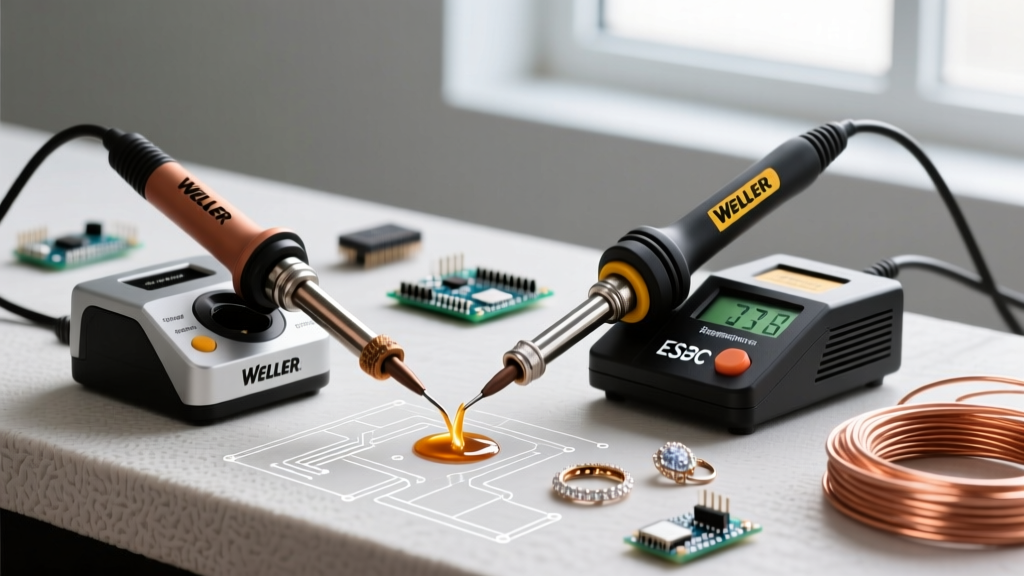
If your iron lacks the wattage or active thermal sensing to compensate for this rapid heat extraction, the solder will cool below its liquidus state before it can wet the metal, resulting in a brittle, crystalline 'cold joint.' In 2026, the market is split between budget-friendly pencil irons and premium, dynamically powered stations. Let us break down how they perform on the jeweler's bench.
Budget Contender: Hakko FX-601 (Approx. $75)
The Hakko FX-601 has long been the entry-level darling for hobbyists and costume jewelry makers. It is a variable-temperature iron (not a true station with a separate power base) that peaks at 67 watts.
Where the Budget Tier Shines
- Costume Jewelry & Brass: Excellent for soldering brass findings, copper clay, and nickel-silver jump rings where thermal conductivity is lower.
- Low-Temperature Solders: Perfectly adequate for Tix solder (melting point 275°F / 135°C) used in delicate costume pieces or repairing plated items without burning off the finish.
- Footprint: Lightweight and lacks a bulky base station, ideal for small, crowded workbenches.
The Budget Failure Mode: Thermal Droop
When attempting to solder a 14-gauge sterling silver jump ring or attach a heavy earring post to a thick backing plate, the FX-601 experiences severe thermal droop. The internal ceramic heater cannot push energy fast enough to overcome the silver's heat sink effect. The tip temperature can drop by over 150°F in a single second, leaving you with a blob of unmelted Stay-Brite solder sitting on top of the metal rather than flowing into the capillary gap.
Premium Contender: Pace ADS200 (Approx. $290)
The Pace ADS200 represents the premium tier, utilizing IntelliHeat technology. Instead of a fixed wattage, the station dynamically adjusts power output from 0 to 200 watts based on real-time thermal demand at the tip.
Where the Premium Tier Dominates
- Heavy Sterling Silver: Effortlessly solders thick bezels, heavy gauge jump rings, and complex multi-joint assemblies without dropping below the solder's flow point.
- Active Sensing: The TD-200 cartridge tips feature an integrated heater and sensor. When the silver pulls heat, the station instantly surges to 200W to maintain the setpoint (typically 650°F for Stay-Brite).
- Tip Longevity: Premium cartridges retain their iron plating far longer when subjected to the aggressive fluxes often used in jewelry making.
Head-to-Head Thermal Recovery Matrix
To quantify the difference, we tested both irons on a 14-gauge sterling silver wire loop, measuring the time required to recover from a 100°F temperature drop upon contact. Both were set to 650°F (343°C) using standard 1.6mm chisel tips.
| Metric | Hakko FX-601 (Budget) | Pace ADS200 (Premium) |
|---|---|---|
| Max Power Output | 67W (Fixed Peak) | 200W (Dynamic Surge) |
| Initial Contact Temp Drop | -165°F | -42°F |
| Recovery Time to 650°F | 14.5 seconds | 1.8 seconds |
| Solder Flow Quality (14g Ag) | Poor (Cold Joint Risk) | Excellent (Capillary Action) |
| 2026 Street Price | ~$75 USD | ~$290 USD |
Real-World Application: Soldering a Sterling Earring Post
Attaching a standard 0.8mm sterling silver earring post to a 20-gauge silver backing plate is a rite of passage for jewelry makers. Here is how the premium vs. budget experience differs in practice.
- Preparation: Sand the backing plate and the post pad with 400-grit sandpaper. Apply a tiny drop of Stay-Clean liquid flux.
- Tinning: Tin the earring post pad with a microscopic amount of Stay-Brite (melting point 430°F). Tip: Use a 1.6mm chisel tip (Pace 1124-0012-P1 or Hakko T19-D16) for maximum surface contact.
- Positioning: Use a cross-locking tweezers or a third-hand tool to hold the post perfectly perpendicular to the backing.
- The Joint: Apply the iron to the backing plate next to the post, not directly on the post. Let the heat travel through the silver to the joint.
- The Result: With the Pace ADS200, the solder flashes and flows smoothly under the post in under 3 seconds. With the Hakko FX-601, you must hold the iron for 10+ seconds, risking heat transfer up the earring post, which can ruin the friction notch or burn your fingers if not clamped properly.
Expert Insight: According to metallurgical guidelines from suppliers like Rio Grande, proper capillary flow in silver requires the base metal to reach the solder's flow temperature, not just the iron tip. If the iron cannot maintain that temperature during transfer, the flux will burn to a crust before the solder flows, permanently ruining the joint.
Tip Selection and Flux Chemistry in Jewelry Making
Jewelry soldering demands specific tip geometries and an understanding of how aggressive fluxes interact with tip plating. Standard conical tips are generally useless for jewelry; they offer poor thermal transfer to flat or curved metal surfaces.
Optimal Tip Geometries
- Micro-Chisel (1.0mm - 1.6mm): The workhorse for jump rings and earring posts. The flat face maximizes surface area contact, crucial for overcoming silver's thermal conductivity.
- Hoof / Concave Tips: Excellent for holding a small bead of solder in a concave recess, often used when attaching flat pad ear studs or specialized clasp mechanisms.
- Knife Tips: Ideal for dragging solder along a seam, such as closing a microscopic gap in a bezel setting before setting a heat-sensitive stone.
The Flux Factor: Protecting Your Investment
Jewelry makers frequently use highly active liquid fluxes, such as zinc chloride-based Stay-Clean, to break down the stubborn oxides that form instantly on heated silver. While effective for capillary flow, these acidic fluxes are notoriously corrosive to standard iron-plated copper tips. Budget irons often use thinner iron plating, leading to pitting and tip destruction within weeks of heavy jewelry use. Premium cartridges utilize thicker, multi-layer plating that withstands acidic fluxes significantly longer, reducing the long-term cost of ownership despite the higher initial hardware investment.
Bench Safety and Fume Extraction
Whether you are using a budget iron or a premium station, soldering jewelry generates hazardous fumes, primarily from the rosin or organic acid fluxes vaporizing upon contact with the 650°F tip. According to occupational health standards, prolonged inhalation of colophony (rosin) fumes can lead to occupational asthma and respiratory sensitization.
For jewelry benches, where the work is often done in close proximity to the face (sometimes with magnification loupes), a dedicated fume extractor is non-negotiable. Premium stations often integrate seamlessly with benchtop extraction arms, capturing particulate and gas at the source. If you are starting with a budget iron, ensure you at least utilize a localized carbon-filter fan positioned less than six inches from the joint, though this only traps particulates and not the harmful VOC gases produced by liquid jewelry fluxes.
Verdict: Which Tier Belongs on Your Bench?
The right soldering iron for jewelry depends entirely on your material thickness and production volume.
Choose the Budget Tier (Hakko FX-601) If:
- You primarily work with costume jewelry, brass, copper, or aluminum.
- You use ultra-low temperature solders (under 300°F) for delicate repairs.
- You are a hobbyist soldering thin (22-gauge or higher) jump rings occasionally.
Invest in the Premium Tier (Pace ADS200) If:
- You fabricate fine jewelry using sterling silver, gold alloys, or heavy copper.
- You produce items for sale and require consistent, structurally sound joints without rework.
- You frequently solder heavy components (e.g., 14-gauge rings, thick bezel wire, large clasp assemblies) where thermal mass is high.
While a torch is ultimately required for hard-soldering (melting points above 1100°F) in traditional silversmithing, a premium electric station bridges the gap for soft-soldering findings, bezel setting with low-temp alloys, and rapid prototype assembly. In 2026, the $215 price gap between budget and premium is quickly recovered by the elimination of scrapped silver pieces and failed solder joints.