
When repairing printed circuit boards (PCBs), the margin for error is measured in microns and milliseconds. Selecting the right soldering iron for circuit board repair is not merely about finding a tool that gets hot; it is about mastering thermal recovery, tip geometry, and electrostatic discharge (ESD) safety. Whether you are reworking a delicate 0402 surface-mount resistor or desoldering a 14-pin DIP chip on a copper-heavy ground plane, the wrong iron will result in cold joints, lifted pads, or catastrophic thermal shock to sensitive silicon.
In this comprehensive guide, we dissect the engineering realities of PCB soldering and review the top-tier irons and stations that dominate the workbenches of professional repair technicians today.
The Thermal Reality of PCB Repair: Why Wattage Lies
A common misconception among hobbyists is that higher wattage automatically equates to better soldering. In reality, thermal recovery and thermal mass are the true metrics of a circuit board repair soldering iron. Modern multilayer PCBs feature internal copper ground planes that act as massive heat sinks. When you apply a standard 40W iron to a via connected to a ground plane, the board instantly absorbs the heat. If the iron's sensor and heating element cannot recover that lost thermal energy within milliseconds, the solder will fail to reflow properly.
According to the IPC J-STD-001 requirements for soldered electrical assemblies, prolonged dwell times caused by poor thermal recovery lead to pad delamination and flux exhaustion. To compensate, amateurs often crank the temperature to 420°C or higher, which oxidizes the tip plating and boils the rosin core, resulting in brittle, grainy cold joints.
Top Soldering Irons for Circuit Board Repair Compared
Below is a data-driven comparison of the most reliable soldering stations and portable irons used in professional PCB diagnostics and rework environments.
| Model | Peak Wattage | Temp Stability | Tip Architecture | Best Application |
|---|---|---|---|---|
| Hakko FX-888D | 70W | ±5°C | T18 (Sleeve) | General Through-Hole & 0805 SMD |
| Pine64 Pinecil V2 | 65W (PD) | ±2°C | TS100 / T12 | Field Repair & Drone Diagnostics |
| Weller WE1010NA | 70W | ±3°C | ET (Sleeve) | Mid-Volume Production & Rework |
| JBC T245 System | 130W | ±1°C | C245 Cartridge | Heavy Ground Planes & QFN/BGA |
Hakko FX-888D: The Benchmark for General Rework
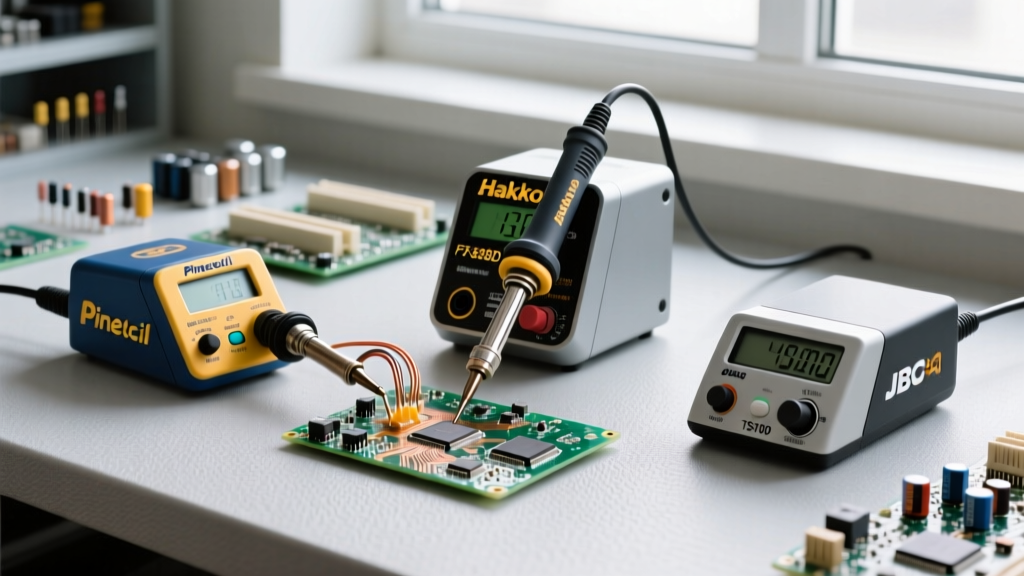
The Hakko FX-888D remains the undisputed workhorse of electronics repair labs worldwide. Priced around $110, it utilizes the T18 tip series, which features a ceramic heating element wrapped inside a copper sleeve. While this sleeve design introduces a slight thermal lag compared to integrated cartridges, the sheer variety of T18 tip geometries available makes it incredibly versatile. For standard through-hole capacitors, DIP ICs, and larger SMD components like 1206 resistors, the FX-888D provides reliable, ESD-safe performance. However, it struggles with heavy copper pours, requiring the user to employ pre-heating techniques to avoid thermal stalling.
Pinecil V2: The RISC-V Disruptor for Field Diagnostics
For mobile repair technicians and drone engineers, the Pine64 Pinecil V2 has revolutionized portable PCB repair. Powered by a RISC-V microcontroller and capable of drawing 65W via USB-C Power Delivery, this $26 iron heats to 300°C in under six seconds. It supports both TS100 and T12 tip ecosystems. The open-source IronOS firmware allows for precise PID tuning, meaning you can adjust the thermal aggressiveness based on whether you are soldering a fragile flexible printed circuit (FPC) or a rigid motherboard. Its primary limitation is the reliance on external PD power banks, which can be cumbersome in fixed lab environments.
JBC T245 System: Unmatched Thermal Recovery for Multilayer Boards
When working on 6-layer server motherboards or automotive ECUs with massive ground planes, the JBC T245 is the gold standard. The secret lies in its C245 cartridge system: the heating element and thermocouple are integrated directly into the very tip of the soldering iron. This eliminates the air gap found in sleeve-style tips, resulting in near-zero thermal lag. When the tip touches a cold via, the JBC station detects the micro-voltage drop and dumps 130W of peak power instantly. While the $500+ entry price and expensive proprietary cartridges are steep, the reduction in lifted pads and damaged vias pays for the system in high-stakes repair environments.
Tip Geometry Matrix: Matching the Profile to the Pad
Choosing the correct soldering iron for circuit board repair is only half the battle; selecting the correct tip geometry dictates your success rate. Using the wrong tip profile leads to tombstoning, solder bridges, and insufficient wetting.
- Micro-Pencil (0.2mm - 0.5mm): Essential for 0402 and 0201 SMD components, as well as fine-pitch FPC connectors. Requires excellent flux application to prevent solder from wicking up the tip.
- Chisel (1.5mm - 3.0mm): The standard for through-hole components and drag-soldering SOIC packages. The flat surface maximizes surface area contact for rapid heat transfer.
- Knife / Blade: Highly specialized for drag soldering QFP (Quad Flat Package) microcontrollers and cleaning up solder bridges on 0.5mm pitch ICs.
- Bevel / Hoof: Ideal for tinning heavy gauge wires to PCB pads and reworking D2PAK surface-mount power transistors that require high thermal mass.
ESD Safety and Ground Plane Survival Tactics
Electrostatic Discharge (ESD) can silently destroy the gate oxide of a MOSFET or the logic gates of a microcontroller before the iron even touches the pad. The NASA Workmanship Standards dictate that all soldering equipment used on sensitive avionics and commercial PCBs must feature a verified earth ground path. When evaluating a soldering station, ensure the handle and tip are grounded to the station's chassis with a resistance typically between 1 and 10 ohms.
Pro-Tip for Ground Planes: Never increase your iron's temperature past 380°C to compensate for a heat-sinking ground plane. Instead, use a broad chisel tip to maximize surface contact, apply a generous amount of high-activity flux, and utilize a PCB preheater to bring the ambient board temperature to 120°C before applying the iron.
Furthermore, always use a grounded wrist strap connected in series with a 1-megohm safety resistor when handling bare CMOS or RF ICs. The combination of an ESD-safe iron and proper operator grounding prevents catastrophic latent failures that might pass initial testing but fail in the field.
Final Verdict: Choosing Your PCB Repair Weapon
The ideal soldering iron for circuit board repair depends entirely on your specific workload. If you are a hobbyist or run a general repair shop handling consumer electronics, the Hakko FX-888D offers the best balance of cost, reliability, and tip variety. For field technicians who need to diagnose and repair drones or automotive sensors on-site, the Pinecil V2 is an unbeatable, ultra-portable smart iron.
However, if your daily work involves high-layer-count motherboards, heavy copper power supplies, or complex BGA/QFN rework, investing in the JBC T245 cartridge system is non-negotiable. Its integrated heater technology eliminates the thermal lag that causes pad delamination, ultimately saving you time, expensive replacement boards, and the frustration of failed rework attempts. Master your thermal dynamics, respect your flux, and your PCB repairs will consistently meet professional IPC standards.