
The Hardware Store Dilemma: Convenience vs. Capability
When a weekend electronics project stalls because of a broken wire or a snapped header pin, the immediate instinct is to visit a local retailer. For many DIYers, searching for a soldering iron Ace Hardware inventory yields immediate, tangible results. You can walk in, pick up a blister-packed iron, and be back at your workbench in twenty minutes. But in 2026, the gap between legacy hardware store tools and modern premium soldering stations has never been wider.
This analysis breaks down exactly what you get when you buy a budget soldering iron from a big-box or local hardware store versus investing in a premium, closed-loop soldering station. We will examine thermal recovery, tip metallurgy, and the hidden costs of 'cheap' tools to help you decide if local convenience is worth the performance trade-off.
What Actually Sits on the Ace Hardware Shelves?
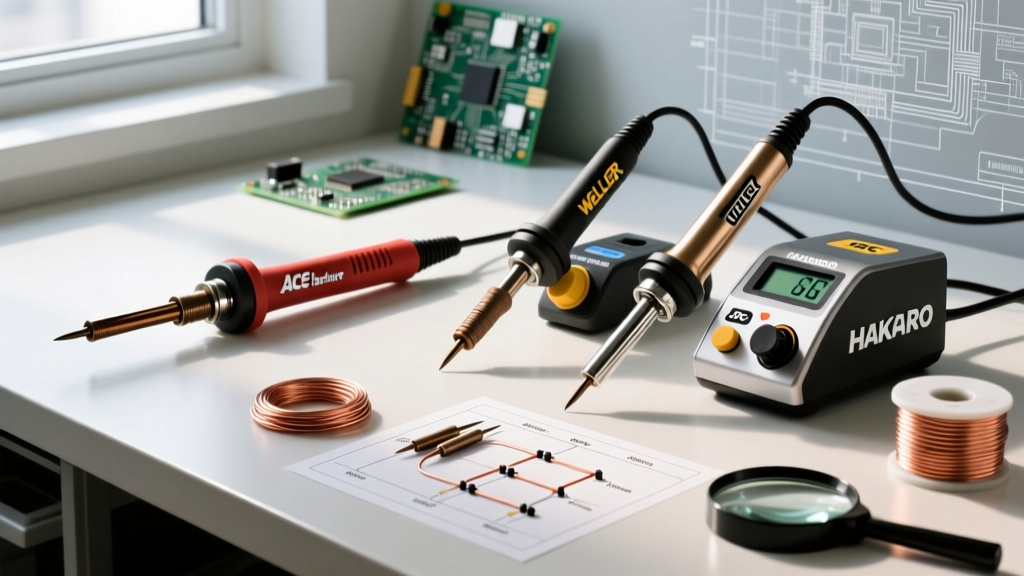
If you walk into a typical Ace Hardware today, the soldering aisle is usually dominated by consumer-grade, fixed-wattage irons. The most common brands include the Weller Consumer line (such as the Weller SP40NK or SP80NK), Stanley, and occasionally Craftsman or store-brand generics. These kits typically range from $20 to $45 and include a basic stand, a generic sponge, and a few pre-tinned replacement tips.
The Limitations of Fixed-Wattage Technology
Hardware store irons operate on the principle of thermal equilibrium. A 40-watt iron has a simple resistive heating element that runs at full capacity until the tip reaches a rough equilibrium temperature (usually around 400°C to 450°C at the core, dropping to roughly 350°C at the surface). There is no thermocouple, no microcontroller, and no feedback loop. When you touch the tip to a component, the iron cannot detect the temperature drop, nor can it actively compensate for it.
Budget vs. Premium: Head-to-Head Comparison Matrix
To understand the performance delta, we must compare a standard hardware store staple against a recognized premium benchmark. Below is a technical comparison between the typical Weller SP40NK (frequently found at Ace Hardware) and the Hakko FX-888D (a standard premium digital station).
| Feature | Ace Hardware Staple (Weller SP40NK) | Premium Standard (Hakko FX-888D) |
|---|---|---|
| Retail Price (Approx.) | $32.00 | $125.00 |
| Wattage Output | 40W Fixed | 70W (Dynamic PID Control) |
| Temperature Control | None (Open-Loop Equilibrium) | Digital Closed-Loop (100°C - 480°C) |
| Thermal Recovery Time | > 45 seconds | < 6 seconds |
| Tip Construction | Hollow sleeve over ceramic heater | Solid core with integrated heater |
| Lead-Free Solder Capability | Poor (Struggles with high melt points) | Excellent |
The Physics of Cold Solder Joints
The primary failure mode of budget hardware store irons is the creation of cold solder joints. According to the IPC-A-610 Acceptability of Electronic Assemblies standards, a proper solder joint requires the formation of a specific intermetallic layer (typically the Cu6Sn5 phase) between the copper pad and the tin alloy. This requires precise thermal energy transfer over a specific timeframe.
When you apply a 40W fixed-wattage iron to a multilayer PCB with a heavy ground plane, the copper acts as a massive heat sink. The ground plane rapidly absorbs the thermal energy from the tip. Because the hardware store iron lacks a PID (Proportional-Integral-Derivative) controller to detect the temperature drop and dump immediate wattage into the element, the tip temperature plummets. The flux burns away before the solder can properly wet the pad, resulting in a dull, grainy, and mechanically weak joint.
Expert Insight: Thermal mass is the enemy of fixed-wattage irons. If you are soldering 10 AWG silicone wire or a thick brass connector, a 40W iron will simply fail to maintain the 380°C required to melt 63/37 SnPb solder, let alone SAC305 lead-free alloys.
Metallurgy and Tip Degradation
Beyond thermal performance, the physical construction of the tips sold in hardware stores dictates their lifespan. Premium tips feature a thick copper core for rapid heat transfer, plated with a precise layer of iron to prevent the molten solder from leaching the copper away.
- Air Gaps: Budget irons use a hollow tip sleeve that slides over a separate ceramic heating element. This creates a microscopic air gap. Air is a thermal insulator, meaning the heat must radiate across the gap rather than conducting directly, severely bottlenecking thermal transfer.
- Plating Thickness: Consumer-grade tips often have thinner iron plating. When subjected to the aggressive fluxes used in modern electronics, or when users improperly clean them with cold, damp sponges (which causes thermal shock), the plating micro-fractures.
- Copper Leaching: Once the plating cracks, the molten solder dissolves the underlying copper core. The tip develops deep pits and loses its ability to hold a solder bead, rendering it useless after just a few hours of heavy use.
The 2026 USB-C Disruption: A Third Option
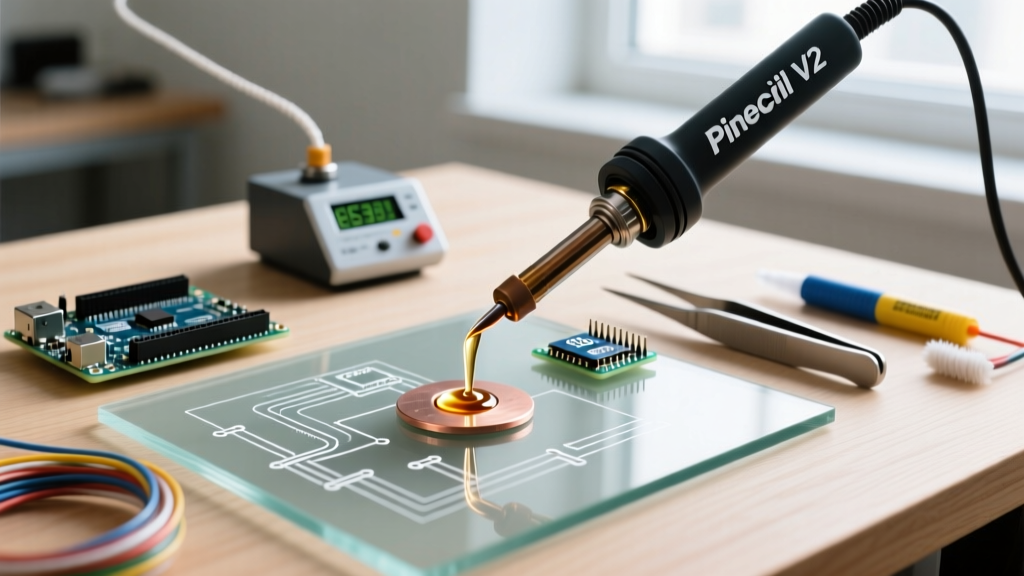
If you are standing in Ace Hardware debating a $35 purchase, you must be aware of the current market disruption: USB-C PD (Power Delivery) smart irons. In 2026, tools like the Pinecil V2 or the FNIRSI HS-02 cost between $25 and $40. Powered by a standard 65W laptop charger, these pocket-sized irons feature 32-bit ARM processors, rapid PID thermal recovery, and digital displays.
A $30 USB-C smart iron will outperform a $40 traditional hardware store iron in every measurable metric. The catch? Hardware stores have been slow to stock these modern smart irons. You generally must order them online. Therefore, the hardware store option is strictly a 'convenience tax'—you are paying for the ability to take it home today, at the cost of long-term performance.
When to Buy from Ace Hardware (And When to Look Elsewhere)
Despite the technical shortcomings, there are specific scenarios where picking up a soldering iron from Ace Hardware is the correct strategic move.
Buy Local When:
- Emergency Field Repairs: You need to fix a broken wire on a lawnmower, a car tail light, or a child's toy immediately, and cannot wait for shipping.
- Heavy-Duty Wire Splicing: You are soldering thick 8 AWG to 12 AWG wires for automotive or solar applications where precise PCB-level temperature control is unnecessary.
- Stained Glass or Crafting: Hardware stores often carry higher-wattage (100W+) irons designed for stained glass foil work, which do not require microchip-level precision.
Invest in Premium (Online/Specialty) When:
- PCB Prototyping: Soldering 0805 SMD components, QFP microcontrollers, or dense Arduino/ESP32 headers.
- Lead-Free Soldering: Working with SAC305 or other high-temperature, RoHS-compliant alloys that demand rapid thermal recovery.
- Professional Output: If your work must pass NASA Workmanship Standards or strict IPC visual inspection criteria, a fixed-wattage iron will not provide the consistency required.
Final Verdict
A soldering iron from Ace Hardware is a tool of convenience, not precision. The Weller SP series and similar consumer irons are perfectly adequate for basic wire tinning, heavy-gauge splicing, and emergency household repairs. However, for anyone serious about electronics, microcontrollers, or PCB repair, the lack of closed-loop temperature control and poor thermal recovery makes them a liability. In the modern era of $30 USB-C smart irons and $120 digital stations, the traditional hardware store soldering iron is rapidly becoming a legacy relic best left on the shelf for plumbing and crafting, rather than electronics.