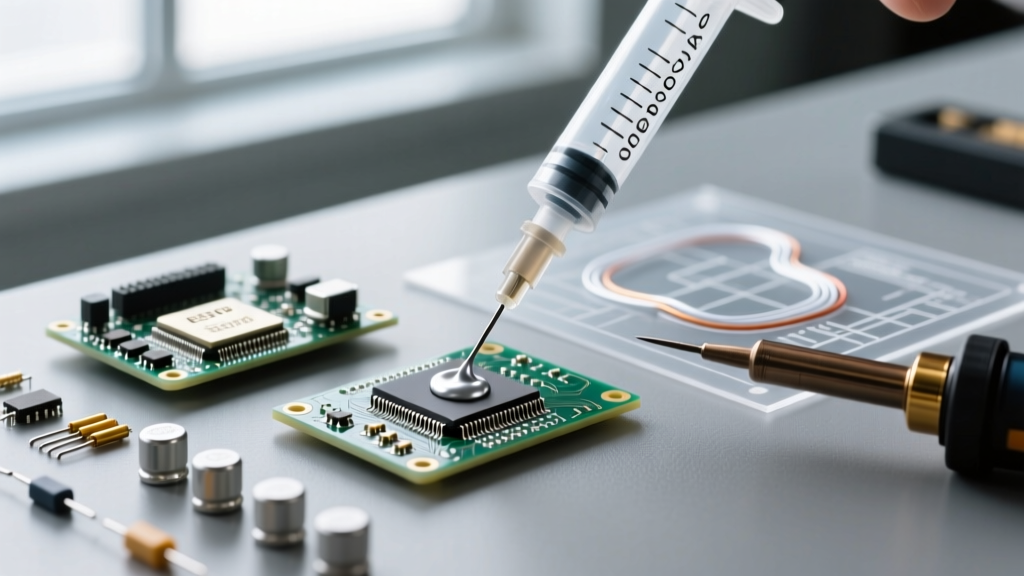

The Core Question: What Is Soldering Paste For?
When transitioning from basic through-hole wiring to modern surface mount technology (SMT), hobbyists and professional engineers inevitably ask: what is soldering paste for? Unlike solid solder wire, which requires a soldering iron to simultaneously melt the alloy and activate a rosin core, solder paste is a precisely engineered, thixotropic mixture of microscopic solder alloy powder and liquid flux.
Solder paste is specifically formulated for batch reflow processes and complex surface mount packages where a traditional iron cannot reach. It is the absolute standard for attaching Ball Grid Arrays (BGAs), Quad Flat No-leads (QFNs), and micro-passives (like 0402 and 0201 components) to printed circuit boards (PCBs). The paste holds components in place via its tacky flux medium before a reflow oven or hot air station melts the powder into a permanent metallurgical bond.
Solder Paste vs. Solder Wire: The Application Divide
Understanding what soldering paste is for requires contrasting it with traditional wire. While wire is ideal for point-to-point wiring, heavy-gauge through-hole components, and manual touch-ups, paste dominates high-density SMT applications.
| Feature | Solder Paste | Solder Wire |
|---|---|---|
| Primary Application | SMD, BGA, QFN, Stencil Printing, Syringe Dispensing | Through-hole, Point-to-point, Manual Touch-up |
| Flux Delivery | Pre-mixed uniformly throughout the alloy powder | Extruded from a central rosin/core channel |
| Heating Method | Reflow oven, hot air, infrared, hotplate | Direct contact via soldering iron tip |
| Minimum Pitch | 0.2mm (using Type 5/6 powder and stencils) | 0.5mm (highly dependent on operator skill) |
| Cost Profile | High upfront ($30-$50 per 35g syringe), low cost-per-joint | Low upfront ($10-$20 per spool), high labor cost |
Decoding Solder Paste Specifications
To select the right paste, you must look beyond the basic alloy and understand the IPC J-STD-005 classifications for powder mesh size and the chemical nature of the flux medium. According to industry standards from leading manufacturers like Kester, the powder size dictates the minimum component pitch you can reliably print.
Powder Mesh Sizes Explained (Type 3 to Type 6)
- Type 3 (25–45 µm): Best for standard SMT components (1206, 0805) and pitch sizes down to 0.5mm. Rarely used in modern high-density 2026 workflows.
- Type 4 (20–38 µm): The current industry workhorse. Ideal for 0.4mm pitch QFPs, 0402 passives, and general BGA rework. If you are buying one syringe for general prototyping, buy Type 4.
- Type 5 (10–25 µm): Required for 0.3mm pitch micro-BGAs, WLCSP (Wafer-Level Chip Scale Packages), and 0201 components.
- Type 6 (5–15 µm): Reserved for ultra-fine pitch semiconductor packaging and advanced RF modules. Highly susceptible to oxidation and expensive.
Alloy Selection: SAC305 vs. Sn63/Pb37 vs. Low-Temp
The alloy dictates your reflow profile and joint reliability.
- SAC305 (Sn96.5/Ag3.0/Cu0.5): The lead-free standard. Melts at 217°C–220°C. Excellent for commercial and industrial production. A 35g syringe of Chip Quik SMD431AX10 (SAC305, Type 4) typically costs around $42.
- Sn63/Pb37 (Eutectic): Melts sharply at 183°C. Preferred for hobbyists, aerospace (where lead-free is banned by NASA workmanship standards), and rework where thermal budget is tight.
- SnBiAg (Low Temperature): Melts around 138°C. Used for step-soldering or heat-sensitive components (like certain RF modules and flexible PCBs), but suffers from brittle joints under mechanical stress.
Application-Specific Recommendations for Modern Workflows
Knowing what soldering paste is for is only half the battle; knowing which paste to use for your specific scenario is where true expertise lies.
Scenario A: Hobbyist Prototyping & Hand Assembly
For manual syringe dispensing onto 0805 passives and SOIC-8 chips, use a No-Clean, Type 4, Sn63/Pb37 paste. The no-clean flux leaves a benign, non-conductive residue that you can leave on the board without washing. The lower 183°C melting point makes it forgiving when using a basic hot air gun (like the Quick 861DW set to 320°C) without scorching the PCB laminate.
Scenario B: Production Stenciling & Reflow Ovens
If you are applying paste via a laser-cut stainless steel stencil and running the board through a conveyor reflow oven, use a SAC305 Type 4 paste with a high-tack, no-clean flux vehicle (such as Indium NC191). The high tack is necessary to prevent components from shifting when the board is moved from the pick-and-place machine to the oven.
Scenario C: BGA Rework and Reballing
For BGA reballing, you need a Water-Soluble or High-Activity No-Clean Type 5 paste. The finer powder ensures the spheres coalesce perfectly under the BGA footprint, while the aggressive flux is required to break through the heavy oxidation on older BGA pads. Water-soluble variants must be washed with heated deionized water post-reflow to prevent electrochemical migration.
Expert Insight: Never use solder paste for large ground plane vias or heavy power connectors. The volume of paste required to fill a via would result in massive voiding and thermal cracking. Use traditional high-flux rosin-core wire and a high-wattage iron (e.g., 80W+) for heavy thermal mass joints.
Critical Failure Modes & Troubleshooting
When operators misunderstand what soldering paste is for and treat it like liquid solder, they encounter distinct failure modes.
1. Tombstoning (Drawbridging)
The Defect: A small passive component (like a 0603 resistor) stands up on one end like a tombstone.
The Cause: Asymmetrical heating during the reflow ramp. If one pad reaches the solder's liquidus temperature before the other, the wetting force on the molten side pulls the component upright.
The Fix: Slow down the preheat ramp rate in your reflow profile (aim for 1°C to 2°C per second) to ensure the entire board reaches thermal equilibrium before the paste melts.
2. Solder Balling and Splattering
The Defect: Tiny spheres of solder scatter around the main pad, risking short circuits.
The Cause: Moisture trapped inside the paste flashing into steam during rapid heating, or flux solvents boiling too violently.
The Fix: Ensure your paste has not absorbed ambient humidity. Always allow refrigerated paste to acclimate to room temperature before opening the jar.
3. Head-in-Pillow (HiP) Defect
The Defect: Common in BGAs, where the solder sphere on the chip melts but fails to merge with the paste on the PCB pad, resting on top like a head on a pillow.
The Cause: Insufficient flux activity to break through pad oxidation, or PCB warpage during the high-heat reflow zone.
The Fix: Switch to a paste with a higher-activity flux vehicle or increase the peak reflow temperature by 5°C to improve coalescence.
Storage, Shelf Life, and The Tack Life Trap
Solder paste is a perishable chemical product. Proper storage is non-negotiable.
- Shelf Life: Typically 6 months when stored in a dedicated refrigerator between 0°C and 10°C (32°F–50°F). Never freeze it, as freezing can separate the flux vehicle from the alloy powder.
- Tack Life: Once printed onto a PCB, the paste remains tacky enough to hold components for 8 to 24 hours (depending on ambient humidity). After this window, the flux solvents evaporate, and components will shift.
- The Acclimation Rule: When removing a syringe or jar from the fridge, do not open it immediately. Let it sit at room temperature for 2 to 4 hours. Opening cold paste in a warm room causes condensation to form inside the container, introducing water that will cause catastrophic solder balling during reflow.
Summary
So, what is soldering paste for? It is the indispensable medium for modern, high-density electronics manufacturing. By matching the correct powder type (Type 4 for general SMD, Type 5 for micro-BGA), selecting the appropriate alloy (SAC305 for commercial, Sn63/Pb37 for aerospace/hobby), and strictly managing your thermal profiles and cold-chain storage, you can achieve professional, void-free solder joints that rival high-end contract manufacturing facilities.