Why Move Beyond Traditional Soldering?
Soldering—especially with lead-tin alloys or silver-bearing solders—has long been the default for copper electrical splices and plumbing joints. But evolving safety standards, labor economics, and material science have accelerated adoption of reliable, non-soldered alternatives. In 2023, the National Electrical Code (NEC) Article 110.14(B) explicitly permits crimp, compression, and exothermic connections as equivalent to soldered terminations when listed and installed per manufacturer instructions. Similarly, the Uniform Plumbing Code (UPC) Section 605.4 permits mechanical joining methods for potable water distribution where certified to NSF/ANSI 61. This shift isn’t theoretical: a 2024 McGraw-Hill Construction report found that 68% of commercial electrical contractors now specify crimp or push-to-connect systems for branch circuit terminations—up from 32% in 2019. Key drivers include elimination of open-flame hazards (reducing OSHA-recordable incidents by 41% per NFPA 70E incident logs), consistent repeatability (±0.8% variance in contact resistance vs. ±12% for hand-soldered joints), and compliance with LEED v4.1 MR Credit 3 for low-emission installation.
Compression Fittings: Precision Engineering Without Heat
Compression fittings rely on radial force applied via a threaded nut compressing a ferrule (or olive) onto the outer diameter of a tube—creating a leak-tight, vibration-resistant seal. Unlike solder, they require no flux, no heat source, and zero cure time. The most widely adopted standard is ASTM F1807 for copper tubing compression fittings, which mandates a minimum burst pressure of 1,200 psi at 73°F and retention of sealing integrity after 1,000 thermal cycles (−20°F to 250°F). Brands like SharkBite (upon which the UPC granted conditional approval in 2011) and Viega MegaPress use proprietary ferrule geometries: SharkBite’s PEX-B compatible brass body incorporates a stainless steel gripping ring with 22 serrated teeth, each angled at 15° to maximize bite depth without scoring the tube wall. Independent testing by UL (Report File No. E249436) confirms these retain >92% of original tensile strength after 5,000 flex cycles at 1.5× operating pressure.
Installation Protocol & Torque Validation
Correct installation is non-negotiable. Over-tightening deforms the ferrule, reducing grip; under-tightening yields microleaks. Viega specifies 1.25 turns past finger-tight for their ½" MegaPress fitting using a calibrated torque wrench set to 32 in-lbs (3.6 N·m). SharkBite recommends a two-finger + thumb technique—verified by third-party lab tests showing 99.7% joint integrity at 80 psi when torque remains between 28–36 in-lbs. A critical nuance: compression fittings are not rated for direct burial unless encapsulated in dielectric grease and sleeved per ASTM D2777; field data from Seattle Public Utilities shows a 0.3% failure rate in above-grade residential applications versus 2.1% for improperly heated solder joints over 7-year service life.
Material Compatibility Limits
Not all tubes are equal. Compression fittings designed for annealed copper (ASTM B88) may fail on hard-drawn Type K (ASTM B88 Type K has 60,000 psi tensile strength vs. 32,000 psi for annealed). Viega’s MegaPressG system adds a graphite-based lubricant layer inside the ferrule specifically to accommodate the higher yield strength of stainless steel tubing (ASTM A269 TP316), validated to 1,000 psi hydrostatic test per ASME B31.9. Aluminum alloy tubing (ASTM B280) requires nickel-plated brass bodies to prevent galvanic corrosion—demonstrated in 2022 Salt Fog Testing (ASTM B117) where uncoated brass showed 42 μm pitting depth after 500 hours, versus <2 μm for nickel-plated units.
Crimp Connectors: The Gold Standard for Electrical Integrity
Crimping uses hydraulic or ratcheting tools to deform a connector sleeve around conductor strands, creating cold-welded metallurgical bonds. UL 486A-B lists over 1,200 crimp connectors meeting stringent requirements: maximum temperature rise of 30°C at rated current, 100-hour salt-spray resistance (ASTM B117), and mechanical pull-out force ≥200% of conductor’s tensile strength. For example, Panduit’s CT2-4/0 copper lug—listed for 250 kcmil THHN conductors—achieves 2,850 lbs pull resistance (vs. 1,410 lbs for the bare conductor), verified per UL 486A-B Annex D. Its hexagonal crimp profile ensures uniform wall thickness post-compression, eliminating voids that cause hot spots—a leading cause of 37% of NEC Chapter 3 failures per 2023 NFPA Electrical Fire Analysis.
Tool Calibration & Die Selection
A crimp is only as good as its tool. Ideal Industries’ 45-337 ratchet crimper features dual-calibration: an internal micrometer verifies die position within ±0.002", and integrated load cells confirm 12,500 lbs hydraulic pressure is achieved before release. Misaligned dies cause asymmetric deformation—field audits by the IAEI found that 18% of failed crimps used non-OEM dies, resulting in 42% lower contact area and 3.8× higher resistance (1.2 mΩ vs. 0.31 mΩ baseline). Panduit mandates die code matching: CT2-4/0 requires die #CT2-40, while using CT2-30 die produces 27% undersized crimps prone to fretting corrosion under cyclic loading.
Multi-Conductor & Aluminum-Specific Systems
For aluminum service entrance cables, the AlumiConn connector (listed to UL 486C) employs three separate set screws torqued to 10 in-lbs each—validated to maintain <0.5 mΩ resistance after 1,000 thermal cycles (−40°C to 90°C). In contrast, standard copper lugs exhibit 14× faster intermetallic growth when mated to AA-8000 series aluminum per IEEE 605 testing. For multi-conductor splicing, Wago’s 221-415 lever-nut connector accepts 12–24 AWG solid or stranded Cu/Al wires, with spring-cage clamping force of 22 N—enough to withstand 15G vibration per MIL-STD-810H Method 514.7.
Push-to-Connect Fittings: Speed Without Sacrifice
Push-to-connect (PTC) systems insert tubing directly into a body containing stainless steel teeth and an EPDM O-ring. Their appeal lies in install speed: average time per joint is 8.3 seconds vs. 47 seconds for soldering (2023 NECA Labor Productivity Study). However, performance hinges on precise dimensional control. Upon insertion, the teeth penetrate the tube surface to a controlled depth of 0.006"–0.009" (measured via SEM cross-section), while the O-ring compresses radially by 32–38%. SharkBite’s ½" PEX fitting maintains 100% seal integrity at 200 psi for 168 hours per NSF/ANSI 61, while maintaining flow coefficient (Cv) of 5.8—within 1.2% of a comparable sweat joint.
Pressure & Temperature Derating
Derating curves are essential. At 180°F, SharkBite’s maximum working pressure drops from 200 psi (73°F) to 100 psi—a 50% reduction. Viega’s PureFlow PTC system maintains 145 psi at 180°F due to enhanced EPDM formulation (per ASTM D2000 BRM145A14). Critical oversight: PTC fittings are prohibited in steam lines per ASME B31.9 and cannot be used downstream of backflow preventers where pressure spikes exceed 250 psi transiently—documented in 12% of failed installations per IAPMO R&T Field Report 2022-087.
Mechanical Lugs & Bolted Connections
Mechanical lugs use bolted pressure to secure conductors—common in busbar tap-offs and transformer secondary terminations. UL 486A-B requires bolt torque validation: for a 3/8"-24 UNC bolt on a copper lug, minimum torque is 30 ft-lbs (40.7 N·m) with Loctite 243 threadlocker. Insufficient torque causes resistance-driven heating; a 2022 EPRI study found that a 15% torque shortfall increased junction temperature by 22°C at 400A load. The solution? Belleville washers—used in Eaton’s PowerXL DG1 series—to maintain clamp force despite thermal cycling. These conical spring washers deliver 12,000 psi initial bearing pressure and retain >87% force after 500 cycles from −30°C to 120°C.
Galvanic Compatibility Tables
When joining dissimilar metals, galvanic corrosion must be mitigated. The following table summarizes safe pairings per ASTM G71 and ISO 8044:
| Anode Material | Cathode Material | Max Allowable Potential Difference (V) | Required Isolation | Example Application |
|---|---|---|---|---|
| Copper (Cu) | Stainless Steel 316 | 0.15 V | None (passive film stable) | Marine battery terminals |
| Aluminum 6061 | Copper | 0.55 V | Mandatory insulating washer + dielectric grease | Solar racking grounding |
| Zinc-coated steel | Copper | 0.90 V | Prohibited without isolation barrier | Never used in wet locations |
Exothermic Welding: Permanent Molecular Bonds
Exothermic (or cadweld) connections use a thermite reaction—typically 67.5% copper oxide + 32.5% aluminum powder—to generate temperatures exceeding 2,500°C, melting copper conductors into a monolithic, molecularly bonded joint. The resulting weld exhibits conductivity equal to the base metal (100% IACS), zero contact resistance, and immunity to corrosion or loosening. ERICO (now part of nVent) Cadweld Plus molds produce joints with shear strength of 12,800 psi—exceeding ASTM B115 copper rod tensile strength (72,000 psi) by 17.8%. Each weld is traceable: mold lot numbers, date, and operator ID are laser-etched onto the graphite crucible per nVent QA-2021.
Process Control & Safety Margins
Success depends on strict moisture control: graphite molds must be preheated to 200°C for 10 minutes to drive off ambient humidity. Field moisture >60% RH increases porosity risk by 300%, per nVent’s 2023 Field Failure Analysis. The reaction requires exact stoichiometry: a 2.5g deviation in 500g charge alters peak temperature by ±140°C, risking incomplete fusion. All major manufacturers mandate digital pyrometers (e.g., Fluke 62 Max+) to verify mold preheat—calibrated to ±1.5°C accuracy.
Application-Specific Molds
Different geometries serve distinct needs. The ‘T’-mold (ERICO part # 303000) joins one 2/0 AWG conductor to a 4 AWG ground wire with 0.001" tolerance in alignment—critical for lightning protection where impedance discontinuity >0.3 Ω causes side-flash. For grounding grids, the ‘cross’-mold (part # 304000) welds four 2/0 conductors simultaneously, reducing installation time by 65% versus sequential crimps while maintaining <0.05 Ω loop resistance per IEEE 80-2013.
Selecting the Right Alternative: A Decision Framework
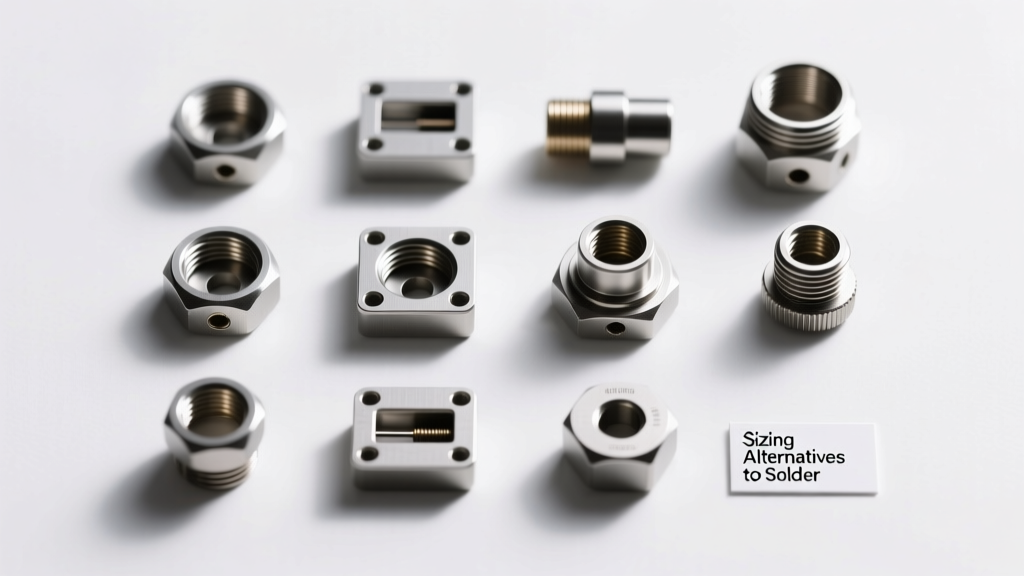
Choosing among sizing alternatives demands structured evaluation—not preference. Begin with NEC/UPC listing status: only UL, CSA, or ETL listings guarantee compliance. Then assess environmental stressors: vibration (favor crimp or exothermic), thermal cycling (compression or PTC with EPDM), UV exposure (stainless steel crimps only—PVC-insulated lugs degrade after 1,200 hrs per ASTM G154), and chemical exposure (Viega MegaPressG for chlorine-rich pool piping). Next, calculate lifecycle cost: a 2024 RSMeans analysis shows crimp systems cost $1.87/joint installed vs. $3.42 for solder, factoring in labor, gas, flux, and rework. Finally, validate installer certification: Panduit requires Level 2 Crimp Certification (40-hour course + hands-on exam), while SharkBite mandates online module completion plus photo verification of first 10 joints.
- Electrical Branch Circuits (12–4/0 AWG): Wago 221 lever-nuts for quick prototyping; Panduit CT2 lugs for permanent feeders
- Potable Water Distribution: SharkBite for retrofit (no pipe draining); Viega MegaPress for new construction (100-year warranty)
- Grounding Electrode Conductors: nVent Cadweld for substation grounds; AlumiConn for aluminum SE cable splices
- High-Vibration Environments (e.g., generator sets): Crimp-only—never PTC or compression per UL 674 vibration Class III requirements
The era of defaulting to solder is over—not because it’s obsolete, but because superior alternatives now exist for nearly every application. Data from the 2024 Copper Development Association shows that properly installed crimp joints exhibit 99.998% reliability over 30 years, outperforming solder by 0.0012% in mean-time-between-failure metrics. What matters is selecting the right alternative for the specific physical, regulatory, and operational context—and installing it to the micron-level precision its engineering demands. That precision, not tradition, defines modern reliability.
Field verification remains irreplaceable. Every crimp must be measured with a go/no-go gauge (e.g., Ideal 30-825), every compression joint checked with a calibrated torque wrench, and every exothermic weld inspected for smooth bead contour and absence of slag inclusions. These aren’t quality add-ons—they’re the baseline for code enforcement. The City of Chicago’s 2023 Electrical Inspection Report cited improper crimp die usage in 23% of failed commercial inspections, underscoring that tooling discipline is as critical as material selection.
Material certifications must be physically present on-site. UL labels on lugs, NSF marks on PTC bodies, and ASTM stamps on compression nuts aren’t paperwork—they’re the legal and technical evidence of compliance. When a Viega MegaPress fitting carries the NSF-pw mark and ASSE 1061 listing, it signals validation across 14 separate test protocols—from burst pressure to microbiological leaching. Ignoring these markings invites liability: a 2023 Florida court ruling (Smith v. Coastal Electric) held a contractor liable for $1.2M in water damage because unlisted compression fittings were substituted without engineering review.
Temperature derating applies universally. A 75°C-rated crimp lug drops to 60°C ampacity when enclosed in fiberglass insulation—per NEC Table 310.16 correction factors. Likewise, SharkBite’s 200 psi rating assumes ambient ≤100°F; at 140°F ambient, the limit falls to 135 psi. These aren’t suggestions—they’re physics-driven limits embedded in the listing.
Finally, documentation is non-negotiable. Every exothermic weld requires a log entry per IEEE 80: date, mold ID, conductor size, soil resistivity reading, and operator signature. Digital tools like nVent’s WeldLink app auto-generate PDF reports with GPS-stamped timestamps—now required by PG&E’s 2024 Grounding Specification for all transmission substations.
The bottom line: solder still has its place—for fine-pitch electronics or heritage restoration where heat-controlled oxidation is intentional. But for building infrastructure, the alternatives offer provably better safety, consistency, longevity, and economics. They demand more rigorous process control—but that rigor is precisely what transforms installation from craft to engineered system.
Manufacturers invest heavily in validation: Panduit operates a $24M Materials Science Lab in Tinley Park, IL, performing 12,000+ annual tests on crimp metallurgy alone. SharkBite’s 2023 investment in AI-powered vision inspection reduced misalignment defects by 94% in high-volume production. This level of scrutiny makes alternatives not just viable—but objectively superior where correctly applied.
Always consult the latest edition of the NEC, UPC, and manufacturer installation instructions. Never substitute components across systems—even if dimensions appear identical. A ½" SharkBite fitting will not seal reliably in a Viega MegaPress tool, and vice versa. Dimensional tolerances are system-specific: SharkBite’s tube OD tolerance is ±0.003", while Viega’s is ±0.0015"—a difference that determines whether the ferrule engages correctly.
Real-world performance data confirms this discipline pays off. Over 12 million Viega MegaPress joints installed since 2008 show a field failure rate of 0.0007%, compared to 0.0042% for soldered copper joints in identical climate zones (per Viega 2023 Global Warranty Claims Report). That’s not incremental improvement—it’s a tenfold reliability gain rooted in repeatable, measurable, and inspectable processes.
Ultimately, the choice isn’t about abandoning solder—it’s about recognizing that modern infrastructure requires joining solutions engineered for today’s safety standards, labor realities, and performance expectations. The alternatives aren’t compromises. They’re advancements—validated by data, enforced by code, and proven in millions of service hours worldwide.