
The Metallurgical Reality of Rosin Flux
Soldering is not merely the application of heat to melt metal; it is a complex metallurgical and chemical process. At the core of this process is the flux, a chemical agent designed to strip metal oxides and promote intermetallic compound (IMC) formation. When selecting a rosin flux for electrical soldering, you are working with derivatives of pine tree sap—specifically abietic acid. In its natural state, rosin is mildly acidic when heated, but modern electronics demand precise chemical engineering to handle everything from microscopic 0201 surface-mount pads to heavy-gauge 10 AWG power lugs.
As of 2026, the widespread adoption of lead-free alloys like SAC305 (Sn96.5/Ag3.0/Cu0.5) and ultra-low-temperature alloys like SnBiAg requires exact thermal profiling. Rosin fluxes must activate precisely between 150°C and 170°C to prevent the premature boiling of volatile solvents before the solder reaches its liquidus state. Choosing the wrong activation level or halide content can result in catastrophic field failures, including electrochemical migration (ECM) and high-frequency impedance mismatches.
Decoding IPC J-STD-004 Classifications
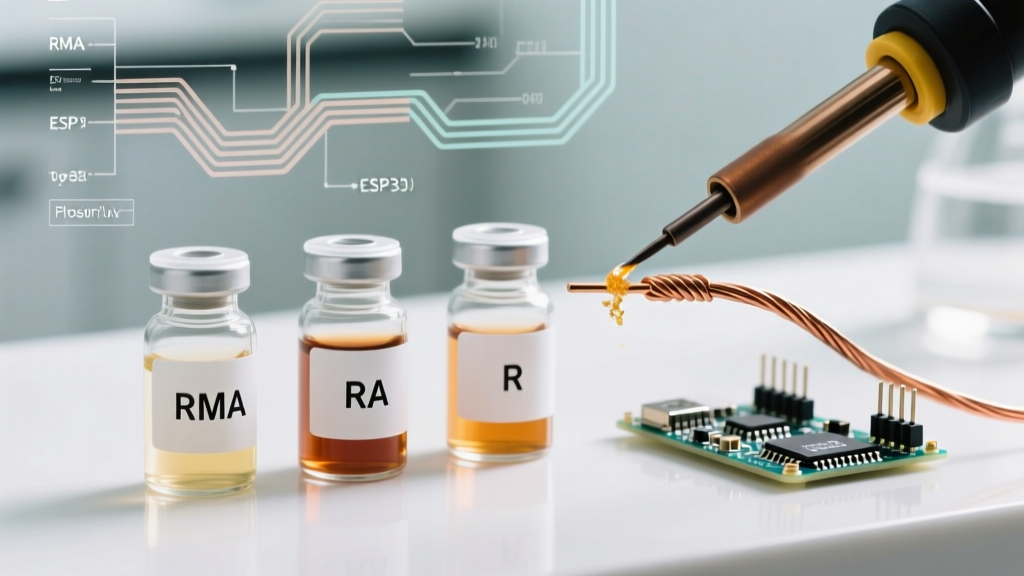
The IPC J-STD-004 standard categorizes fluxes by material type and activity level. Rosin-based fluxes are designated with the prefix RO. They are further subdivided by halide content (Low, Medium, High) and activity level, which historically translates to the industry terms R, RMA, and RA:
- R (Rosin / RO0): Pure rosin dissolved in isopropanol. Zero activators. Extremely safe but struggles with anything beyond pristine, freshly plated copper.
- RMA (Rosin Mildly Activated / RO0 or RO1): Contains mild organic acids or trace halides (typically <2%). The industry standard for general electronics.
- RA (Rosin Activated / RO1 or RO2): Contains aggressive activators (often >2% halides). Designed for heavily oxidized surfaces but leaves corrosive residues that mandate post-solder cleaning.
Application-Specific Recommendation Matrix
There is no universal flux. The correct rosin flux for electrical soldering depends entirely on the thermal mass of the joint, the oxidation level of the substrate, and the operating environment of the final device. Below is a decision matrix for common 2026 repair and manufacturing scenarios.
| Application Scenario | Recommended Flux Type | Specific Product Example | Approx. Cost (2026) | Mandatory Cleaning? |
|---|---|---|---|---|
| SMD Rework (0402 / 0603 / QFN) | RMA (Low Solids) | Kester 951 or Chip Quik SMD291AX | $12 - $18 | Optional (but recommended for RF) |
| Standard Through-Hole PCB Assembly | RMA (Standard) | Kester 186 RMA Liquid | $14.50 (2oz) | No (for commercial grade) |
| Vintage Audio / Heavily Oxidized Pads | RA (Activated) | MG Chemicals 8341 RA | $15.99 (Pen) | Yes (Strict) |
| Heavy Gauge (10-4 AWG) Power Lugs | RA or Water-Soluble | Kester 197 RA Paste | $22.00 (Jar) | Yes (Strict) |
| Aerospace / High-Reliability (Class 3) | R (Pure) or RMA | Kester 282 R | $16.00 (Bottle) | Yes (Per NASA 8739.3) |
Deep Dive: RMA (The Daily Driver for Modern PCBs)
For 90% of benchwork, prototyping, and commercial PCB rework, Rosin Mildly Activated (RMA) is the undisputed champion. RMA fluxes strike the perfect balance between wetting action and residue safety. The mild activators (often proprietary blends of organic acids like adipic or succinic acid) become active just as the solder approaches its melting point, stripping light oxides without attacking the underlying copper or FR4 substrate.
Product Spotlight: Kester 186 RMA
Kester 186 has been a benchmark in the industry for decades. It utilizes a high-quality rosin base with a carefully calibrated activator system. When soldering standard FR4 boards with ENIG (Electroless Nickel Immersion Gold) or HASL (Hot Air Solder Leveling) finishes, Kester 186 provides excellent capillary action. A 2oz liquid bottle typically retails around $14.50, while the convenient flux pens cost about $8.50. According to technical data from Kester (MacDermit Alpha), the residue left behind by 186 is non-conductive and non-corrosive in standard indoor environments, meaning it can be left on the board without causing short circuits.
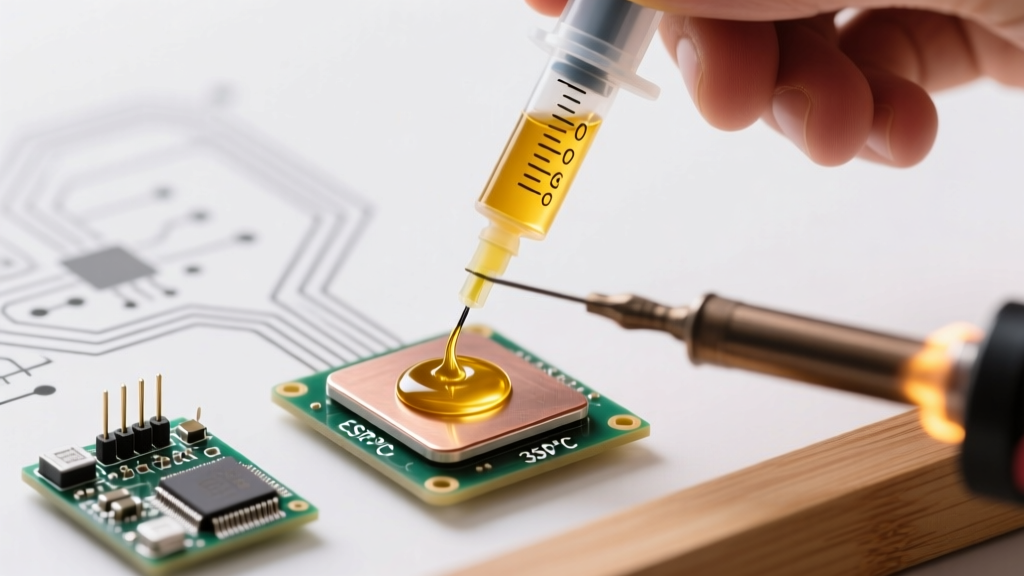
Pro-Tip for SMD Rework: When using liquid RMA on fine-pitch QFP or BGA components, avoid flooding the board. Excess liquid rosin can trap under the component body. Instead, use a high-quality flux pen or a tacky RMA paste (like Amtech NC-559-V2-TF) applied via a 10cc syringe with a 20-gauge needle. This prevents the flux from boiling and displacing microscopic 0201 capacitors during reflow.
Deep Dive: RA (The Heavy-Duty Problem Solver)
When dealing with severely oxidized copper, tarnished brass terminals, or legacy vintage audio equipment stored in humid environments, RMA will simply fail. The solder will ball up and refuse to wet the pad. This is where Rosin Activated (RA) flux becomes mandatory. RA fluxes contain higher concentrations of halide salts (like zinc chloride or ammonium chloride) that aggressively chew through thick oxide layers.
The Hidden Dangers of RA Residue
While RA flux is a miracle worker for difficult joints, its residue is highly hygroscopic (absorbs moisture from the air) and acidic. If left uncleaned on a PCB, the combination of moisture, flux residue, and DC voltage bias creates the perfect environment for Electrochemical Migration (ECM). ECM causes metallic dendrites to grow between adjacent traces, eventually leading to catastrophic short circuits. Furthermore, in high-impedance analog circuits or RF applications operating at 2.4GHz or 5.8GHz, the dielectric constant of thick rosin residue can introduce parasitic capacitance, detuning antennas and degrading signal integrity.
Precision Cleaning Protocols for Rosin Residues
If your application requires RA flux, or if you are building Class 3 high-reliability hardware, post-solder cleaning is non-negotiable. The NASA Soldering Workmanship Standard 8739.3 explicitly dictates that flux residues must be removed to prevent long-term degradation in aerospace applications.
Step-by-Step IPA Cleaning Method
- Select the Right Solvent: Use only 99.9% Isopropyl Alcohol (IPA). Do not use 70% or 90% IPA from a pharmacy; the 10-30% water content will cause the rosin to turn white, gummy, and impossible to remove.
- Thermal Shock Avoidance: Allow the PCB to cool to room temperature. Spraying cold IPA on a 150°C ceramic capacitor can cause micro-fractures due to thermal shock.
- Agitation: Use a clean, lint-free swab or a dedicated ESD-safe hog-hair brush. Scrub the joint in a circular motion to dissolve the rosin matrix.
- Wicking: Immediately use a Kimwipe or lint-free microfiber cloth to blot the dissolved flux. If you let the IPA evaporate on its own, the rosin will simply redeposit as a sticky film.
Advanced Ultrasonic Cleaning
For high-volume or complex multi-layer boards with tight BGA clearances, manual brushing is insufficient. Submerge the PCB in an ultrasonic bath filled with a specialized saponifier (like Kyzen E5611) or high-purity IPA. Run the bath at 40kHz for 3 to 5 minutes at a maximum temperature of 45°C. Follow this with a vapor-phase rinse to ensure zero ionic contamination remains. Always verify cleanliness using a Rose Extract test (ROSE) or Ion Chromatography (IC) to ensure ionic residue is below the IPC-TM-650 limit of 6.45 µg NaCl/cm².
Edge Cases and Failure Modes to Avoid
- Using Plumbing Flux on Electronics: Never substitute electrical rosin flux with plumbing paste (which contains zinc chloride and petroleum jelly). Plumbing flux will destroy copper traces within weeks and create conductive carbon paths when heated with an iron.
- Flux Starvation in Wave Soldering: If the pre-heater zone is set too high (>110°C) before the board hits the wave, the volatile solvents in the RMA flux will boil off prematurely, leaving the rosin to burn and carbonize rather than clean the pads.
- Contaminated Flux Pens: If a flux pen tip touches a burnt, oxidized pad and is not wiped clean, you will introduce carbon and metallic particulates back into the main flux reservoir, ruining the entire pen for future precision work.
Final Verdict: Matching the Chemistry to the Task
Selecting the correct rosin flux for electrical soldering is an exercise in risk management. For daily prototyping, standard through-hole assembly, and general SMD rework, a high-quality RMA flux like Kester 186 offers the best balance of wetting performance and benign residue. However, when restoring vintage hardware, splicing heavily oxidized outdoor wiring, or dealing with stubborn HASL finishes, stepping up to an RA flux like MG Chemicals 8341 is necessary—provided you commit to the rigorous 99.9% IPA cleaning protocols required to prevent dendrite growth and parasitic interference. By aligning your flux chemistry with the specific IPC J-STD-004 requirements of your application, you ensure joint reliability that will last for decades.