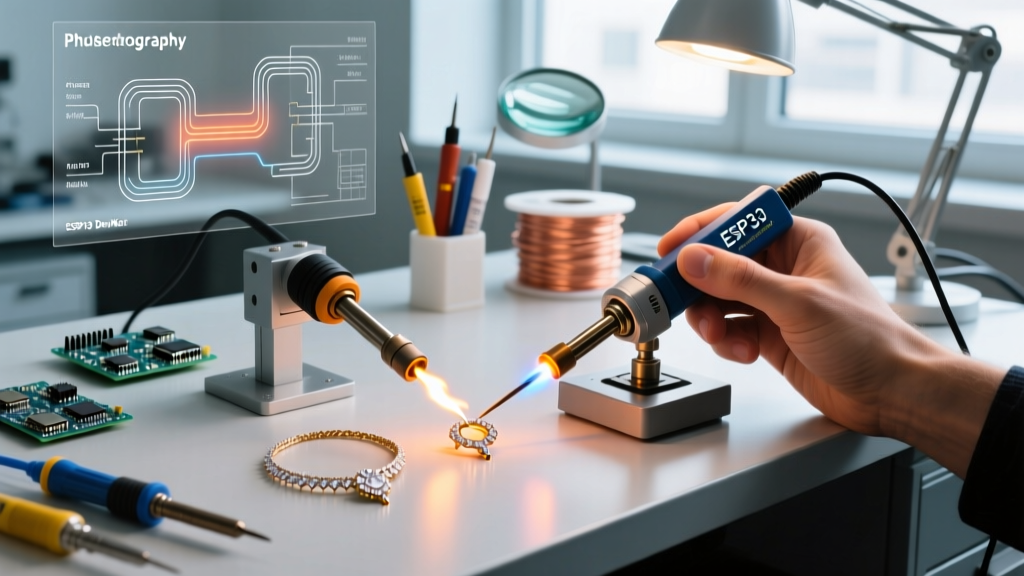

The Battle of the Bench: Traditional Torch vs. Pulse-Arc Laser
When it comes to jewelry soldering, the method you choose dictates your shop's capabilities, repair turnaround times, and the types of metals you can safely manipulate. For decades, the traditional micro-torch has been the undisputed king of the jeweler's bench. However, the rapid advancement of pulse-arc laser technology has fundamentally shifted the landscape. As of 2026, bench jewelers face a critical decision: stick with the reliable, high-heat chemistry of gas torches, or invest in the pinpoint, non-destructive precision of laser welding and soldering?
This comprehensive method comparison breaks down the metallurgical realities, exact equipment specifications, operational costs, and specific failure modes of both traditional torch soldering and modern laser jewelry soldering. Whether you are sizing a platinum ring, retipping a delicate emerald prong, or assembling complex silver filigree, understanding the physics of your heat source is mandatory for professional results.
Method 1: Traditional Micro-Torch Soldering
Traditional jewelry soldering relies on capillary action and precise thermal management. The jeweler uses a gas torch to heat the entire assembly until the base metal reaches the flow temperature of the solder alloy, which is formulated to melt at a slightly lower temperature than the parent metal.
Equipment and Gas Configurations
The industry standard for precision bench work is the Smith Little Torch (Model 23-1001C). This system utilizes a mixture of oxygen and a fuel gas—typically propane, acetylene, or natural gas. For most precious metal soldering, an oxy-propane mix is preferred due to its clean burn and precise flame control.
- Regulator Settings: Oxygen is typically set between 8 to 12 PSI, while propane is set between 4 to 6 PSI, depending on the torch tip size (Tips #1 through #5 are standard).
- Flame Types: Jewelers must master the oxidizing, neutral, and reducing flames. A slightly reducing (carburizing) flame is often used for silver to minimize fire scale, while a neutral flame is standard for gold and platinum.
Metallurgy and Solder Grades
Precious metal solders are graded by their flow temperatures to allow for multiple soldering steps on a single piece without remelting previous joints. According to metallurgical guidelines from major suppliers like Rio Grande, standard silver solders flow at distinct intervals:
- Hard Solder: Flows at approximately 1425°F (774°C). Used for the primary structural joints.
- Medium Solder: Flows at approximately 1325°F (718°C). Used for secondary joints and sizing.
- Easy Solder: Flows at approximately 1240°F (671°C). Used for final catch-ups and delicate repairs.
The reliance on flux is absolute. Handi-Flux (a boric acid and borax suspension) is required for silver to dissolve cupric oxides, while specialized fluoride-based fluxes like My-T-Flux are necessary for gold and platinum alloys to break down stubborn base metal oxides.
Method 2: Pulse-Arc Laser Soldering and Welding
Laser jewelry soldering does not rely on capillary flow of a separate solder alloy in the traditional sense; instead, it uses concentrated pulses of light energy to melt the parent metals together (autogenous welding) or to fuse a microscopic amount of filler wire. The standard for the modern bench is the Nd:YAG (Neodymium-doped Yttrium Aluminum Garnet) pulse-arc laser.
Equipment Specifications and Beam Physics
Systems like the Sunstone Orion 150s or 250s dominate the 2026 market, with entry-level professional units starting around $7,500 to $8,500. These machines emit a 1064nm wavelength beam that is delivered in highly controlled pulses.
- Pulse Width: Adjustable from 0.1 milliseconds (ms) to 10.0 ms. Shorter pulses deliver high peak power for reflective metals like silver and copper, while longer pulses provide a softer, broader heat pool for gold and platinum.
- Spot Size: The beam diameter can be adjusted via the microscope optics from 0.1mm (for microscopic prong retipping) up to 2.0mm (for structural ring shank welds).
- Argon Shielding: Because the laser melts metal instantly, atmospheric oxygen will cause severe porosity. A continuous flow of argon gas through the microscope nozzle is mandatory to displace oxygen and ensure a clean, oxide-free weld pool.
The Silver Reflectivity Challenge
One of the most critical technical hurdles in laser jewelry soldering is sterling silver. At the 1064nm wavelength, silver reflects up to 95% of the laser's energy. To overcome this, jewelers must use extremely high peak power and ultra-short pulse widths to 'keyhole' the surface before the metal has time to reflect the beam. Modern units feature dedicated 'Silver Modes' that automatically adjust the pulse envelope to compensate for this high reflectivity.
Head-to-Head Comparison Matrix
| Feature | Traditional Micro-Torch | Pulse-Arc Laser (Nd:YAG) |
|---|---|---|
| Initial Equipment Cost | $150 - $400 (Torch, tanks, regulators) | $7,500 - $15,000+ |
| Heat Affected Zone (HAZ) | Large (heats entire component) | Microscopic (localized to 0.1mm - 2.0mm) |
| Stone Safety | Poor (requires stone removal or heavy heat sinking) | Excellent (can weld 1mm away from heat-sensitive stones like emeralds and opals) |
| Consumables | Gas, flux, pickling compounds, varied solder grades | Argon gas, microscopic filler wire, flashlamp replacements |
| Learning Curve | High (requires years of muscle memory and flame reading) | Moderate (requires understanding of pulse width and metallurgy) |
| Best Application | Chain soldering, large assembly, heavy structural joints | Prong retipping, sizing without stone removal, porosity filling |
Critical Failure Modes and Troubleshooting
Both methods present unique failure modes that can ruin a piece of jewelry or compromise its structural integrity. Recognizing these edge cases is what separates a master jeweler from an amateur.
Torch Soldering Failure Modes
- Fire Scale (Ghosting): When sterling silver is heated in the presence of oxygen, the copper in the alloy oxidizes deep beneath the surface, creating a dull, purple-grey shadow. Solution: Use a high-quality boric acid flux barrier and maintain a slightly reducing flame to starve the surface of oxygen.
- Solder Balling and Poor Flow: If the torch flame is too concentrated on the solder rather than the parent metal, the solder will melt into a ball and fail to flow via capillary action. Solution: Heat the surrounding metal broadly, allowing the thermal mass of the parent metal to draw the solder into the joint.
- Thermal Shock to Stones: Heating a ring shank with a torch can transfer enough heat to fracture included stones like emeralds or shatter opals. Solution: Submerge the stone in a heat-sinking compound like Kool Jewel, or remove the stone entirely before soldering.
Laser Soldering Failure Modes
- Weld Porosity: If the argon shielding gas flow rate is too low (below 1.5 CFM) or the pulse width is too long, atmospheric gases become trapped in the cooling weld pool, creating microscopic voids. Solution: Increase argon flow and utilize a shorter pulse width with higher peak power.
- Blow-Through (Hole Creation): Using too much peak energy on thin materials (like a 0.5mm gold bezel) will vaporize the metal entirely, blowing a hole through the piece. Solution: Reduce the voltage and increase the pulse width to spread the thermal energy over a longer timeframe.
- Cracking in High-Karat Gold: Welding 22k or 24k gold with standard filler wire can cause micro-cracking due to the lack of alloying elements. Solution: Use a specialized high-karat filler wire and anneal the area gently post-weld.
Which Method Should You Choose for Your Bench?
The decision between torch and laser jewelry soldering ultimately depends on your shop's volume, budget, and the specific types of repairs you encounter. As noted by gemological and trade experts at the Gemological Institute of America (GIA), preserving the integrity of treated gemstones during repairs is a paramount concern in modern jewelry maintenance, an area where lasers excel.
Choose the Traditional Micro-Torch if: You are primarily manufacturing new pieces from scratch, soldering long chains, working with heavy silver assemblies, or operating on a strict startup budget. The torch remains unbeatable for broad, structural capillary joints and is an essential foundational skill for any metallurgist.
Invest in a Pulse-Arc Laser if: Your business relies heavily on retail repairs, sizing rings with channel-set diamonds, retipping worn prongs on antique jewelry, or working with heat-sensitive gemstones. The ability to complete a repair in five minutes without the time-consuming process of stone removal, pickling, and repolishing yields a massive return on investment through increased bench throughput.
Pro Tip for 2026: Many high-volume repair shops now utilize a hybrid approach. They use the laser for 80% of their precision repair work and prong retipping, while keeping a Smith Little Torch on standby for heavy chain repairs and large-scale silver assembly where the laser's small spot size would be inefficient.
Frequently Asked Questions (FAQ)
Can a laser welder replace my torch completely?
No. While lasers are superior for precision repairs and localized welding, they cannot replicate the broad, sweeping heat required for sweat-soldering large backplates, assembling complex multi-joint filigree, or annealing large metal sheets. A complete bench requires both tools.
Is laser jewelry soldering safe for all gemstones?
While lasers are significantly safer than torches, they are not universally safe. Diamonds can generally withstand the peripheral heat of a laser weld, but stones with fracture fillings, surface-reaching inclusions, or organic gems like pearls and amber can still be damaged by localized thermal shock. Always inspect stones under 10x magnification before applying laser energy.
How often do laser flashlamps need replacing?
In modern Nd:YAG systems like the Sunstone Orion series, the xenon flashlamp that pumps the laser crystal typically lasts for approximately 500,000 to 1,000,000 pulses. For an average repair shop, this translates to roughly 3 to 5 years of use before a $300-$500 replacement is required.
For further technical specifications on precious metal alloys and their respective melting ranges, consult the metallurgical data sheets provided by Sunstone Welders and your primary precious metal refinery.