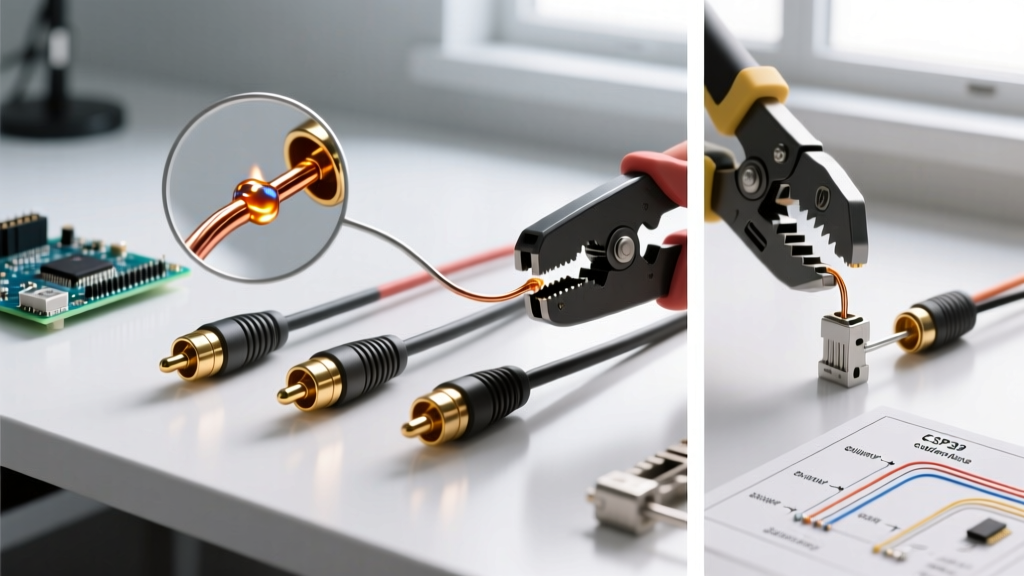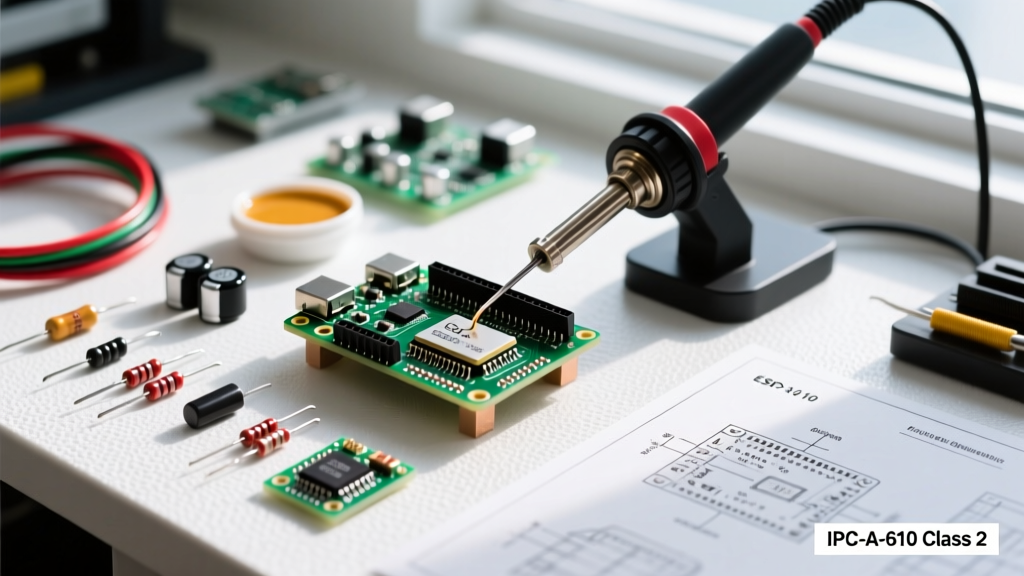

The Exact Spelling: S-O-L-D-E-R-E-D
The correct spelling of the past tense verb and adjective used to describe a completed metallic join is soldered (S-O-L-D-E-R-E-D). While this may seem like a basic linguistic question, in the high-stakes environment of electronics manufacturing, procurement, and quality assurance (QA), the exact spelling and application of this term carry significant operational weight. A single typographical error in a Bill of Materials (BOM) or a vendor specification sheet can cascade into severe supply chain disruptions, failed audits, and misclassified components.
For electronics buyers, supply chain managers, and QA engineers, understanding the distinction between raw materials, tooling, and the final soldered state is critical for accurate procurement and compliance with industry standards like IPC-A-610. This guide explores why precise terminology matters in modern electronics manufacturing and how to avoid costly documentation errors.
The Hidden Cost of Typos in Electronics Procurement
In modern enterprise resource planning (ERP) systems like SAP S/4HANA or Oracle Agile PLM, procurement is heavily automated. Buyers rely on exact string matches to pull approved vendor lists (AVL) and historical pricing data. When a junior engineer or technical writer misspells a termination method on a BOM, the automated procurement scripts fail.
Real-World BOM Failure Scenarios
- The 'Solderd' Search Failure: If a BOM line item requests 'custom solderd wire harnesses' instead of 'custom soldered wire harnesses', the PLM system will not recognize the approved manufacturer part number (MPN). This forces manual buyer intervention, delaying the procurement cycle by 48 to 72 hours.
- Material vs. Service Confusion: Confusing 'solder' (the raw consumable alloy, such as SAC305) with 'soldered' (the completed assembly service) can result in a buyer purchasing $5,000 worth of raw solder wire when the production floor actually needed an outsourced contract manufacturer to provide pre-soldered cable assemblies.
- Tariff and HS Code Misclassification: Customs declarations rely on precise descriptions. A 'solder wire' falls under different Harmonized System (HS) codes than a 'soldered electronic assembly'. Misspellings or incorrect terminology on commercial invoices can trigger customs holds and incorrect tariff applications.
"In technical documentation, clarity is not just about grammar; it is about engineering safety and supply chain integrity. Precise nomenclature ensures that the physical product matches the digital twin." — Purdue Online Writing Lab (OWL) Technical Writing Guidelines
IPC Standards and Strict Nomenclature
The electronics industry relies on the Association Connecting Electronics Industries (IPC) to define acceptability and terminology. According to IPC Standards, specifically IPC J-STD-001 (Requirements for Soldered Electrical and Electronic Assemblies) and IPC-A-610 (Acceptability of Electronic Assemblies), the term soldered is used exclusively to describe the final state of the metallurgical bond.
QA inspectors must use exact terminology when logging defects. Under IPC-A-610 Rev H, inspectors evaluate 'soldered connections' against three classes of product requirements:
- Class 1 (General Electronic Products): Focuses on basic functionality. A 'soldered' joint must simply be electrically conductive and mechanically stable enough for the product's intended life.
- Class 2 (Dedicated Service Electronic Products): Requires continued performance and extended life. Soldered joints must exhibit proper wetting and a specific fillet geometry.
- Class 3 (High-Performance Electronic Products): Used in aerospace, medical, and automotive sectors. Soldered connections must meet the most stringent criteria for wetting, hole fill, and absence of voids.
Terminology Matrix: Solder vs. Soldered vs. Soldering
To maintain clean BOMs and accurate QA logs, procurement and engineering teams must adhere to the following nomenclature matrix:
| Term | Grammatical Role | Industry Application & Procurement Context | Example BOM Description |
|---|---|---|---|
| Solder | Noun / Verb (Present) | The raw fusible metal alloy (e.g., Sn63Pb37, SAC305) or the act of joining. | 'Alloy: SAC305 Solder Wire, 0.8mm' |
| Soldered | Adjective / Verb (Past) | The completed state of a joint; describes an assembly that has undergone the process. | 'Harness: 4-Pin Molex, Pre-Soldered' |
| Soldering | Verb (Continuous) / Noun | The active process or the tooling category used to create the joint. | 'Station: Weller WE1010 Soldering Iron' |
| Desoldered | Verb (Past) | The act of removing a component or the state of a removed joint (note the single 's' in the middle). | 'Rework: Desoldered U4 Microcontroller' |
AI, AOI, and NLP in 2026 Defect Tracking
As of 2026, Automated Optical Inspection (AOI) systems from manufacturers like Koh Young and Omron are deeply integrated with Natural Language Processing (NLP) tools. These systems parse technician notes and QA defect logs to identify recurring failure modes on the SMT (Surface Mount Technology) line.
If a technician manually logs a defect as a 'cold solderd joint' instead of a 'cold soldered joint', the NLP algorithm may fail to categorize the defect under the correct IPC-A-610 defect code (e.g., Code 2.1.3 for Cold Solder Connections). This results in skewed yield analytics. Engineering managers reviewing the dashboard will see a drop in 'soldered' defect metrics, not realizing the data is simply fragmented under misspelled tags. Accurate spelling ensures that AI-driven predictive maintenance models correctly correlate flux chemistry, reflow oven profiles, and final joint quality.
Safety Data Sheets (SDS) and Chemical Documentation
Correct spelling also intersects with environmental health and safety (EHS) compliance. When procuring fluxes or cleaning agents used on soldered assemblies, buyers must review Safety Data Sheets (SDS). The National Institute for Occupational Safety and Health (NIOSH) provides extensive guidelines on managing exposure to rosin-based solder flux fumes and lead particulates.
EHS documentation requires precise language. A safety report detailing 'fume extraction over the soldered area' carries different spatial implications than 'fume extraction over the soldering area'. The former implies a post-process cleaning or inspection station, while the latter correctly identifies the active thermal process where hazardous fumes are generated. Mislabeling these zones in facility planning documents can lead to improper HVAC routing and OSHA compliance violations.
Actionable Framework for Engineering and Procurement Managers
To eliminate terminology errors and protect your supply chain from avoidable friction, implement the following framework in your organization:
1. Standardize BOM Dictionaries
Lock down your PLM software's dictionary. Create controlled vocabularies for termination methods. Users should only be able to select 'Soldered', 'Crimped', 'Pressed', or 'Wire-Wrapped' from a dropdown menu, completely eliminating the risk of manual typographical errors like 'solderd' or 'sodered'.
2. Audit Vendor Specification Sheets
When onboarding new contract manufacturers (CMs), audit their documentation. If a CM consistently uses non-standard terminology or misspells 'soldered' on their traveler documents and certificates of conformance (CoC), it is a red flag regarding their broader attention to detail and IPC compliance.
3. Train QA Staff on IPC Nomenclature
Do not assume native language proficiency equates to technical proficiency. Include a module on exact IPC nomenclature in your internal IPC-A-610 training sessions. Inspectors must know the exact phrasing required for defect logging to ensure seamless integration with your factory's Manufacturing Execution System (MES).
Conclusion
While asking 'how do you spell soldered' might seem elementary, the answer forms the bedrock of clear communication in electronics manufacturing. The correct spelling is soldered. By enforcing strict nomenclature in your BOMs, QA logs, and vendor contracts, you ensure that your procurement algorithms function correctly, your IPC compliance remains unassailable, and your production lines run without documentation-induced delays. In the electronics industry, precision in language is just as critical as precision in metallurgy.