
The Flawed Approach to Buying Soldering Tools
Most buyer guides approach soldering tools by simply listing the 'Top 10 Irons' based on Amazon ratings. For an engineer, technician, or serious hobbyist, this is a fundamentally flawed methodology. A drone racer repairing 14AWG silicone wire has radically different thermal requirements than a micro-soldering technician replacing a 0.4mm pitch BGA chip on an iPhone logic board.
In 2026, the market has bifurcated into high-efficiency portable PD (Power Delivery) irons and ultra-stable benchtop active-cartridge stations. To make a capital investment that lasts, you must evaluate soldering tools through a strict decision framework based on three axes: Thermal Recovery Dynamics, ESD & Grounding Topology, and Fume Mitigation.
Axis 1: Heater Technology and Thermal Recovery
The most critical specification of any soldering iron is not its maximum wattage, but its thermal recovery time—the speed at which the heater can replenish heat drawn away by a copper ground plane. We categorize modern tools into three distinct architectures:
1. Traditional Ceramic Heaters (The Legacy Standard)
Tools like the classic Hakko FX-888D use a separate ceramic heating element that transfers heat to the tip via physical contact. While reliable and cheap, the thermal lag is significant. When you touch a large ground plane, the tip temperature drops, and the sensor takes 3 to 5 seconds to register the loss and ramp the heater. This results in 'cold joints' and prolonged dwell times that can delaminate PCB pads.
2. T12 Cartridge Systems (The Modern Workhorse)
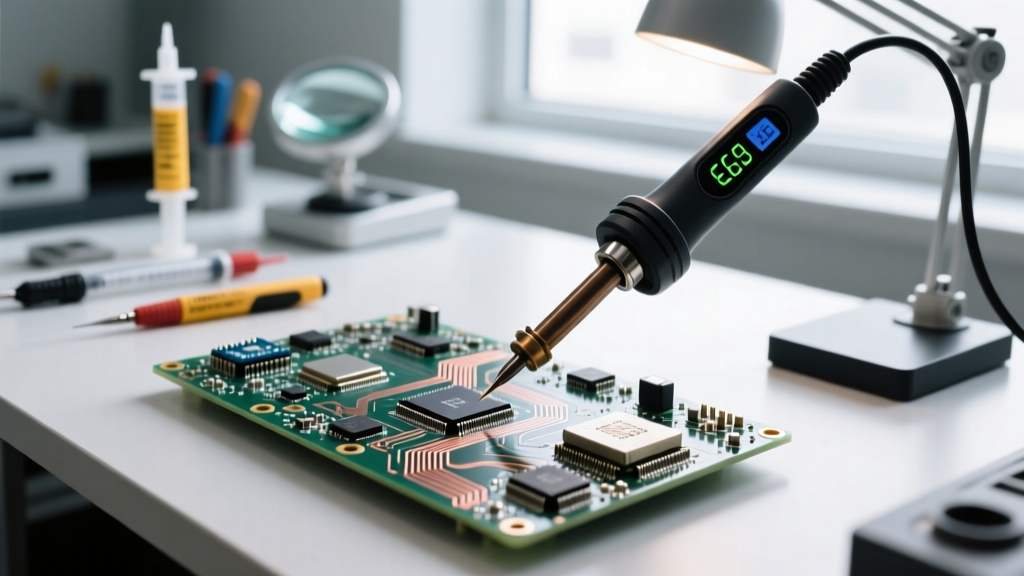
T12 tips integrate the heater and thermocouple directly inside the tip's metal shaft. This eliminates the air gap of ceramic heaters. The Pine64 Pinecil V2 and Hakko FX-951-66 utilize this tech, achieving near-instantaneous thermal feedback. If a T12 tip drops below your setpoint, the PID controller corrects it in milliseconds, not seconds.
3. Active Proprietary Cartridges (The Benchmark)
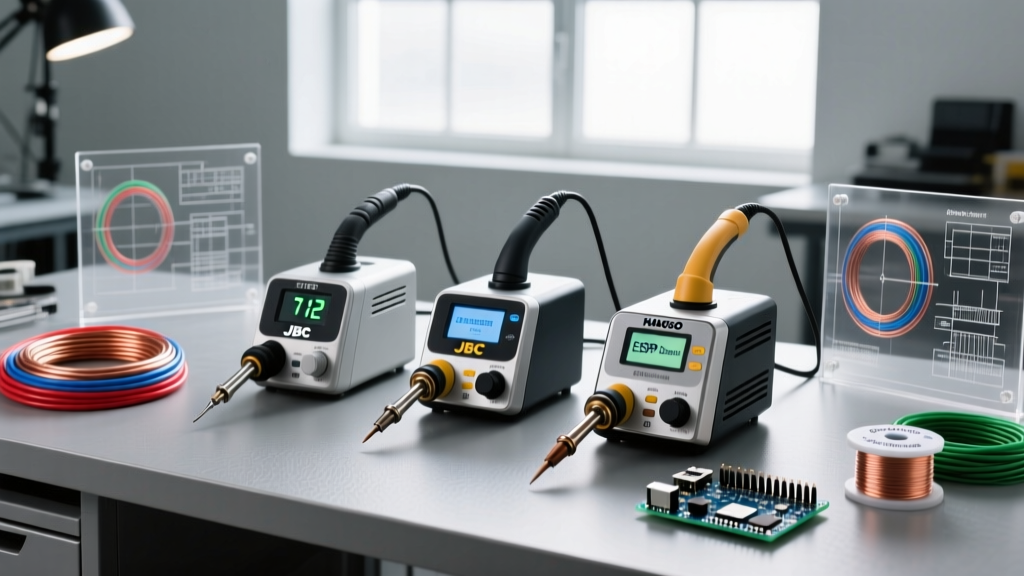
JBC’s C245 and C210 ecosystems use a proprietary 3-wire cartridge system that places the heating element literally millimeters from the very edge of the tip. This provides unmatched thermal mass transfer, allowing a 40W JBC station to outperform a 100W legacy ceramic station on heavy multilayer boards.
Thermal Architecture Comparison Matrix
| Architecture | Recovery Time | Tip Cost (Avg) | Best Application | 2026 Benchmark Model |
|---|---|---|---|---|
| Ceramic Element | 3.0 - 5.0 seconds | $8 - $12 | Through-hole, basic wiring | Hakko FX-888D |
| T12 Cartridge | < 0.5 seconds | $15 - $25 | General SMD, PCB repair | Pine64 Pinecil V2 |
| JBC Active (C245) | < 0.2 seconds | $45 - $65 | Heavy ground planes, micro-BGA | JBC CD-2BQE |
Axis 2: The USB-C Ground Loop Trap (Critical Edge Case)
The explosion of USB-C PD soldering irons (like the Pinecil V2 or Miniware TS101) has introduced a severe, rarely discussed failure mode: floating ground loops.
Expert Warning: If you power a USB-C soldering iron with a standard, non-isolated laptop charger, the DC negative rail may not be tied to earth ground. This can cause high-frequency AC ripple or phantom voltages to appear on the iron's tip. When you touch a sensitive MOSFET gate or an unpowered microcontroller, that voltage discharges through the silicon, instantly bricking the component.
The Decision Rule: If you are working on bare, sensitive silicon (e.g., custom PCB prototyping, repairing powered-off logic boards), you must use an ESD-safe benchtop station with a hardwired earth ground (like the Weller WE1010NA), or ensure your USB-C power supply is a certified, fully isolated medical-grade or industrial-grade brick with a 3-prong earthed plug. Never risk a $50 STM32 chip to save money on a power supply.
Axis 3: Tip Geometry and Wetting Dynamics
Beginners almost universally make the mistake of buying 'conical' (pencil point) tips, assuming a sharper tip equals more precision. In reality, a conical tip has terrible thermal transfer because the surface area touching the joint is microscopic. The solder will ball up on the tip and refuse to flow onto the pad.
- Chisel (e.g., T12-D24): The undisputed king for 90% of tasks. The flat face maximizes surface area, allowing rapid heat transfer and easy drag-soldering of SOIC chips.
- Hoof / Bevel (e.g., T12-C4): Ideal for drag-soldering fine-pitch TQFP chips and cleaning up solder bridges with the concave 'cup' of the tip.
- Micro-Conical (e.g., JBC C115-112): Reserved strictly for 0201 components and micro-soldering under a microscope. Requires flawless flux application to prevent instant oxidation.
Axis 4: Health, Safety, and Fume Extraction
Soldering fumes are not just annoying; they are a documented respiratory hazard. The primary culprit in traditional solder wire is colophony (rosin), a pine-derived flux that, when vaporized, is a known occupational asthmagen. According to the UK Health and Safety Executive (HSE), repeated exposure to rosin flux fumes can cause irreversible sensitization.
Do not rely on the $15 desktop fans with thin carbon filters sold alongside cheap irons. These do not capture sub-micron particulate matter. A proper 2026 decision framework requires a two-stage extraction system:
- Particulate Capture: A true HEPA filter to trap the solid rosin particulates.
- VOC Adsorption: A deep-bed activated carbon filter to absorb volatile organic compounds (VOCs).
For benchtop setups, the Hakko FA-400 or the Metcal MX-Arm extraction systems are mandatory investments. Furthermore, always review the Safety Data Sheets (SDS) for your specific flux chemistry, in compliance with OSHA Hazard Communication guidelines, to understand the specific ventilation requirements of no-clean vs. water-soluble fluxes.
The 2026 Soldering Tools Decision Matrix
Use this matrix to map your primary use case to the correct tool class and budget allocation.
| User Profile | Primary Use Case | Recommended Tool Class | Specific 2026 Model | Estimated Budget |
|---|---|---|---|---|
| The Field Tech / Hobbyist | Drones, RC cars, on-the-go wiring, basic through-hole. | Portable T12 (USB-C PD) | Pine64 Pinecil V2 | $30 - $60 (plus PD brick) |
| The Prosumer / Repair Tech | General PCB repair, SMD components, audio gear. | Benchtop T12 Station (ESD Safe) | Hakko FX-951-66 | $350 - $400 |
| The Production Engineer | Multilayer boards, heavy ground planes, micro-BGA. | Active Cartridge System | JBC CD-2BQE (C245) | $650 - $750 |
Consumables: Where the Real Budget Goes
A $700 JBC station is useless if you feed it cheap, oxidized solder wire from an unknown marketplace vendor. Adherence to IPC J-STD-001 standards for reliable electrical assemblies dictates strict control over your metallurgy and flux chemistry.
Solder Wire Selection
- Leaded (Sn63/Pb37): Still the gold standard for hobbyists and repair techs where RoHS compliance is not legally mandated. The eutectic 63/37 ratio melts and solidifies at a single temperature (183°C), preventing 'disturbed joints' during cooling. Recommendation: Kester 245 (No-Clean) or Kester 331 (Rosin).
- Lead-Free (SAC305): Mandatory for commercial production. Melts higher (217°C-220°C), requires more aggressive flux, and accelerates tip oxidation. If you must use lead-free, you must budget for replacing your iron tips 3x more often.
Supplemental Flux
Never rely solely on the flux core inside your solder wire for rework or SMD soldering. The core is designed for automated wave soldering, not manual rework. You must use a supplemental tacky flux. Amtech NC-559-V2-TF remains the industry benchmark for lead-free and leaded SMD rework, providing the necessary surface tension reduction to prevent bridging on 0.5mm pitch QFP chips.
Final Verdict: Build Your Ecosystem
When buying soldering tools, stop viewing the iron as a standalone purchase. You are buying into an ecosystem. Before committing to a brand, check the long-term availability and pricing of their replacement tips. The Pinecil V2 wins the hobbyist tier because genuine T12 tips are abundant and cheap. JBC wins the professional tier because their C245 tips, while expensive, offer a level of thermal performance that simply cannot be replicated by legacy ceramic heaters. Define your thermal needs, secure your ESD grounding, and invest heavily in proper fume extraction.