
The Pre-Electric Era: Copper Bolts and Open Flames
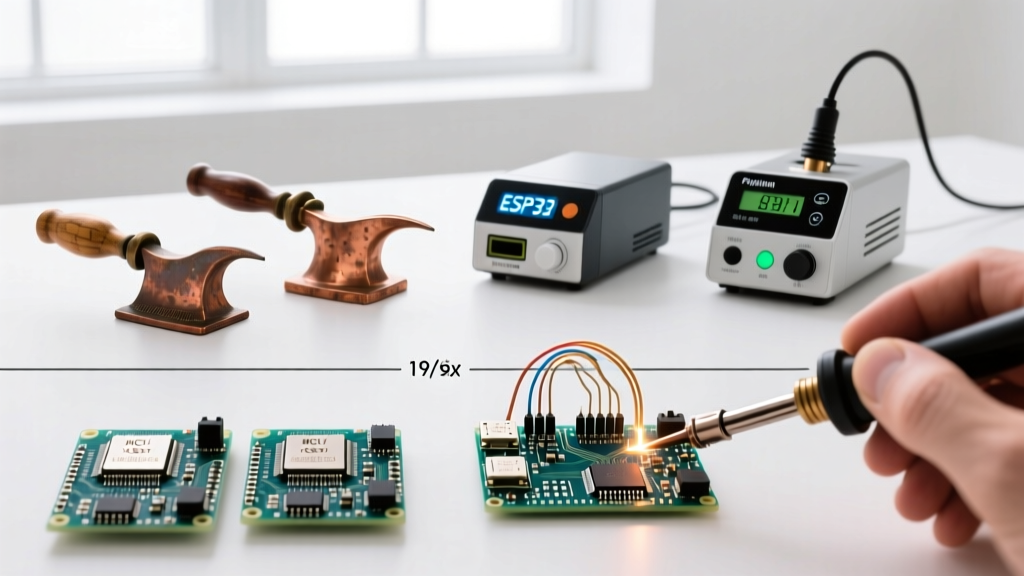
Before the invention of the modern soldering tool, early 19th-century metalworkers and early electronics pioneers relied on solid copper bits heated in charcoal braziers or open blowtorches. Copper was chosen for its exceptional thermal conductivity (approximately 401 W/m·K), allowing it to transfer heat rapidly to tin-lead alloys. However, this primitive approach suffered from severe thermal mass limitations. Once the copper bit touched a cold chassis or thick wire, its temperature plummeted, leading to 'cold joints'—a failure mode where the solder fails to form a proper intermetallic compound (IMC) with the base metal.
Furthermore, solid copper tips dissolved rapidly into molten solder, requiring constant filing and re-tinning. A craftsman in the 1920s might go through several copper tips in a single week of heavy production work, making the process both inefficient and materially expensive.
The Electric Revolution: Weller and the First Irons
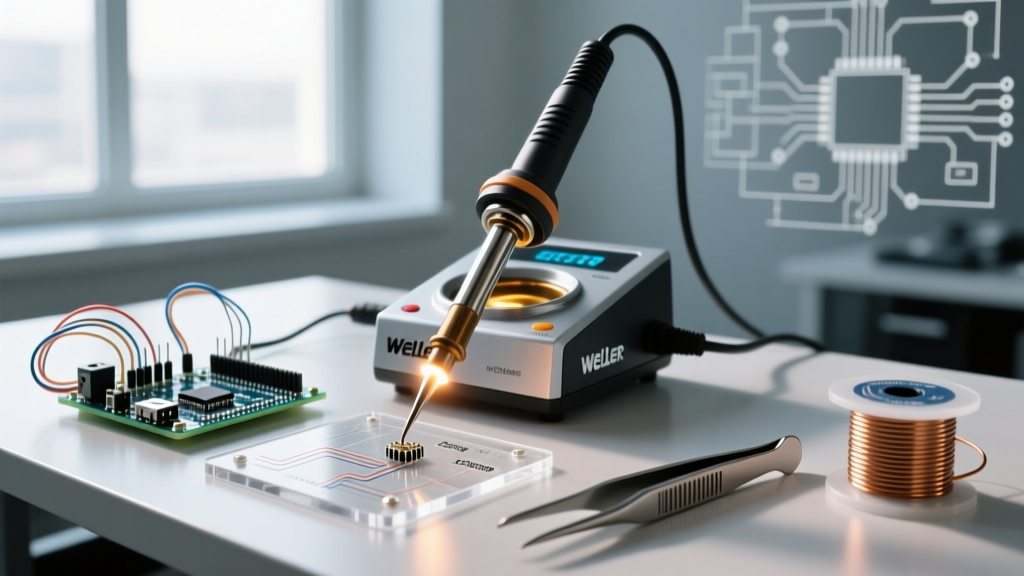
The landscape of electronics assembly changed forever in 1941 when Carl Weller invented the first pistol-grip electric soldering iron. By wrapping nichrome resistance wire around an insulated ceramic core, Weller eliminated the need for open flames and external braziers. According to Weller Tools historical archives, this innovation allowed workers to maintain a continuous, localized heat source directly at the bench.
The Introduction of Iron Plating
By the late 1960s, the transition from solid copper to iron-plated copper tips revolutionized tool longevity. A thin layer of iron (typically 0.003 to 0.005 inches thick) was electroplated onto the copper core. Because iron does not dissolve into tin-lead solder, tip life increased from mere hours to several months. The working end of the tip was further plated with tin for solderability, while the non-working areas were coated with chromium to prevent solder creep.
Temperature Control and the Curie-Point Breakthrough
As printed circuit boards (PCBs) became more complex in the 1970s and 1980s, excessive heat began delaminating early FR-4 fiberglass boards and destroying sensitive semiconductor junctions. The industry needed precise thermal regulation.
This led to the adoption of Curie-point magnetic temperature control, a technology heavily championed by Metcal's SmartHeat induction technology. Instead of using a fragile thermocouple and a relay, these tools used a ferromagnetic alloy on the tip. When the tip reached its specific Curie temperature (e.g., 350°C), it lost its magnetic properties, instantly cutting off the induction field. When it cooled, magnetism returned, and heating resumed. This provided zero-overshoot temperature control, a massive leap for manufacturing reliability.
Evolution of Soldering Tool Tip Technology & Thermal Recovery
| Era | Tip Construction | Heating Method | Thermal Recovery Time | Benchmark Model |
|---|---|---|---|---|
| Pre-1940s | Solid Copper | Charcoal Brazier | 10+ Minutes | Blacksmith Forge |
| 1950s-1970s | Iron-Plated Copper | Nichrome Wire | 45-60 Seconds | Weller SP40 |
| 1980s-2000s | Iron-Plated / Ceramic | Ceramic Heater | 15-20 Seconds | Hakko 936 |
| 2010s-Present | Integrated Cartridge | Core / Induction | 2-3 Seconds | JBC CD-2BE |
The Modern Era: Smart Irons and Cartridge Systems (2010s–2026)
As of 2026, the soldering tool market is defined by two distinct technological leaps: integrated cartridge tips and open-source smart microcontrollers.
Integrated Cartridge Technology
Traditional irons separate the heating element, the temperature sensor, and the tip. This physical distance creates a thermal barrier, causing a lag in heat transfer. Companies like JBC solved this by integrating the heater and thermocouple directly inside the tip cartridge. The result is a 2-second thermal recovery time. When soldering heavy ground planes on multi-layer PCBs, a JBC C245 cartridge delivers instantaneous heat, preventing the operator from dwelling on the pad and lifting the copper trace.
The Open-Source Smart Iron Revolution
The DIY and prosumer space has been entirely disrupted by USB-C Power Delivery (PD) smart irons. Devices like the Pinecil V2 (priced between $30 and $45) utilize a 32-bit RISC-V processor to manage PID temperature control algorithms. These tools can negotiate up to 65W via USB-C PD, reaching 350°C in under 8 seconds. They also feature sleep modes triggered by built-in accelerometers, dropping the temperature to 150°C when the tool is set down, drastically extending tip life and reducing bench fire hazards.
Industry Standard Note: When selecting a tool for commercial production, compliance with IPC standards (specifically J-STD-001) is mandatory. The standard dictates that the soldering tool must maintain the required intermetallic compound (IMC) formation temperature without exceeding thermal limits that damage components or PCB laminates. Smart tools with data-logging capabilities are increasingly used to prove compliance during ISO audits.
Buying Guide: Which Evolution Stage Fits Your Bench?
Understanding the history of these tools helps clarify why modern pricing and performance vary so wildly. Here is how to match the technology to your specific needs in 2026:
- The Hobbyist & Field Tech (Smart Irons): If you are repairing drones in the field or building DIY synthesizers at home, a USB-C PD smart iron like the Miniware Pinecil V2 or Sequre T55 ($30–$60) is unbeatable. They require a separate 65W GaN charger but offer performance that rivals $150 traditional stations.
- The Prosumer & Repair Shop (Ceramic Stations): For general through-hole and basic SMD work, the Hakko FX-888D ($110–$130) remains the undisputed workhorse. Its ceramic heater and digital interface provide reliable, consistent heat for 90% of daily repair tasks, though it struggles with massive multi-layer ground planes.
- The Professional Production Line (Cartridge Systems): If you are soldering 0402 SMD components, BGA chips, or heavy RF shielding, you must invest in a cartridge system. The JBC CD-2BE ($550+) or the Pace ADS200 ($450+) are mandatory. The high upfront cost is offset by the elimination of burned pads, reduced rework time, and unparalleled thermal recovery.
Maintenance in the Modern Age
Regardless of whether you use a 1990s Hakko or a 2026 smart iron, tip maintenance remains rooted in basic metallurgy. Never file a modern iron-plated tip; doing so exposes the copper core to instant destruction. Always use a damp cellulose sponge or brass wire wool, and leave a thick layer of high-flux solder on the tip before powering down to prevent oxidation. The evolution of the soldering tool has brought us incredible precision, but the fundamental chemistry of soldering remains unchanged.