
The Shift to Non-Contact: Why Laser Soldering Demands New Safety Protocols
Laser soldering has rapidly transitioned from niche aerospace applications to mainstream high-density PCB rework and microelectronics assembly. Unlike traditional conductive soldering irons or hot air rework stations, modern diode laser soldering systems utilize focused infrared (IR) beams—typically operating at 808nm, 915nm, or 980nm wavelengths—to deliver precise, non-contact thermal energy directly to the solder joint. While this eliminates mechanical stress on delicate components and pads, it introduces a completely different matrix of occupational hazards.
For electronics manufacturers, DIY engineers, and lab managers purchasing laser soldering equipment in 2026, understanding the intersection of optical radiation, localized vaporization, and thermal runaway is non-negotiable. A standard 50W to 150W Class 4 diode laser system can cause instantaneous, irreversible retinal damage and vaporize flux compounds into hazardous sub-micron aerosols. This guide breaks down the critical safety best practices and equipment purchasing decisions required to engineer a compliant, hazard-free laser soldering workstation.
The Invisible Threat: Optical Radiation and Eye Protection
The most severe risk in laser soldering is optical radiation. Most commercial soldering diodes operate at 980nm. This wavelength is entirely invisible to the human eye, meaning the body's natural aversion response (the blink reflex) will not trigger if a stray beam or reflection hits the eye. Furthermore, 980nm IR radiation is heavily absorbed by the water in the cornea and the retina, causing thermal burns in milliseconds.
Selecting the Correct Optical Density (OD) Eyewear
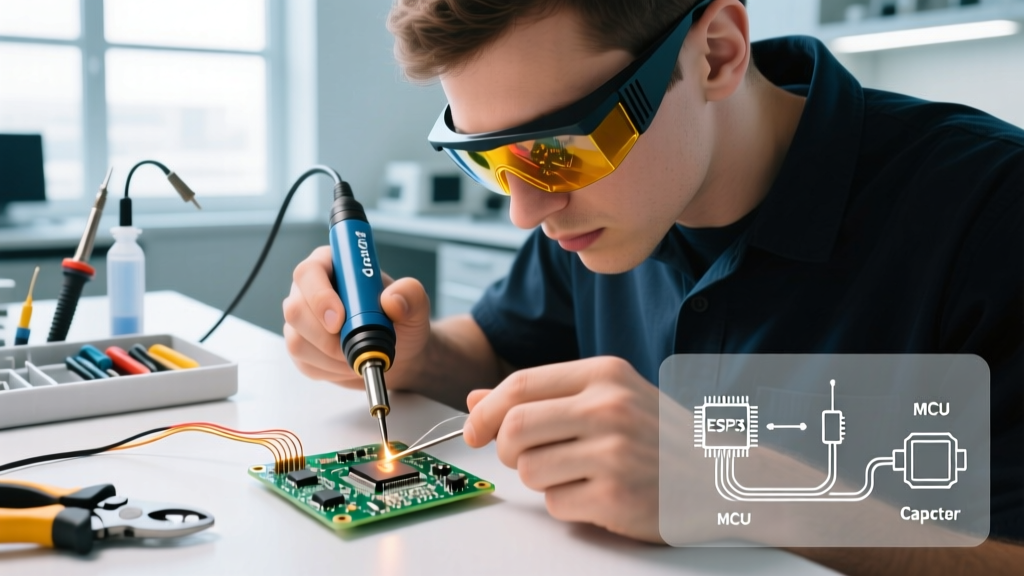
Standard welding shades or generic safety glasses offer zero protection against coherent IR diode lasers. You must purchase laser-specific safety goggles rated for the exact wavelength of your equipment. The protection level is measured in Optical Density (OD). An OD of 5 reduces laser intensity by a factor of 100,000 (10^5).
- Calculate Your OD Requirement: For a 50W (50,000 mW) 980nm laser, an OD 5 filter reduces exposure to 0.5 mW. While this is below the maximum permissible exposure (MPE) for brief accidental exposure, continuous alignment work requires higher attenuation.
- Buyer Recommendation: Invest in ANSI Z136.1-certified polycarbonate goggles with an OD 7+ at 980nm. Models like the Phillips Safety Laser Shield 980 (approx. $95) or Thorlabs SG500 (approx. $125) provide the necessary attenuation while maintaining enough visible light transmission (VLT) to see your workpiece and monitor screens.
CRITICAL WARNING: Never rely on the laser's built-in red aiming beam (usually 650nm) to gauge the danger of the main IR beam. The aiming beam is a low-power Class 2 or 3R visible laser, while the invisible 980nm soldering beam is a Class 4 hazard capable of igniting materials and causing instant blindness.
Fume Extraction: Managing Vaporized Flux and Metal Aerosols
Laser soldering vaporizes flux at highly localized temperatures, often exceeding 400°C at the point of impact. This rapid thermal shock creates a dense plume of sub-micron particulates and volatile organic compounds (VOCs). When using SAC305 (Tin-Silver-Copper) solder paste with rosin-based or synthetic fluxes, the vaporization process releases colophony, aldehydes, and isocyanates—all of which are known respiratory sensitizers that can trigger occupational asthma.
Designing Your Extraction Setup
To comply with OSHA and NIOSH indoor air quality standards, your fume extraction system must capture the plume before it enters the operator's breathing zone (typically within 2 to 3 inches of the joint).
- Pre-Filter & HEPA Stage: Captures 99.97% of particulate matter down to 0.3 microns, preventing sticky flux residue from clogging the main carbon filter.
- Activated Carbon Stage: Essential for adsorbing VOCs and toxic gases. Look for systems with a minimum of 5 lbs of deep-bed activated carbon, rather than thin carbon sheets which saturate within weeks.
- Buyer Comparison: For light benchtop rework, the Hakko FA-400 ($350) provides adequate localized capture. For high-volume or continuous automated laser soldering, invest in a multi-stage industrial extractor like the BOFA AD Oracle 500 ($6,500+), which features independent airflow control and filter saturation alarms.
Thermal Runaway and Substrate Damage Prevention
Safety in laser soldering also extends to the integrity of the PCB and components. Because laser energy is absorbed differently depending on the surface finish (e.g., bare copper absorbs 980nm poorly, while oxidized copper or dark flux absorbs it rapidly), open-loop laser systems are prone to severe thermal runaway.
If the laser hits a highly reflective gold pad, the energy may scatter, risking damage to adjacent plastic connectors or the operator. Once the flux carbonizes and turns black, absorption spikes, causing the joint temperature to exceed 600°C in a fraction of a second, leading to FR4 delamination or pad lifting.
The Necessity of Closed-Loop Pyrometry
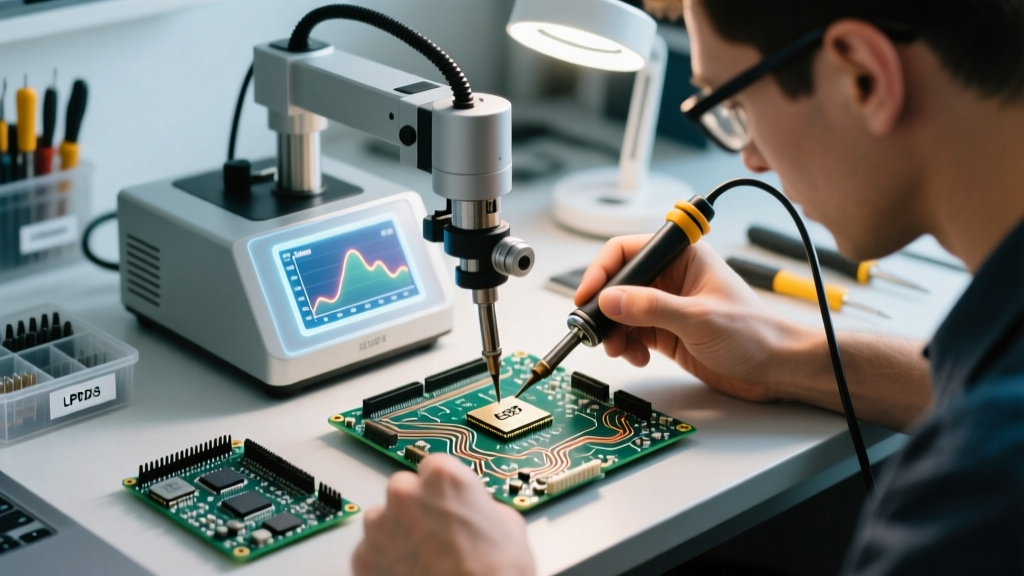
When purchasing a laser soldering station, prioritize systems equipped with integrated coaxial pyrometers. These sensors read the infrared thermal emission of the solder joint in real-time and dynamically adjust the laser diode's power output via a PID controller. This closed-loop feedback ensures the joint never exceeds the target liquidus temperature (e.g., 235°C for SAC305), effectively eliminating thermal damage and reducing the risk of secondary fires caused by overheated substrates.
Workspace Engineering: Enclosures and Beam Dumps
A safe laser soldering environment requires engineering controls that contain the beam. According to the MIT Environment, Health and Safety Laser Protocols, Class 4 lasers must be operated within enclosed interlocked workspaces whenever possible.
- Laser Enclosures: If buying an automated desktop laser soldering robot, ensure the chassis is constructed from laser-absorbing polycarbonate or anodized aluminum with safety interlocks that cut power to the diode if the access door is opened.
- Beam Dumps: For manual or open-bed systems, you must install a beam dump to catch the through-beam. Never use bare stainless steel, copper, or glossy surfaces as a backstop, as they will create dangerous specular reflections. Use specialized laser-absorbing glass or matte-black anodized aluminum angled at 45 degrees to scatter and absorb residual energy.
- Remove Reflective Jewelry: Operators must remove all rings, watches, and metallic jewelry before operating manual laser soldering equipment to prevent accidental beam deflection.
2026 Laser Soldering Safety Budget Breakdown
When procuring laser soldering technology, safety equipment must be factored into the initial capital expenditure. Below is a realistic budget matrix for a compliant, professional-grade manual laser soldering workstation.
| Safety Equipment Category | Recommended Specification | Estimated Cost (2026) |
|---|---|---|
| OD 7+ Laser Safety Goggles (x2) | ANSI Z136.1 certified, 980nm specific | $190 - $250 |
| Benchtop Fume Extractor | HEPA + Deep-bed Carbon, 150+ CFM | $800 - $1,500 |
| Laser Safety Enclosure / Curtains | Interlocked polycarbonate or OD 5+ vinyl | $1,200 - $3,000 |
| Beam Dump / Backstop | Matte black anodized aluminum, angled | $150 - $300 |
| Interlock Bypass & Signage Kit | Class 4 warning labels, indicator lights | $50 - $100 |
Pre-Flight Safety & Calibration Checklist
Before initiating the laser diode, operators must complete the following verification sequence to ensure compliance with FDA CDRH Laser Safety Guidelines and IPC J-STD-001 workmanship standards:
- Verify Eyewear: Inspect goggles for scratches or degradation. Ensure the OD rating matches the specific wavelength (e.g., 980nm) printed on the laser chassis.
- Check Extraction Flow: Power on the fume extractor and verify airflow using a thermal anemometer or visual flow indicator. Position the capture nozzle 2.5 inches from the target area.
- Clear the Work Zone: Remove all unnecessary tools, reflective surfaces, and flammable solvents (like IPA) from the laser's potential beam path.
- Test the Interlocks: Open the safety enclosure door while the system is armed to verify that the laser diode power is immediately severed.
- Calibrate the Pyrometer: Run a test pulse on a scrap PCB with a thermocouple attached to verify that the closed-loop temperature readings match actual substrate temperatures within ±5°C.
Conclusion
Laser soldering offers unparalleled precision for modern microelectronics, but it replaces traditional burn hazards with severe optical and respiratory risks. By investing in the correct OD-rated eyewear, closed-loop pyrometry, and high-CFM HEPA extraction systems, engineering teams can harness the power of diode lasers while maintaining a rigorously safe, compliant workspace. Always prioritize verified safety certifications over budget alternatives when outfitting your laser rework station.