
The Leap from Hobbyist to Industrial Electronics Manufacturing
Every soldering beginner typically starts their journey with basic through-hole DIY kits, Arduino microcontrollers, and inexpensive irons. However, transitioning into professional Electronics Manufacturing Services (EMS), aerospace, or automotive assembly requires a massive paradigm shift. Industrial soldering is not just about melting metal to join two surfaces; it is a highly regulated metallurgical process governed by strict reliability standards, precise thermal profiles, and rigorous electrostatic discharge (ESD) protocols.
In 2026, the electronics industry is pushing the boundaries of miniaturization, with 0201 (metric) and 01005 surface-mount components becoming standard in high-density interconnect (HDI) boards. For an aspiring professional or a workshop looking to secure industrial contracts, understanding the gap between hobbyist practices and industrial requirements is the first step toward mastery.
Understanding the Industry Bibles: IPC and NASA Standards
In the DIY world, a solder joint is considered "good" if it conducts electricity and looks shiny. In the industrial sector, joints are graded against stringent visual and metallurgical criteria. The two primary authorities governing these standards are the IPC (Association Connecting Electronics Industries) and NASA.
IPC J-STD-001 Requirements
The IPC J-STD-001 standard dictates the requirements for soldered electrical and electronic assemblies. It categorizes products into three distinct classes:
- Class 1 (General Electronic Products): Consumer electronics where functionality is the primary concern (e.g., toys, basic household gadgets).
- Class 2 (Dedicated Service Electronic Products): Products requiring extended life and high performance, though uninterrupted operation is not critical (e.g., telecommunications gear, industrial controllers).
- Class 3 (High-Performance Electronic Products): Equipment where failure is unacceptable, such as medical life-support systems, aerospace flight controls, and automotive safety modules.
NASA-STD-8739.3
For aerospace applications, technicians must adhere to NASA Workmanship Standards. This standard goes beyond IPC Class 3, requiring specific solder wetting angles, exact fillet geometries, and zero-tolerance policies for flux entrapment or intermetallic compound (IMC) overgrowth.
Critical Industry Note: A soldering beginner moving into Class 3 assembly must understand that a joint with a disturbed crystalline structure during cooling (a "disturbed joint") is an automatic reject in aerospace, whereas it might pass as a simple rework in a Class 1 hobby project.Equipment Upgrade Path: Buying Your First Industrial Rig
Thermal recovery is the most critical metric in industrial soldering. When a heavy ground plane acts as a heatsink, a hobbyist iron will stall, leading to cold joints or pad delamination from prolonged dwell times. Industrial stations utilize active tip sensing and high-wattage transformers to maintain thermal equilibrium.
| Feature | Hobbyist (Pine64 Pinecil V2) | Mid-Tier Pro (Hakko FX-951) | Industrial (JBC CD-2B) |
|---|---|---|---|
| Approx. Cost (2026) | $26 | $330 | $615 |
| Heater Technology | Ceramic (Separate from tip) | Composite Cartridge | Integrated Smart Cartridge |
| Heat-up Time | ~12 seconds | ~10 seconds | < 2 seconds |
| Thermal Recovery | Poor on heavy ground planes | Good for standard SMD/PTH | Exceptional (Handles 10oz copper) |
| ESD Safe? | No (Requires modding) | Yes | Yes (Strict leakage specs) |
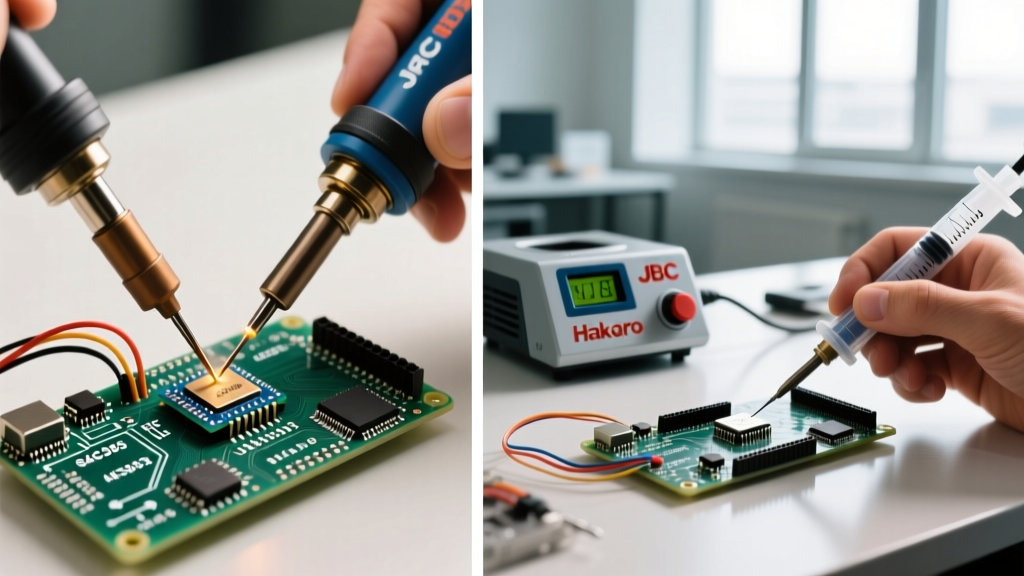
For a workshop aiming for ISO 9001 and IPC certifications, the JBC CD-2B or the Weller WX2021 (approx. $1,350) are mandatory investments. The integrated heater in JBC cartridges places the sensing thermocouple millimeters from the pad contact point, allowing the station to dump 130 watts of power instantly when a thermal drop is detected.
Consumables: Selecting Industrial-Grade Solder and Flux
A soldering beginner usually relies on generic 60/40 rosin-core wire. Industrial applications demand precise alloy compositions and flux chemistries tailored to the cleaning process and environmental regulations.
Solder Alloy Metallurgy
While Sn63/Pb37 (Tin/Lead) remains popular in exempt aerospace and military applications due to its reliable 183°C eutectic melting point and lack of tin whisker growth, commercial EMS facilities must comply with RoHS directives. The industry standard is SAC305 (96.5% Tin, 3.0% Silver, 0.5% Copper).
- SAC305 Melting Point: 217°C - 220°C (Non-eutectic, features a slight plastic range).
- Tip Temperature Requirement: 320°C to 350°C to ensure proper wetting and IMC formation.
- Drawback: Higher operating temperatures accelerate tip oxidation and increase the risk of thermal damage to sensitive BGAs and MLCCs.
Flux Chemistry (IPC J-STD-004B)
Flux is classified by its base material and activity level. For high-reliability assemblies that will not undergo aqueous washing (No-Clean processes), ROL0 (Rosin, Low activity, 0% Halides) is the gold standard. It leaves a benign, non-conductive residue that passes Surface Insulation Resistance (SIR) testing even in high-humidity environments.
"Using a high-activity water-soluble (ORA or ORH) flux on a Class 3 medical device without a thorough ultrasonic or saponified wash will lead to dendritic growth and catastrophic field failure within months."
ESD and Environmental Controls
Industrial assembly environments are governed by the ESD Association standard ANSI/ESD S20.20. A soldering beginner working at home might generate 10,000 volts of static electricity simply by standing up from a fabric chair. In an EPA (ESD Protected Area), this would instantly destroy the gate oxide of a MOSFET or cause latent damage to an IC.
To transition to professional work, your bench must include:
- Dissipative Matting: Surface resistance between 1.0 x 10^6 and 1.0 x 10^9 ohms.
- Continuous Monitors: Wrist strap monitors that alarm if the operator loses ground contact.
- Ionizers: Overhead ionizing blowers to neutralize static charges on non-conductive materials like FR4 PCB substrates and plastic component trays.
Common Soldering Beginner Failure Modes in EMS
When auditing assemblies from technicians transitioning from hobbyist backgrounds, quality assurance (QA) inspectors frequently flag specific defects that violate IPC Class 2 and 3 criteria.
1. Intermetallic Compound (IMC) Overgrowth
IMC is the actual metallurgical bond (typically Cu6Sn5) between the copper pad and the tin solder. A proper IMC layer is 1 to 3 micrometers thick. Hobbyists often leave the iron on the joint for 5 to 10 seconds to "make sure it melts." This excessive dwell time causes the IMC layer to grow too thick, becoming brittle and prone to micro-cracking under thermal cycling or mechanical vibration.
2. Tombstoning on Passive Components
When hand-soldering 0402 or 0603 MLCC capacitors, uneven heating of the two pads causes the flux on one side to activate and wet before the other. The surface tension of the molten solder pulls the component upright, resembling a tombstone. Industrial technicians mitigate this by using pre-heaters (set to 100°C - 120°C) to bring the entire PCB to a uniform baseline temperature before applying the iron.
3. Solder Wicking (Solder Theft)
Applying the iron directly to the component lead rather than the pad/lead interface causes solder to wick up the lead, away from the joint. This results in a starved fillet that fails the IPC requirement for a proper concave wetting angle.
Final Thoughts on Making the Transition
Moving from a soldering beginner to an industrial electronics technician is less about buying the most expensive gear and more about adopting a mindset of process control. By aligning your workflow with IPC J-STD-001, investing in thermally responsive cartridge stations like the JBC CD-2B, and strictly controlling your flux chemistry and ESD environment, you bridge the gap between making things work and building products that survive in the real world.