
The Thermal Reality: Soldering vs. Brazing with Propane
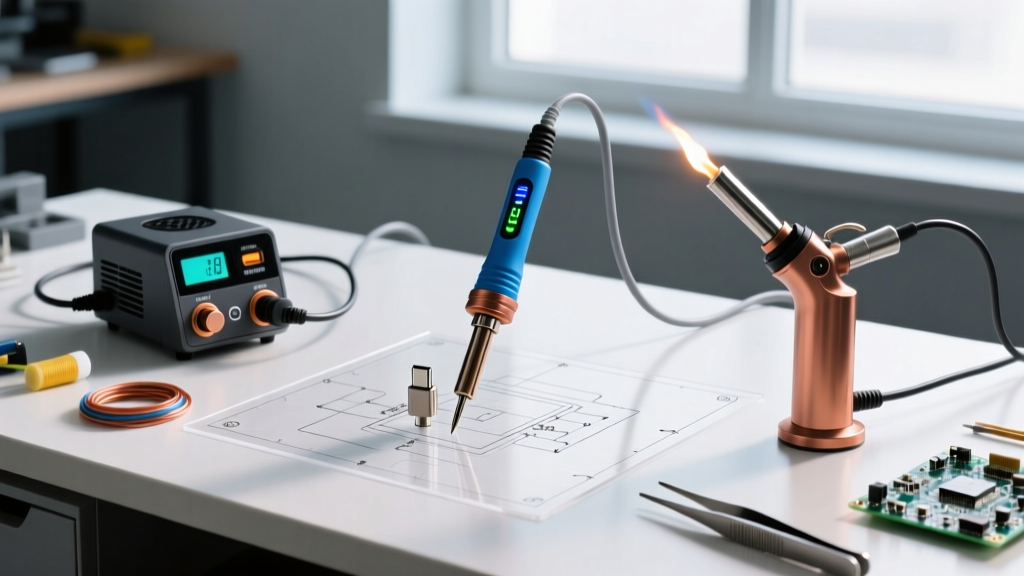
When professionals and DIYers refer to a 'soldering propane torch,' they are often conflating two distinct metallurgical processes. According to the American Welding Society (AWS), soldering occurs when the filler metal melts below 840°F (450°C), while brazing occurs above this threshold. A standard propane torch burning in atmospheric air reaches a maximum flame temperature of roughly 3,600°F (1,982°C). However, the critical metric is not peak flame temperature, but rather heat transfer rate (BTU output) to the workpiece.
As of 2026, with MAP-Pro (propylene) cylinders becoming increasingly scarce and expensive (often exceeding $20 per 14.1oz cylinder), high-efficiency propane swirl torches like the Bernzomatic TS8000 (retailing around $60) have become the undisputed standard for light commercial HVAC, plumbing, and electronics chassis work. But propane is not a universal solution. Its thermal profile dictates strict material compatibility constraints.
Expert Insight: The bottleneck with propane is not getting the metal hot enough to melt soft solder; it is overcoming the thermal mass of thicker base metals before the flux burns out and the joint oxidizes. Swirl-combustion torch heads are mandatory for anything beyond 1/2-inch copper tubing.
Material Compatibility Matrix
The following matrix evaluates base metal compatibility when using a high-BTU propane torch (e.g., TS8000 or equivalent) paired with appropriate fluxes and filler alloys.
| Base Metal | Process Type | Recommended Filler Alloy | Flux Requirement | Propane Viability |
|---|---|---|---|---|
| Copper (Cu) | Soft Solder / Braze | Harris Stay-Brite 8 / Sil-Fos 5 | Liquid Rosin / No Flux (Cu-Cu) | Excellent |
| Brass (Cu-Zn) | Silver Brazing | Lucas-Milhaupt BAg-7 (Sil-Fos) | Black Flux (Borax-based) | Good (Watch for fuming) |
| Mild Steel (Fe) | Silver Brazing | BAg-24 (50% Silver) | White / Black Paste Flux | Fair (High pre-heat needed) |
| Stainless Steel | Silver Brazing | BAg-24 with specialized flux | Fluoride-compound paste | Poor (Oxide layer issues) |
| Aluminum (Al) | Low-Temp Braze | Zinc-Aluminum rods | Fluoride-based liquid | Very Poor (High failure rate) |
Deep Dive: Soldering Specific Metals with Propane
Copper and Brass: The Propane Sweet Spot
Copper is the most forgiving metal for propane torch work. Its exceptional thermal conductivity allows heat to distribute evenly through capillary joints. For plumbing applications, the Copper Development Association recommends maintaining joint clearances between 0.002 and 0.005 inches for optimal capillary draw. When using a silver-bearing tin solder like Harris Stay-Brite 8 (melting point 535°F / 280°C), a standard pencil-flame propane torch is sufficient for tubing up to 3/4-inch diameter.
Brass presents a secondary challenge: dezincification. If a propane torch is held too close or applied too long, the zinc in the brass alloy will vaporize (fume) at around 1,650°F, leaving a porous, weakened joint. Always use a sweeping flame motion and remove the heat the instant the filler metal flashes and flows.
Steel and Iron: The Pre-Heat Challenge
Steel has a lower thermal conductivity than copper but a much higher specific heat capacity. This means it takes significantly more total BTU energy to raise a steel workpiece to the 1,100°F+ required for silver brazing. A standard pencil-flame propane torch will fail here; the localized heat will burn the flux to a glassy slag before the surrounding steel reaches flow temperature. You must use a swirl-combustion torch head and employ a 'pre-heat and soak' technique, heating the broad mass of the steel before focusing the inner cone on the joint seam.
Aluminum and Stainless Steel: The Danger Zone
Attempting to braze aluminum with a propane torch is a common point of failure for DIYers. Aluminum melts at roughly 1,220°F, but its surface oxide layer (aluminum oxide) does not melt until 3,760°F. Propane lacks the concentrated, high-velocity heat of an oxy-acetylene rig to mechanically disrupt this oxide layer, and standard chemical fluxes struggle to penetrate it at propane's lower heat-transfer rates. The result is almost always a 'cold joint' where the filler metal balls up and rolls off the base metal. Similarly, stainless steel forms a tenacious chromium oxide layer that requires aggressive fluoride-based fluxes and precise temperature control rarely achievable with atmospheric propane.
Choosing the Right Filler Alloy and Flux
Material compatibility is only half the equation; the metallurgical bridge (filler) dictates joint strength. For a comprehensive breakdown of alloy flow characteristics, refer to the Lucas-Milhaupt Brazing Basics guide.
- Harris Stay-Brite 8: A 95% tin, 5% silver alloy. Melts at 535°F. Ideal for low-stress copper plumbing, electrical grounding lugs, and sheet metal HVAC seams. Requires a mild liquid acid or rosin flux.
- Lucas-Milhaupt Sil-Fos 5 (BCuP-3): A 5% silver, 6% phosphorus, 89% copper alloy. Melts at 1,195°F. The phosphorus acts as a built-in flux when joining copper-to-copper, eliminating the need for external chemical flux. Never use on steel or brass, as the phosphorus will form brittle iron/copper phosphides at the joint interface.
- BAg-24 (50% Silver): Melts at 1,325°F. Used for brazing steel, stainless, and brass. Requires a heavy, borax-based black paste flux to protect the joint from atmospheric oxidation during the prolonged heating cycle required by propane.
Torch Setup and Flame Tuning for Optimal Heat
To maximize the thermal efficiency of a Bernzomatic TS8000 or similar swirl torch, proper flame tuning is critical. Follow this sequence:
- Purge the Line: Open the cylinder valve and trigger the torch away from the workpiece for 3 seconds to clear ambient air from the regulator.
- Ignite and Adjust: Trigger the ignition. Turn the gas control valve until the flame transitions from a chaotic, roaring yellow-orange to a defined, tight blue cone.
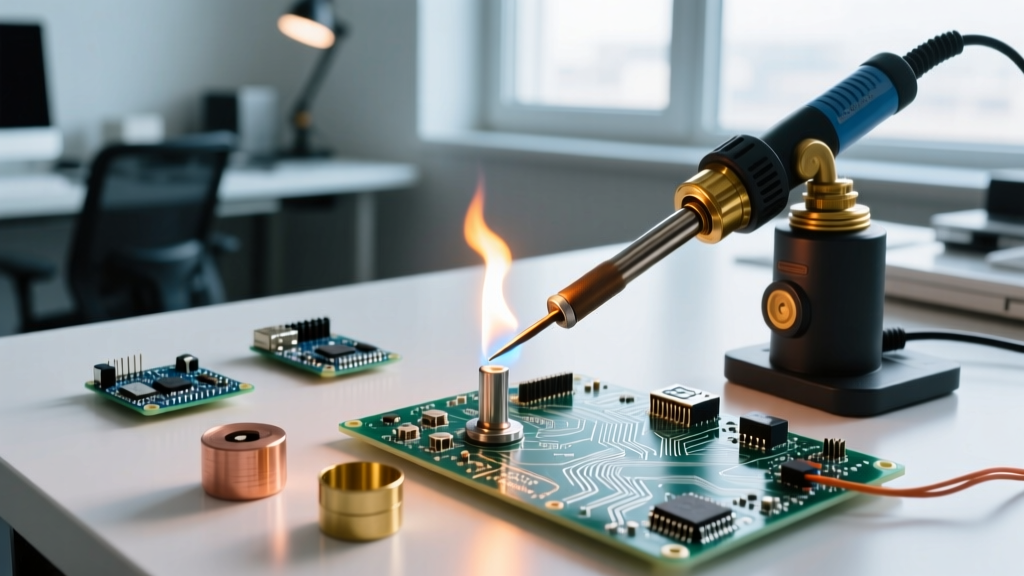
- Identify the Envelope: The hottest part of a swirl propane flame is not the tip, but the base of the inner blue envelope, roughly 1/8-inch from the workpiece. The outer translucent blue envelope provides the broad pre-heat.
- Angle of Attack: Hold the torch at a 45-degree angle to the joint, allowing the exhaust gases to sweep across the seam, pre-heating the metal just ahead of the filler rod application point.
Common Failure Modes and Troubleshooting
1. Flux Glazing (Burnt Flux)
Symptom: The flux turns into a hard, black, glass-like crust, and the filler metal refuses to wet the surface.
Cause: The workpiece was heated too slowly. Propane's lower BTU transfer rate means the flux was exposed to oxygen for too long before reaching its active flow temperature, causing it to carbonize.
Fix: Quench the joint, mechanically wire-brush the glaze away, re-apply fresh flux, and use a broader flame pattern to heat the mass faster.
2. Capillary Starvation
Symptom: Filler metal flows around the outside of a lap or socket joint but does not draw deep into the capillary gap.
Cause: Uneven heating. The heat was applied directly to the joint seam rather than the broader base metal. The filler melted on contact with the torch-heated surface but the interior of the joint was below the alloy's liquidus temperature.
Fix: Apply heat to the thickest part of the male/female fitting, allowing thermal conductivity to draw the heat into the gap. Apply the filler rod to the opposite side of the joint from the flame.
3. Base Metal Erosion (Washout)
Symptom: Pitting or thinning of the copper or brass base metal directly under the flame path.
Cause: Holding the inner cone of the flame stationary on a thin-walled tube while using a high-silver alloy that requires extended dwell time.
Fix: Keep the torch in constant, sweeping motion. If the joint requires more than 45 seconds of continuous heat to flow a standard silver braze, the thermal mass is too large for a single propane torch; a dual-torch setup or an oxy-propane rig is required.