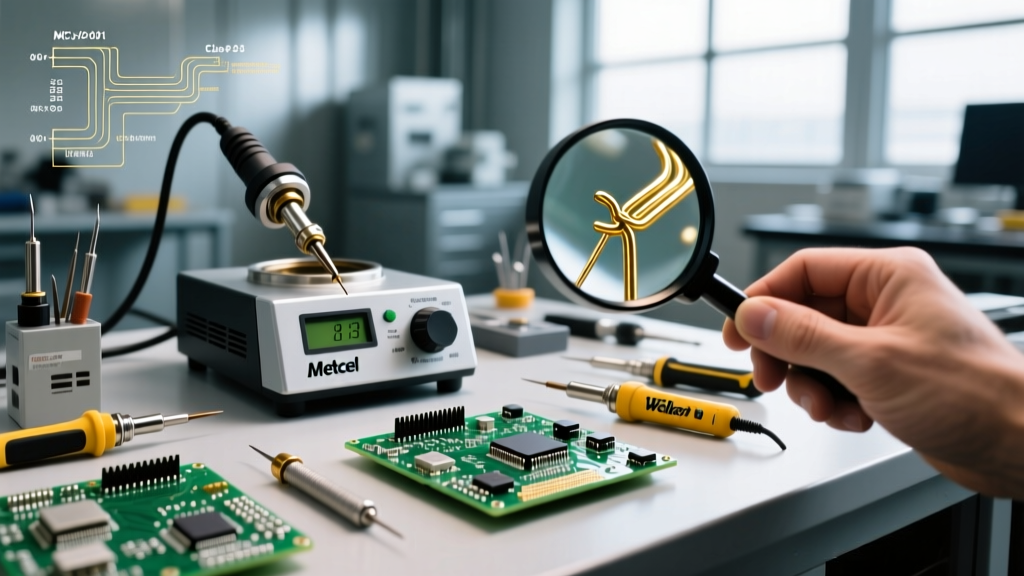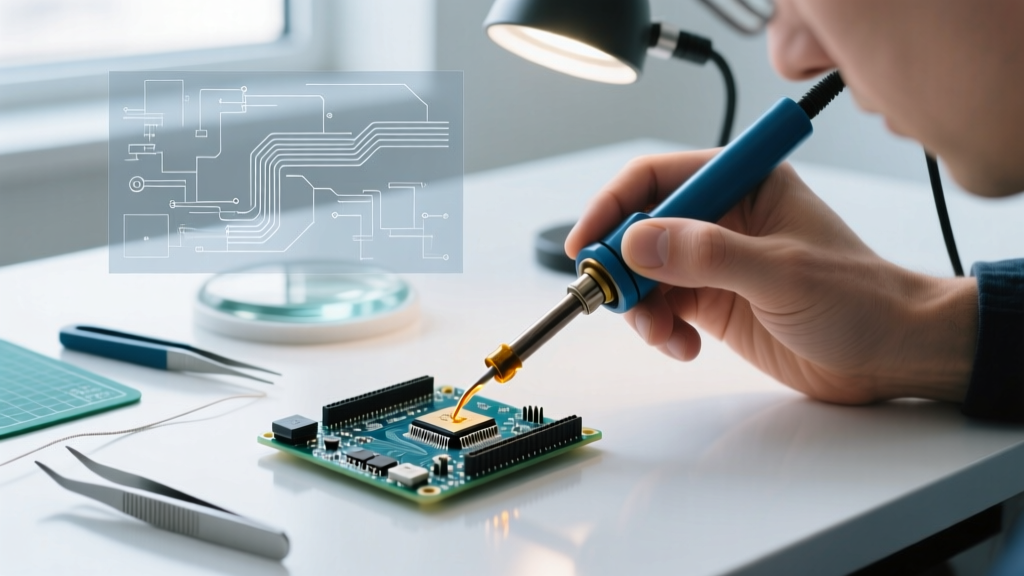

The Dual Mandate: Human and Component Safety
When soldering integrated circuits (ICs), safety is a two-front battle. On one side, you must protect the operator from hazardous fumes, thermal burns, and ergonomic strain. On the other, you must protect the highly sensitive silicon die and microscopic bond wires inside the IC from electrostatic discharge (ESD) and catastrophic thermal shock. As the industry has transitioned almost entirely to lead-free alloys like SAC305 (96.5% Sn, 3.0% Ag, 0.5% Cu), the required soldering temperatures have increased, amplifying both health risks and component failure rates. In 2026, professional rework demands a rigorous, standardized approach to safety that goes far beyond simply wearing safety glasses.
Electrostatic Discharge (ESD) Protocols
Modern ICs, particularly those with nanometer-scale gate oxides (like advanced FPGAs and microcontrollers), can be destroyed by ESD events as low as 10 volts—well below the human threshold of perception (roughly 3,000V). Latent ESD damage is even more insidious, as the component may pass initial testing but fail prematurely in the field.
Grounding and Wrist Strap Specifications
According to the ESD Association, any workspace handling unpackaged ICs must comply with ANSI/ESD S20.20 standards. This requires a continuous, verified path to ground.
- Wrist Straps: Always use a wrist strap with a built-in 1-megohm safety resistor. This resistor limits current flow to safe levels (under 5mA) if you accidentally touch a live AC circuit while grounded, preventing lethal electrocution while still dissipating static charge.
- ESD Mats: Your work surface must be a dissipative mat (typically 3M 5400 series or similar), with a surface resistance between 10^6 and 10^9 ohms. Conductive mats (below 10^4 ohms) discharge too rapidly and can actually cause EOS (Electrical Overstress) damage to sensitive IC pins.
- Verification: Use a daily wrist strap tester (e.g., Hakko FG-501, approx. $120) before touching any moisture-sensitive components.
Expert Warning: Never rely on the ground pin of your soldering station's AC plug for ESD protection. AC grounds can carry high-frequency noise and voltage differentials. Always use a dedicated, hard-wired ESD earth ground point tied to a verified grounding rod or building steel.
Thermal Profiling and Moisture Sensitivity
The most common physical failure mode when soldering integrated circuits is the "popcorn effect." IC packages are made of epoxy resins that are slightly hygroscopic (they absorb ambient moisture). When the soldering iron or hot air rework station hits the package with 350°C+ heat, the trapped moisture instantly flashes into steam, expanding and cracking the package from the inside or delaminating the die attach.
Understanding MSL Ratings
Components are classified by Moisture Sensitivity Levels (MSL) under IPC/JEDEC J-STD-020. Before applying heat, you must know the MSL of your IC and adhere to its floor life limits.
| MSL Rating | Max Floor Life (at <30°C / 60% RH) | Required Pre-Solder Action | Typical IC Types |
|---|---|---|---|
| MSL 1 | Unlimited | None required | DIP, basic SOIC, through-hole |
| MSL 2 | 1 Year | Inspect for moisture; bake if expired | Standard QFP, SOIC |
| MSL 3 | 168 Hours (1 Week) | Bake at 125°C for 24 hours if expired | QFN, small-pitch TQFP, ARM MCUs |
| MSL 4 | 72 Hours | Bake at 125°C for 24 hours if expired | Complex BGAs, RF modules |
| MSL 5/6 | 48 Hours / Time on Label | Mandatory baking; immediate reflow | High-density BGAs, advanced FPGAs |
Preheating vs. Top-Heat Profiling
To safely solder MSL-3 and higher components, do not rely solely on a top-heat soldering iron. Applying a 380°C iron to a room-temperature BGA creates a massive thermal gradient, warping the PCB and tearing micro-vias. Use a bottom preheater (like the Hakko FR-830, approx. $1,200) to raise the entire PCB assembly to 120°C–150°C. This reduces the delta-T (temperature difference) your top-heat tool must overcome, allowing you to use lower iron temperatures (300°C–320°C) and dramatically reducing thermal stress on the IC die.
Fume Extraction and Respiratory Health
While lead-free solder eliminates the heavy metal toxicity associated with legacy Sn63/Pb37 alloys, the flux cores used in modern wire solder and tacky fluxes pose severe respiratory risks. Most fluxes contain colophony (rosin), a known respiratory sensitizer. Chronic exposure to rosin fumes can cause occupational asthma, a condition that is irreversible once developed. The National Institute for Occupational Safety and Health (NIOSH) explicitly warns against unventilated rosin flux exposure.
Capture Velocity and Filter Media
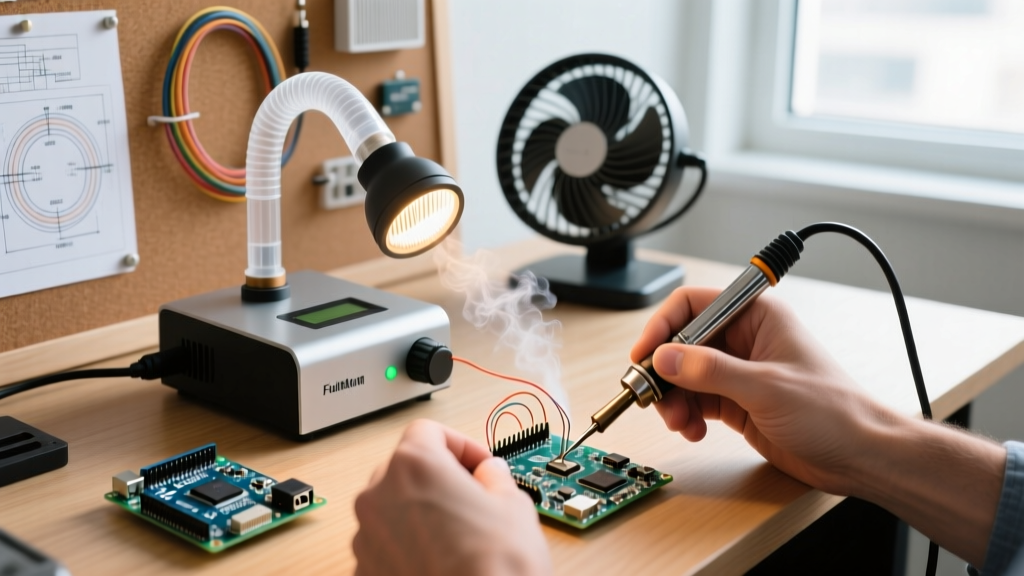
A standard desk fan blowing fumes away is entirely inadequate and violates OSHA workplace safety guidelines. Proper extraction requires source-capture systems.
- Capture Distance: The extraction nozzle must be positioned within 4 to 6 inches of the solder joint. Capture velocity drops off by the square of the distance; moving the nozzle from 6 inches to 12 inches reduces its effectiveness by 75%.
- Filtration Stages: You need a dual-stage filter. A HEPA filter captures particulate matter (sub-micron flux aerosols), while an activated carbon bed (minimum 2 kg of carbon for professional units) adsorbs the volatile organic compounds (VOCs) and aldehydes.
- Recommended Units: For benchtop work, the Metcal MX-AH5 (approx. $650) or the Hakko FA-400 (approx. $150 for light-duty) are industry standards. Replace carbon filters every 6 months, or when you begin to smell the distinct "pine" scent of rosin.
Tooling Matrix for Safe IC Rework
Using the wrong tool forces you to apply excessive heat and dwell time, increasing the risk of pad lift and IC damage. Here is a comparison of top-tier stations optimized for safe IC soldering in 2026.
| Brand / Model | Technology | Thermal Recovery | Best For | Est. Price (2026) |
|---|---|---|---|---|
| JBC CD-2BQE | Cartridge (Heater in tip) | Instantaneous (<2s) | Dense multilayer PCBs, large ground planes | $750 - $850 |
| Hakko FX-951 | Composite Cartridge | Very Fast (<5s) | General IC rework, SOIC, QFP | $320 - $360 |
| Weller WX2021 | Inductive / Cartridge | Fast | ESD-critical environments, micro-BGA | $600 - $680 |
For soldering integrated circuits with heavy thermal mass (like power management ICs with exposed thermal pads), JBC's integrated heater-tip technology is unmatched. It senses the thermal load at the exact point of contact and injects current directly into the tip, preventing the temperature drop that typically causes operators to "lean" on the iron and crush delicate IC pins.
Step-by-Step Safe IC Soldering Workflow
- Preparation & ESD Check: Don your 1M-ohm wrist strap and test it. Verify your ESD mat is connected to the common point ground. Ensure your fume extractor is powered on and positioned 6 inches from the work zone.
- Moisture Management: Check the MSL rating and humidity indicator card (HIC) on the IC packaging. If the HIC shows pink (indicating >10% humidity for MSL-3), bake the IC at 125°C for 24 hours in a dedicated convection oven.
- Flux Application: Apply a high-quality, no-clean tacky flux (e.g., Amtech NC-559 or Chip Quik SMD291AX) to the PCB pads. Flux acts as a thermal bridge and prevents oxidation, drastically reducing the required dwell time of your iron.
- Preheating (If applicable): For BGAs or large QFNs, ramp the PCB to 130°C using a bottom preheater.
- Soldering: Set your iron to 320°C–340°C (for SAC305). Use a chisel or micro-knife tip that matches the pad width. Apply the tip to the pad and pin simultaneously, feed solder, and remove within 2 to 3 seconds per joint. Never drag-solder fine-pitch ICs without a proper desoldering braid on standby to prevent bridging.
- Cooling & Inspection: Allow the board to cool naturally. Do not use compressed air to force-cool the IC, as rapid thermal contraction can crack the solder joints or the silicon die. Inspect under a microscope (minimum 10x magnification) for micro-bridges and cold joints.
Frequently Asked Questions
Is lead-free solder safer for the operator than leaded solder?
From a heavy-metal toxicity standpoint, yes. You eliminate the risk of lead ingestion, which is why the EPA heavily regulates lead handling. However, lead-free solders require higher temperatures to melt (217°C vs 183°C for Sn63). These higher temperatures cause the flux to off-gas more aggressively, producing a higher volume of hazardous VOCs and rosin particulates. Therefore, fume extraction is actually more critical when using lead-free solder.
Can I use a standard multimeter to check my ESD wrist strap?
While a multimeter can verify continuity, it cannot accurately measure the high-resistance range required for ESD safety. You need to verify that the resistance is strictly between 750,000 ohms and 10 megohms. A standard multimeter's continuity checker will beep for a dead short (0 ohms), which is highly dangerous if you touch a live circuit while wearing the strap. Always use a dedicated ESD wrist strap tester.
Why do my IC pins keep lifting off the PCB pads?
Pad lift is almost always a thermal failure. If your iron is set too low (e.g., 280°C for lead-free), the solder won't flow quickly. You will instinctively hold the iron on the pad longer to compensate, transferring excessive heat into the FR4 fiberglass substrate. This degrades the epoxy bond holding the copper pad to the board. The solution is to use a higher-quality iron with better thermal recovery (like JBC or Hakko), use copious amounts of flux, and limit your dwell time to under 3 seconds per pin.