
The Decision Framework: Why Generic Soldering Safety Fails
When evaluating safety for soldering, most buyers make a critical error: they apply a one-size-fits-all approach to a highly variable hazard environment. A hobbyist repairing a vintage amplifier once a month faces a fundamentally different risk profile than a production technician reflowing SAC305 lead-free paste for eight hours a day. As of 2026, the market is saturated with extraction and PPE solutions ranging from $30 desktop fans to $2,500 multi-station HEPA towers. Choosing the wrong tier doesn't just waste capital; it leaves you exposed to invisible respiratory and systemic hazards.
This decision framework strips away the marketing fluff. We will guide you through a four-phase evaluation process—assessing exposure, selecting extraction, hardening your PPE, and understanding material chemistry—so you can build a lab environment that aligns precisely with your operational reality.
⚠️ Critical Hazard Alert: Colophony SensitizationMany technicians focus entirely on lead toxicity, ignoring the flux. Rosin-based fluxes (colophony) are potent respiratory sensitizers. Repeated inhalation of vaporized rosin flux can trigger occupational asthma, which is often irreversible. According to OSHA guidelines on occupational hazards, controlling airborne particulate and chemical vapor is a primary regulatory requirement for any enclosed soldering environment.
Phase 1: Assessing Your Exposure Profile
Before buying a single piece of equipment, you must categorize your operational tier. Your weekly soldering volume dictates the required Minimum Efficiency Reporting Value (MERV) and activated carbon weight for your extraction system.
| Tier | Weekly Volume | Primary Hazards | Required Extraction Tier |
|---|---|---|---|
| Tier 1: Hobbyist | < 5 hours | Mild flux vapor, occasional lead dust | Fan-assisted carbon filter (1-4 oz carbon) |
| Tier 2: Prosumer | 5 - 20 hours | Heavy RMA flux, continuous thermal off-gassing | Desktop HEPA + Carbon Blower (1-2 lbs carbon) |
| Tier 3: Commercial | > 20 hours | SAC305 off-gassing, high-volume rosin, dross | Multi-stage Arm Extractor (5+ lbs carbon + HEPA) |
Phase 2: Fume Extraction Decision Matrix
Fume extraction is the cornerstone of safety for soldering. In 2026, the market is dominated by three distinct architectural approaches. Here is how to decide which model fits your tier.
1. The Fan-Based Absorber (Tier 1)
Representative Model: Hakko FA-400 (Approx. $55)
How it Works: Pulls fumes through a localized activated carbon mat (Hakko A1002 filter, containing roughly 0.4 oz of carbon) and exhausts the air back into the room.
The Verdict: This does not remove sub-micron particulates; it only adsorbs some volatile organic compounds (VOCs) via the carbon. It is strictly for light, occasional leaded soldering in well-ventilated rooms. If you are using no-clean or water-soluble fluxes heavily, this unit is insufficient.
2. The Desktop HEPA/Carbon Blower (Tier 2)
Representative Model: Weller WSA3500 (Approx. $380)
How it Works: Utilizes a multi-stage filtration system. Air passes through a pre-filter, a HEPA filter (capturing 99.97% of particulates down to 0.3 microns), and finally a deep bed of activated carbon (approx. 1.5 lbs).
The Verdict: The gold standard for serious home labs and repair shops. The HEPA stage captures the visible white smoke (particulate rosin), while the heavy carbon bed neutralizes the VOCs. Filter replacement costs are higher (around $80 every 6 months), but the respiratory protection is vastly superior.
3. The Articulating Arm Extractor (Tier 3)
Representative Model: Metcal MX-AARM / BVX-200 Series (Approx. $850 - $1,200)
How it Works: Features a high-static-pressure motor connected to a flexible, articulated extraction arm (usually 30-40 inches long) with a specialized nozzle placed less than 2 inches from the solder joint.
The Verdict: Mandatory for commercial production and BGA rework stations. The proximity capture prevents the thermal plume from ever reaching the operator's breathing zone. When evaluating these systems, always check the static pressure rating (measured in inches of water, e.g., 80-100mm H2O) to ensure the motor can pull air through dense HEPA/Carbon filters without stalling.
Phase 3: PPE and Workspace Hardening
Extraction handles the airborne threat, but dermal contact and ocular hazards require a secondary layer of defense. Do not rely on generic hardware store gear; safety for soldering requires specific material compatibilities.
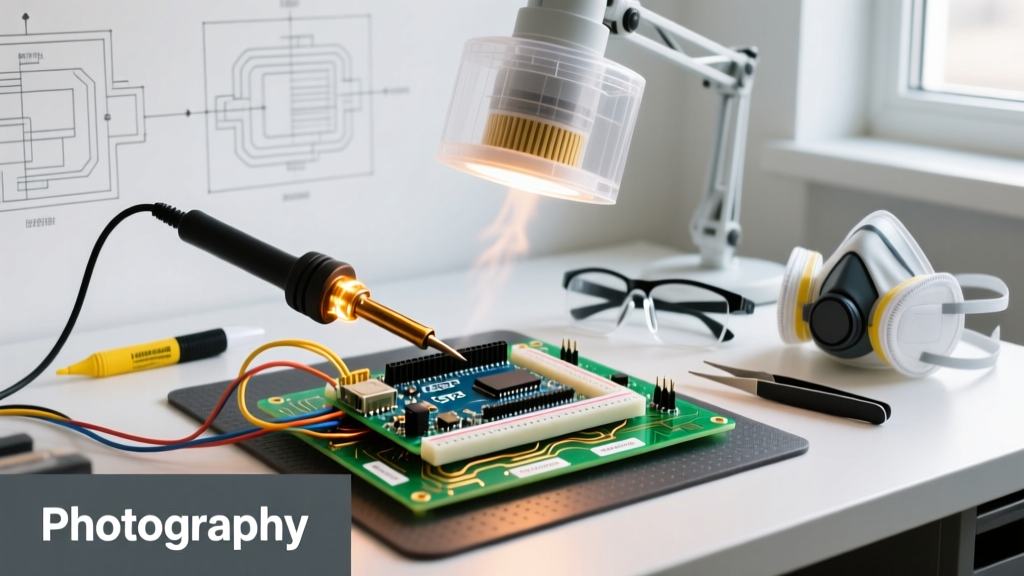
- Ocular Protection: Solder splatter (especially from flux popping under high-heat lead-free profiles) can cause severe corneal burns. You need safety glasses rated to ANSI Z87.1-2020. The Uvex Genesis XC (approx. $25) offers extended wrap-around coverage and an anti-fog coating that resists the humid environment created by soldering plumes.
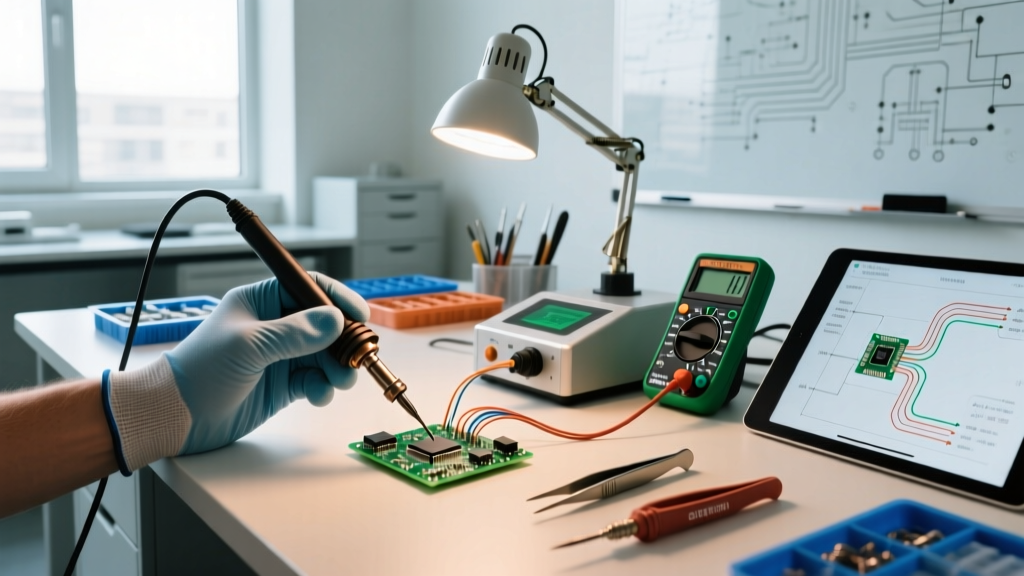
- Dermal Protection (Gloves): Standard latex gloves degrade rapidly when exposed to isopropyl alcohol (IPA) and flux cleaners. Upgrade to 5-mil Nitrile gloves (e.g., Microflex Black Dragon). The 5-mil thickness provides a 10-minute breakthrough time against mild solvents, whereas standard 3-mil medical gloves will fail in under 3 minutes.
- Respiratory PPE (For Unventilated Spaces): If you cannot install a mechanical extractor, a half-mask respirator like the 3M 6200 equipped with 6001 (Organic Vapor) and 2097 (P100 Particulate/Nuisance OV) cartridges is the only acceptable fallback. Note: This is a compromise, not a substitute for source-capture extraction.
- ESD-Safe Matting: While primarily for component protection, a high-quality silicone ESD mat (like the Hakko FX-703) rated to 450°C prevents the toxic off-gassing that occurs when cheaper PVC or rubber mats accidentally contact a 350°C iron tip.
Phase 4: Material Selection and Flux Chemistry
Your choice of solder alloy and flux classification directly dictates your safety requirements. The IPC standards body categorizes fluxes under J-STD-004, and understanding these codes is vital for your health.
The Flux Hazard Hierarchy
- ROL0 / ROL1 (Rosin, Low Activity): The traditional standard. ROL0 has no halides. The primary hazard is the vaporized colophony (pine rosin), which is a known asthmagen. Requires robust carbon/HEPA extraction.
- REL0 / REL1 (Resin, Low Activity): Synthetic resins that are less prone to causing respiratory sensitization than natural rosin. A safer alternative for high-volume manual soldering, though still requiring particulate filtration.
- REH0 / REH1 (Resin, High Activity): Contains aggressive activators and halides to solder through heavy oxidation. The off-gassing includes highly corrosive and toxic hydrogen halides. Mandatory use of localized extraction and eye protection.
Lead-Free vs. Leaded Alloys
While the transition to RoHS-compliant lead-free alloys (like SAC305 - 96.5% Sn, 3.0% Ag, 0.5% Cu) eliminated the systemic neurotoxicity risk of lead (Pb), it introduced a new thermal hazard. Lead-free soldering requires tip temperatures of 350°C to 400°C (compared to 300°C for Sn63/Pb37). This higher thermal energy causes flux to vaporize more violently, increasing the volume of airborne particulate matter by up to 40%. Therefore, switching to lead-free often necessitates an upgrade in your fume extraction capacity.
Frequently Asked Questions (FAQ)
Can I just use a standard desk fan to blow solder fumes away?
No. A desk fan simply disperses the sub-micron rosin particulates and VOCs into the ambient room air, increasing the inhalation risk for everyone in the vicinity. Source-capture extraction (pulling the fume into a filter) is the only acceptable method for managing safety for soldering in an enclosed space.
How often should I replace the carbon filter in my Weller WSA3500?
For a Tier 2 user (10 hours a week), the combined HEPA/Carbon filter should be replaced every 4 to 6 months. A definitive sign that the carbon bed is saturated is when you can smell the sweet, pine-like scent of the rosin flux escaping the exhaust port. Once you smell it, the carbon is no longer adsorbing the VOCs.
Is lead-free solder completely safe to handle without gloves?
While lead-free alloys like SAC305 eliminate the risk of lead absorption through micro-cuts in the skin, the flux residues (especially water-soluble and high-activity variants) are highly acidic and can cause contact dermatitis. Wearing 5-mil nitrile gloves is still highly recommended during the soldering and subsequent cleaning processes.