
The Metallurgy of Jewelry Soldering: Why Gas Torches Dominate
In the realm of fine jewelry manufacturing and high-end repair, thermal management is everything. Unlike printed circuit boards where a 60W electric iron suffices, precious metals like 18k gold, platinum, and sterling silver possess high thermal conductivity and significant mass. Electric soldering irons simply cannot transfer heat fast enough to overcome the heat-sink effect of a heavy gold band or a complex silver bezel. This is why jewelry gas torch soldering remains the undisputed industry standard for fabrication, sizing, and stone-setting repairs in 2026.
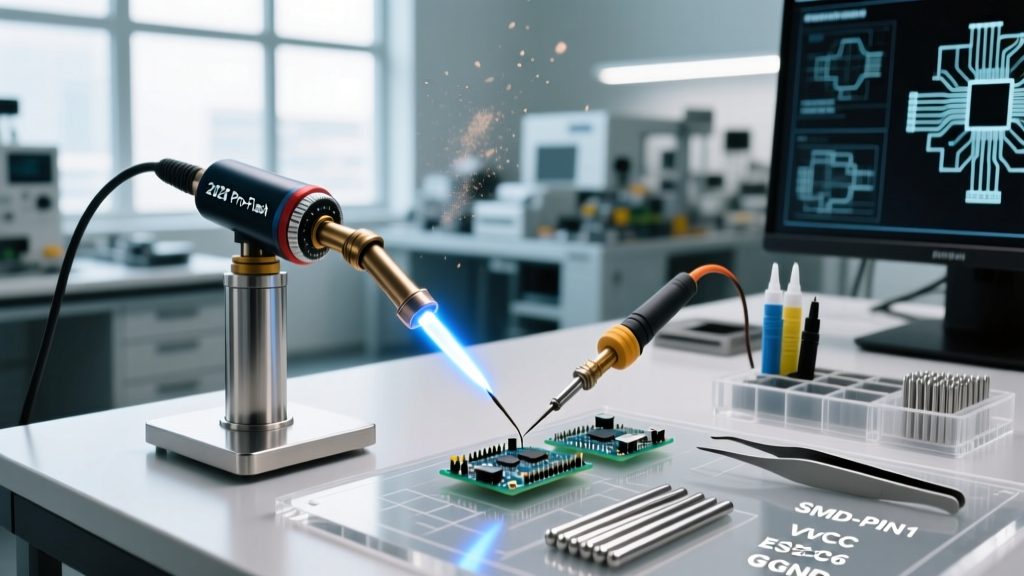
Professional jewelers rely on open-flame gas systems to manipulate the localized thermal envelope, allowing them to bring massive metal components to flow temperature without melting intricate filigree details. This guide breaks down the exact equipment, metallurgical principles, and safety protocols required for a commercial jewelry studio.
2026 Commercial Torch Systems: Market Analysis
Selecting the right torch is the most critical capital expenditure for a new bench jeweler. The market has consolidated around a few high-performance models that offer precise flame control and ergonomic balance for 8-hour production shifts.
| Torch Model | Gas Configuration | Max Temp (Approx) | Best Application | 2026 Price Range |
|---|---|---|---|---|
| Smith Little Torch (23-1001C) | Oxygen / Acetylene | 6,300°F (3,480°C) | Micro-welding, chain repair, pinpoint sizing | $380 - $450 |
| Henrob Delta | Oxygen / Propane | 5,500°F (3,037°C) | Heavy silver fabrication, gold casting repairs | $550 - $620 |
| Proxxon Microflam (28146) | Butane / Air | 2,400°F (1,315°C) | Entry-level repairs, jump rings, light enamel | $90 - $130 |
| Gentec Dual-Gas Bench Torch | Oxygen / Natural Gas | 5,000°F (2,760°C) | High-volume casting tree soldering, melting | $700 - $850 |
System Deep-Dive: The Smith Little Torch vs. Henrob Delta
The Smith Little Torch is legendary for its five interchangeable tips (ranging from a pinpoint #00 to a broad #5). When running oxygen and acetylene, it produces a highly concentrated, intensely hot flame ideal for platinum and high-karat gold. However, acetylene is a dirty gas; it produces soot and requires rigorous tip maintenance.
Conversely, the Henrob Delta utilizes a proprietary mixing chamber that allows it to run on oxygen and propane. Propane burns cleaner and provides a softer, more enveloping flame. This makes the Henrob vastly superior for sterling silver, as the broader flame envelope reduces the risk of localized melting and fire scale formation.
Flame Chemistry and the Thermal Envelope
A fundamental skill in jewelry gas torch soldering is reading the flame envelope. A properly adjusted oxy-gas torch produces three distinct zones:
- The Inner Cone (Oxidizing Zone): The bright blue tip closest to the orifice. This area is oxygen-rich and will oxidize precious metals, creating fire scale. Never use this zone to heat your workpiece.
- The Reducing Zone: Located just past the inner cone. This is the 'sweet spot' for soldering. It is slightly fuel-rich, which actively strips oxides from the metal surface, keeping the seam clean for the solder to flow.
- The Outer Envelope: The cooler, feathery outer edge used for pre-heating the entire piece evenly before focusing the reducing zone on the seam.
'The biggest mistake novice jewelers make is attacking the seam directly with the hottest part of the flame. You must heat the entire mass of the ring or pendant to within 200°F of the solder's flow point using the outer envelope, then introduce the reducing flame to the joint to trigger capillary action.' — Master Bench Jeweler Production Manual
Solder Alloys: Step Soldering and Flow Points
Commercial jewelry fabrication requires 'step soldering'—the process of assembling multiple joints sequentially without melting previous seams. This is achieved by utilizing solders with descending melting points. Modern 2026 alloys have largely eliminated toxic cadmium, relying instead on zinc, tin, and indium to lower flow temperatures.
Standard Gold and Silver Solder Grades
- Hard Solder (Flow Point: 1,425°F - 1,450°F / 774°C - 788°C): Used for the primary structural joints, such as closing the shank of a ring or attaching the main bezel. It has the highest precious metal content and matches the color of the base metal best.
- Medium Solder (Flow Point: 1,275°F - 1,325°F / 690°C - 718°C): Used for secondary joints, like attaching prong heads to a gallery wire or adding decorative elements.
- Easy Solder (Flow Point: 1,145°F - 1,200°F / 618°C - 649°C): Reserved for final sizing repairs, closing jump rings, or attaching earring posts. It contains more base metals and is prone to pitting if overheated.
Advanced Flux Chemistry and Fire Scale Prevention
Flux is not optional; it is a metallurgical necessity. When precious metals are heated, they react with atmospheric oxygen. Copper, which is alloyed with both gold and silver to provide hardness, oxidizes rapidly, forming a black crust (cupric oxide) that prevents solder from wetting the surface.
The Prip's Flux Formula
For comprehensive fire scale prevention on sterling silver, commercial studios rely on Prip's Flux. Unlike standard paste fluxes that are painted onto the seam, Prip's is a liquid barrier applied to the entire piece before soldering.
Authentic Prip's Recipe:
- Boil 300ml of distilled water.
- Dissolve 100g of Boric Acid and 100g of Borax into the boiling water.
- Allow to cool. Heat the silver piece slightly and quench it into the solution.
- Repeat the heat-and-quench process three times to build a glassy, protective crust over the entire item.
This crust physically blocks oxygen from reaching the copper alloy, keeping the silver bright and reducing post-soldering cleanup time by up to 80%.
Critical Production Failure Modes
Even with premium equipment, jewelry gas torch soldering is prone to specific failure modes if thermal dynamics are mismanaged.
1. Solder Balling (Surface Tension Failure)
Symptom: The solder melts into a perfect sphere and rolls away from the seam instead of flowing into the joint.
Cause: The seam is not clean, the flux has burned out, or the metal at the seam is cooler than the solder itself. Solder flows toward heat; if the torch is focused entirely on the solder chip rather than the metal joint, the solder will ball up.
Solution: Quench, pickle the piece to remove oxides, re-flux, and heat the surrounding metal mass, allowing capillary action to draw the molten solder into the joint.
2. Porosity and Pitting
Symptom: The soldered seam looks spongy or develops microscopic pinholes after polishing.
Cause: Overheating the solder, particularly Easy or Medium grades. Excessive heat vaporizes the zinc or tin in the alloy, leaving behind voids. It can also be caused by a heavily oxidizing flame.
Solution: Switch to a larger torch tip to provide a softer, broader flame, and remove the torch the exact second the solder flashes and flows.
3. Melted Workpiece (The 'Slump')
Symptom: The edges of a bezel or filigree wire lose their sharp definition and round off.
Cause: Using a flame that is too concentrated (e.g., a #00 tip on a heavy ring) or failing to use a heat-sink.
Solution: Utilize cross-locking tweezers as a heat sink, or submerge the delicate portion of the piece in a water-filled dish while keeping the soldering seam above the water line.
Industrial Ventilation and Studio Safety Standards
Jewelry gas torch soldering generates hazardous byproducts, including vaporized heavy metals (from the solder alloys), acidic flux fumes (fluorides), and carbon monoxide. Relying on an open window is a severe OSHA violation in a commercial setting.
According to NIOSH guidelines on welding and soldering fumes, local exhaust ventilation (LEV) is mandatory. A commercial jewelry bench must be equipped with an articulated snorkel hood positioned 4 to 6 inches from the soldering block. The exhaust system must pull a minimum of 100 to 150 CFM (Cubic Feet per Minute) per bench to effectively capture the thermal plume of vaporized flux and metal particulates before they enter the jeweler's breathing zone.
Furthermore, studios must adhere to strict gas cylinder protocols. Acetylene cylinders must remain upright to prevent acetone solvent from entering the hoses, and all oxygen lines must be completely free of petroleum-based lubricants to prevent catastrophic flash fires. For comprehensive bench safety layouts and material safety data sheets (MSDS) on modern cadmium-free solders, professionals frequently consult the Ganoksin jewelry manufacturing archives and technical resources provided by major suppliers like Rio Grande.
Conclusion: Investing in Precision
Jewelry gas torch soldering is a synthesis of chemistry, physics, and manual dexterity. Upgrading to a precision system like the Smith Little Torch or Henrob Delta, mastering the reducing flame envelope, and strictly adhering to step-soldering temperature gradients will drastically reduce your scrap rate. In the high-margin world of fine jewelry production, the ability to execute an invisible, structurally sound solder joint on the first attempt is what separates master jewelers from hobbyists.