
The Metallurgy of Industrial Copper Wire
When sourcing copper wire for soldering in high-reliability industrial environments—such as aerospace, medical devices, and automated manufacturing—the metallurgical purity of the conductor is just as critical as the solder alloy itself. Standard commercial wire often falls short when subjected to extreme thermal cycling, high-vibration environments, or aggressive flux chemistries. Understanding the distinction between Electrolytic Tough Pitch (ETP) and Oxygen-Free High Thermal Conductivity (OFHC) copper is the first step in preventing catastrophic joint failures.
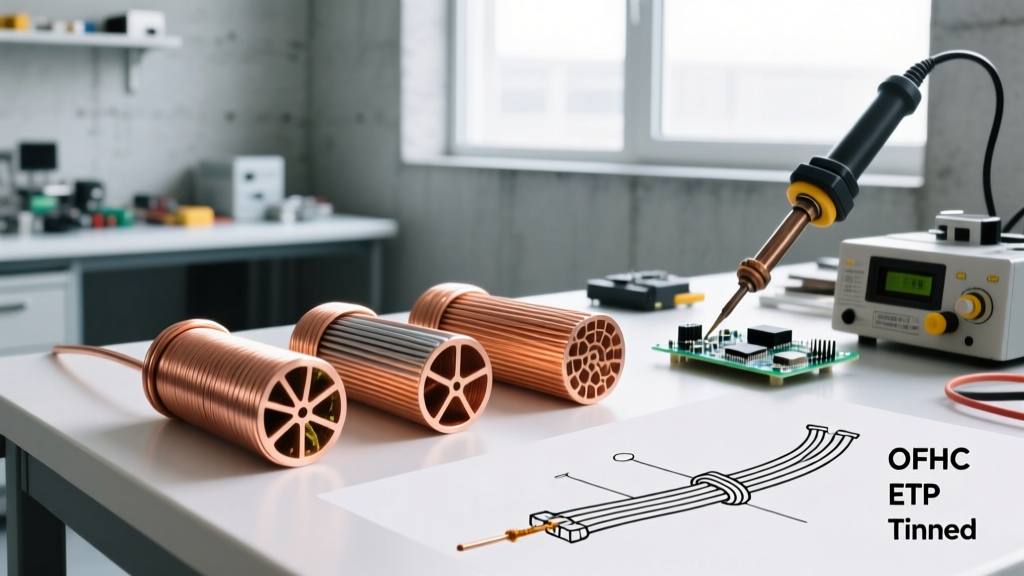
ETP (C11000) vs. OFHC (C10100/C10200)
ETP copper (UNS C11000) is the industry standard for general electrical wiring, containing a minimum of 99.9% copper and up to 0.04% oxygen. While highly conductive and cost-effective, the presence of oxygen creates a vulnerability known as hydrogen embrittlement. When ETP wire is exposed to reducing atmospheres—such as hydrogen-rich soldering fluxes or high-temperature nitrogen/hydrogen furnace environments—the hydrogen reacts with the copper oxide inclusions to form steam. Because the steam cannot escape the solid metal matrix, it creates microscopic internal fissures, leading to brittle wire and eventual mechanical failure at the solder joint.
For mission-critical industrial applications, OFHC copper (UNS C10100 or C10200) is mandatory. OFHC boasts 99.99% purity with oxygen levels strictly controlled below 0.0005%. According to the Copper Development Association, this near-zero oxygen content completely eliminates the risk of hydrogen embrittlement, ensuring the wire maintains its ductility and tensile strength even after repeated high-temperature soldering cycles and harsh chemical flux exposure.
Expert Insight: If your industrial process involves wave soldering, selective soldering, or reflow profiles exceeding 260°C (500°F) with no-clean or water-soluble fluxes, specifying OFHC copper prevents latent micro-cracking that often escapes standard X-ray or AOI (Automated Optical Inspection) quality checks.
Surface Finishes: Bare vs. Tinned vs. Silver-Plated
The surface finish of the copper wire dictates its shelf life, solderability, and high-temperature performance. In industrial procurement, selecting the wrong finish leads to excessive rework, cold joints, and accelerated oxidation.
| Finish Type | Composition | Shelf Life (Solderability) | Max Temp Rating | 2026 Avg. Cost (18 AWG / 1000ft) |
|---|---|---|---|---|
| Bare Copper | Uncoated ETP/OFHC | 3 - 6 Months | 200°C (Insulation dependent) | $45 - $55 |
| Tinned Copper | 1-3 µm Tin Plating | 6 - 12 Months | 150°C (Tin melts at 232°C) | $75 - $95 |
| Silver-Plated | 1-3 µm Silver Plating | 24+ Months | 250°C+ | $180 - $240 |
| Nickel-Plated | 2-4 µm Nickel Plating | 36+ Months | 300°C+ | $210 - $280 |
The Tinned Wire Oxidation Trap
While tinned copper wire is the default choice for most industrial harnesses due to its initial ease of soldering, it presents a hidden failure mode: tin oxide formation. Over 6 to 12 months of warehouse storage, the tin plating oxidizes. Unlike copper oxide, which can often be broken down by mild rosin (R) fluxes, tin oxide requires highly activated rosin (RA) or water-soluble organic acid (OA) fluxes to achieve proper wetting. If assemblers attempt to solder aged tinned wire with standard RMA (Rosin Mildly Activated) flux, the solder will ball up and refuse to flow, resulting in a classic cold joint.
Stranding Classes and the Solder Wicking Phenomenon
Industrial applications demand flexibility, which is achieved through stranding. However, the stranding class directly impacts how solder behaves via capillary action. The ASTM B172 and MIL-W-16878 standards define several stranding classes:
- Class B (Concentric): Standard lay, moderate flexibility. Solder wicks evenly but stiffens the wire significantly.
- Class G (Bunch): Strands are bunched in a single direction without a geometric lay. Highly flexible, but prone to uneven solder wicking and 'bird-caging' (strands splaying out) during stripping.
- Class H (Rope): Multiple bunch groups twisted together. Excellent for robotics and continuous-flex applications.
Mitigating Capillary Wicking in High-Reliability Builds
One of the most common failure modes in industrial wire harnesses is solder wicking—where molten solder is drawn up into the stranded wire beneath the insulation jacket via capillary action. This creates a rigid, brittle section of wire right at the stress relief point. Under industrial vibration profiles, this stiffened section acts as a fulcrum, leading to copper fatigue and wire breakage.
To comply with the IPC-A-610 standard for high-reliability (Class 3) assemblies, solder must not wick into the insulation barrel. Procurement engineers should specify PTFE (Teflon) or Kapton-insulated wire for high-vibration environments. Because solder does not adhere to PTFE, the solder will naturally stop at the strip line, preventing wicking without requiring manual anti-wicking compounds or staggered stripping techniques.
Navigating MIL-SPEC and IPC Standards
For defense, aerospace, and heavy industrial sectors, commercial off-the-shelf (COTS) wire is unacceptable. Procurement must align with strict military and industry specifications. The Defense Logistics Agency (DLA) maintains the active registry for MIL-SPEC components, including the critical MIL-DTL-16878 (formerly MIL-W-16878) specification for extruded insulation wire.
When specifying wire for IPC Class 3 (High Performance) soldering, ensure the following parameters are met:
- Conductor Purity: Must meet ASTM B189 for OFHC or ASTM B170 for ETP.
- Plating Thickness: Silver or tin plating must be a minimum of 40 micro-inches (1 µm) to ensure complete coverage and prevent base metal oxidation during high-heat soldering.
- Insulation Melt-Back: PVC and nylon insulations (like UL1007) suffer from severe melt-back when touched by a 350°C soldering iron. Specifying ETFE (Tzel) or PTFE insulation prevents insulation retraction, which exposes bare copper and creates short-circuit hazards in dense industrial control panels.
2026 Procurement: Pricing and Supply Chain Realities
The global copper market has seen significant volatility, with LME (London Metal Exchange) copper prices stabilizing around $9,800 per metric ton in early 2026. This impacts the procurement strategy for industrial soldering wire. Bulk purchasing of 18 AWG and 20 AWG ETP tinned wire remains the most cost-effective baseline for general industrial control panels, averaging $82 per 1,000-foot spool.
However, for high-temperature environments (e.g., automotive engine bay sensors or industrial boiler controls), the premium paid for nickel-plated OFHC copper with PTFE insulation is justified. While costing upwards of $310 per 1,000-foot spool, it eliminates the cost of field failures, rework, and warranty claims associated with thermal degradation and oxidation-induced cold joints. Smart procurement in 2026 involves locking in long-term contracts for OFHC alloys, as the shift toward EV manufacturing and renewable energy grids continues to strain high-purity copper supply chains.
Frequently Asked Questions (FAQ)
Can I use standard THHN building wire for industrial control panel soldering?
No. THHN wire uses a nylon outer jacket that melts and emits toxic fumes at standard soldering temperatures (300°C - 380°C). Furthermore, THHN stranding is designed for pulling through conduit, not for the fine-pitch termination required in industrial PCBs and relay blocks. Always use UL1015 (for general panel wiring) or MIL-DTL-16878 (for high-reliability) hook-up wire.
Why does my solder refuse to stick to aged tinned copper wire?
The tin plating has oxidized, forming a layer of tin oxide that mild fluxes cannot penetrate. You must either mechanically abrade the wire (which risks damaging the stranding) or switch to a highly activated flux (RA or water-soluble) capable of breaking down heavy oxides. To prevent this, implement FIFO (First-In, First-Out) inventory management and store tinned wire in low-humidity, nitrogen-purged cabinets.
Is silver-plated copper wire worth the extra cost for audio and RF industrial equipment?
Yes. Due to the skin effect, high-frequency RF signals travel primarily on the outer surface of the conductor. Silver has a higher conductivity than copper and is highly resistant to high-frequency signal loss. In industrial RF applications, such as radar arrays or high-speed data telemetry, silver-plated OFHC wire is the undisputed standard despite the 3x to 4x cost premium over standard tinned wire.