
The Economics of Prototyping: Hand Soldering vs. Turnkey PCBA
When transitioning a schematic from a breadboard to a custom PCB, engineers and makers face a critical financial crossroads. The decision of soldering printed circuit board assemblies by hand versus outsourcing to a turnkey Printed Circuit Board Assembly (PCBA) service fundamentally alters your project's burn rate. As we navigate the electronics supply chain in 2026, automated assembly services have become more accessible than ever, yet hand soldering remains a vital skill for rapid, single-unit iteration.
This cost analysis strips away the guesswork. We will evaluate the Capital Expenditure (CapEx), Operational Expenditure (OpEx), and the often-ignored 'rework tax' of manual assembly, comparing them directly against modern PCBA pricing models to help you determine the exact breakeven point for your next hardware run.
Capital Expenditure (CapEx): Building a Production-Ready Soldering Station
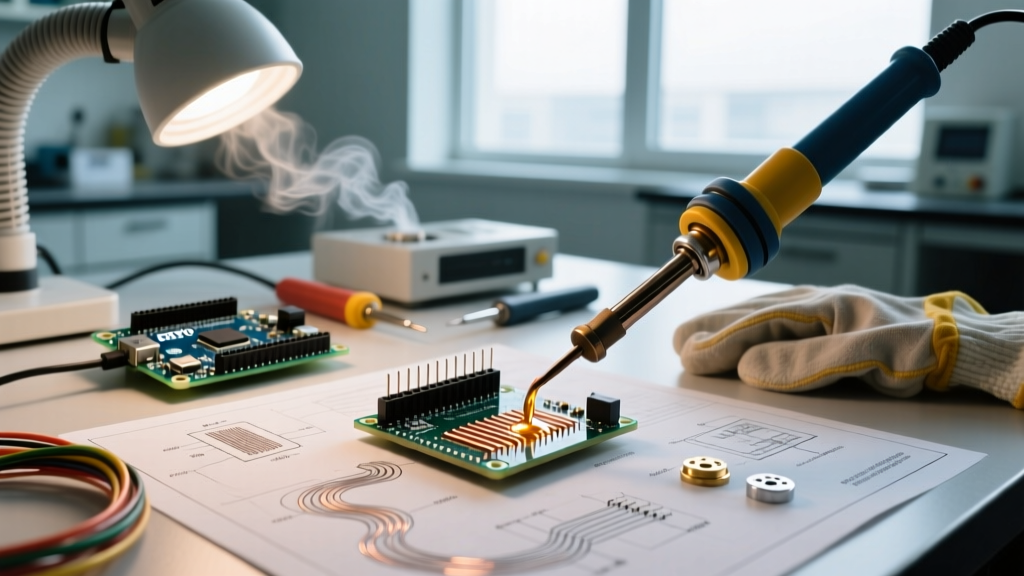
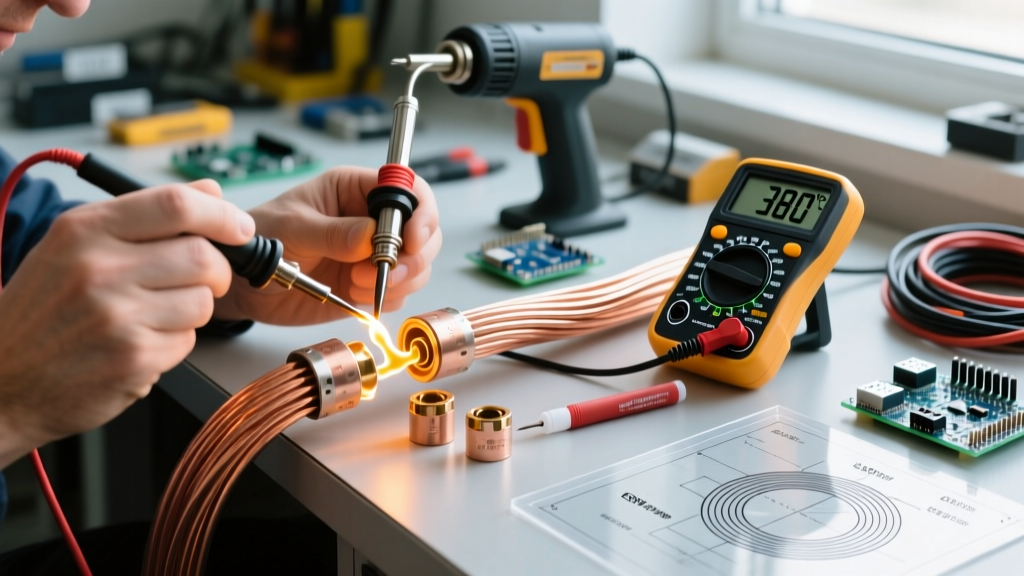
Before you can solder a single joint, you must invest in reliable thermal management. Cheap, unregulated irons cause pad delamination and cold joints, inflating your hidden rework costs. A professional-grade bench setup requires precise temperature control and appropriate tip geometries.
Core Thermal Equipment
- Entry-Level Smart Iron: The Pinecil V2 (approx. $26) offers incredible value, utilizing a RISC-V chip for rapid thermal recovery. However, it requires a separate 65W USB-C PD power supply ($15-$20).
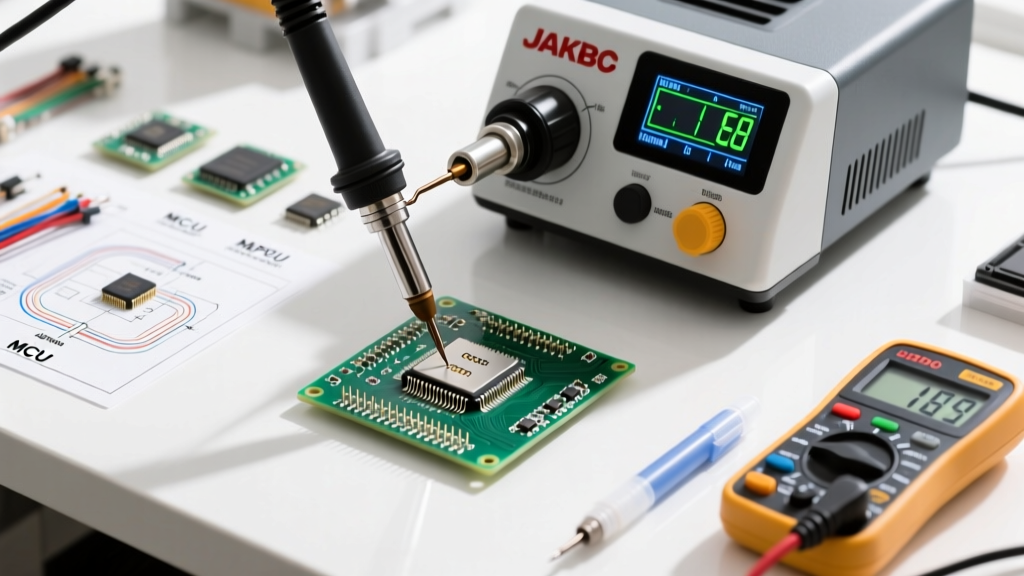
- Industry Standard Bench Station: The Hakko FX-888D ($110) or Weller WE1010NA ($105) remain the workhorses of DIY labs. They provide stable 70W output and a massive ecosystem of T18 and ET-series tips.
- Hot Air Rework Station: Essential for QFN, BGA, and SMD rework. The Quick 861DW ($250) is the gold standard for precise airflow and temperature profiling, though the 858D clones ($45) suffice for basic 0805 and SOIC removal.
Magnification and Inspection
As component densities shrink to 0402 and 0.2mm BGA pitches, the naked eye is insufficient. According to the Adafruit Guide to Excellent Soldering, proper inspection is just as critical as the soldering process itself. A trinocular boom microscope, such as the AmScope SE400-Z ($160), is a mandatory CapEx investment for modern high-density boards, bringing your total baseline CapEx to between $300 and $550.
Operational Expenditure (OpEx): Consumables and the Rework Tax
Consumables represent a recurring cost, but the chemical composition of your solder and flux dictates your failure rate—and therefore your rework time.
Solder Alloy Economics
Leaded eutectic solder (Sn63/Pb37) melts at a forgiving 183°C and exhibits superior wetting characteristics, reducing the time the iron spends on the pad. A 1lb spool of Kester 245 costs roughly $45. Conversely, lead-free alloys like SAC305 (melting point ~217°C) require higher iron temperatures (350°C+), accelerating tip oxidation. While lead-free is mandatory for commercial RoHS compliance, prototyping with Sn63/Pb37 reduces tip replacement costs by up to 40% and drastically lowers thermal damage to FR4 substrates.
The Hidden Cost of Rework
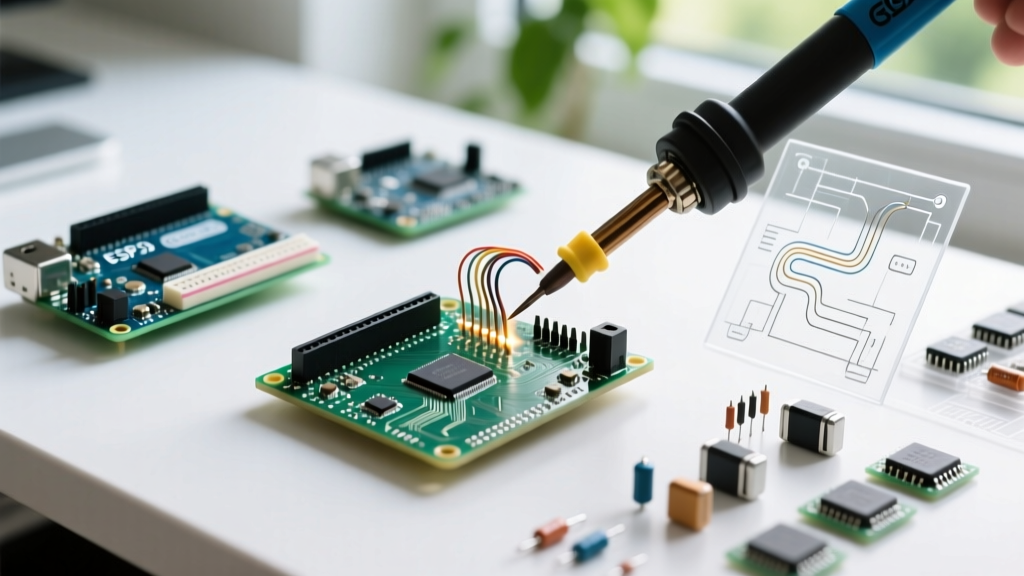
Manual soldering of fine-pitch components introduces defect modes such as tombstoning, solder bridging, and insufficient wetting. Adherence to IPC standards (specifically IPC-A-610 for electronic assemblies) dictates strict criteria for solder fillet geometry. If you bridge a 0.4mm pitch TQFP-44 microcontroller, reworking it requires:
- Applying tacky flux (e.g., Amtech NC-559-V2-TF, $25/syringe).
- Using a hot air station or specialized desoldering wick (e.g., Chemtronics Soder-Wick, $8/spool) to remove excess solder.
- Cleaning the flux residue with isopropyl alcohol (IPA) and a specialized brush.
Assuming a loaded engineering time value of $50/hour, a single 15-minute rework session on a complex IC costs $12.50 in labor, instantly wiping out the perceived savings of hand-assembly over automated services.
Outsourcing: Turnkey PCBA Pricing Mechanics
Turnkey PCBA services (like JLCPCB, PCBWay, or PCBA Store) have revolutionized prototyping economics. They utilize automated processes like wave soldering for through-hole components and precision pick-and-place machines with reflow ovens for SMDs. However, their pricing models are heavily front-loaded.
The PCBA Cost Formula:
Total Cost = (Board Fabrication) + (Stencil Fee) + (Setup Fee) + (Component Cost + Markup) + (Joint Assembly Fee)
Breaking Down the Fees (2026 Market Averages)
- Setup Fee: Typically $8.00 to $12.00 per order, regardless of volume.
- Stencil Fee: $1.50 to $5.00 for a framed or frameless laser-cut steel stencil.
- Joint Fee: $0.003 to $0.005 per SMD joint; $0.01 to $0.02 for through-hole.
- Component Sourcing: 'Basic' parts (common resistors, capacitors, standard logic ICs) often carry a 0% markup. 'Extended' parts (specialized sensors, specific microcontrollers) incur a $0.10 fee per unique part type, plus a 5-15% markup on the component's base price.
Cost Matrix: DIY Hand Soldering vs. Turnkey PCBA
To visualize the financial crossover point, let us model a moderately complex IoT prototype featuring 120 SMD joints (mix of 0603 passives and two QFP-32 ICs) and 10 through-hole connectors. We assume a DIY hourly rate of $50/hr and a hand-soldering time of 1.5 minutes per joint (including fluxing, soldering, and inspection).
| Cost Factor | 1 Prototype (Hand Soldered) | 10 Beta Units (Hand Soldered) | 10 Beta Units (Turnkey PCBA) | 100 Pilot Units (Turnkey PCBA) |
|---|---|---|---|---|
| Equipment / Setup | $400 (Amortized CapEx) | $400 (Amortized CapEx) | $12 (Setup + Stencil) | $12 (Setup + Stencil) |
| Consumables / Parts | $15 (Solder, flux, parts) | $120 (Bulk parts + solder) | $85 (Parts + extended fees) | $650 (Bulk parts discount) |
| Labor / Assembly Fee | $150 (3 hrs @ $50/hr) | $1,500 (30 hrs @ $50/hr) | $4.50 (Joint fees) | $40.00 (Joint fees) |
| Rework Allowance (Est.) | $12.50 (15 min fix) | $125.00 (10 fixes) | $0 (Machine precision) | $0 (Machine precision) |
| TOTAL ESTIMATED COST | $577.50 | $2,145.00 | $101.50 | $702.00 |
| Cost Per Board | $577.50 | $214.50 | $10.15 | $7.02 |
Note: The 1-unit hand-soldered cost is heavily skewed by CapEx amortization. If you already own the tools, the marginal cost of one board is roughly $165 (labor + parts + rework).
The Breakeven Analysis: When to Stop Hand Soldering
The data reveals a stark reality: if you are building more than three to five boards with over 100 SMD joints each, turnkey PCBA is almost always cheaper and vastly superior in reliability. The breakeven point accelerates if your design utilizes 0402 components or BGA packages, as the manual rework tax for these footprints approaches infinity for most hobbyist setups.
When Hand Soldering Wins
- Urgent Single-Unit Iteration: If you need a board in 4 hours and PCBA lead times are 7-14 days, the premium of manual labor is justified by time-to-market.
- Heavy Through-Hole / Connector Boards: PCBA services charge a premium for manual through-hole soldering or require expensive wave-soldering pallets. Boards dominated by large connectors, audio jacks, and terminal blocks are often faster and cheaper to hand-solder.
- High-Mix, Low-Volume Customization: If you are building 5 boards but each requires a slightly different resistor network for analog sensor tuning, managing that variance via PCBA extended part libraries is a logistical nightmare.
Actionable DFM Strategies to Minimize Assembly Costs
Whether you are holding the iron or uploading Gerbers to an assembly house, Design for Manufacturing (DFM) dictates your final bill. Implement these rules during the schematic capture and PCB layout phases:
- Standardize Passive Footprints: Avoid 0201 or 0402 components unless spatial constraints demand them. Standardizing on 0603 (imperial) reduces hand-soldering fatigue and rework time, while keeping you within the 'basic parts' free-tier of most PCBA libraries.
- Consolidate IC Packages: If your design uses three different op-amps in SOIC-8, SOT-23-5, and MSOP-8, you are paying setup and feeder fees for three separate reels. Consolidating to a single package type reduces PCBA extended part fees and simplifies your manual BOM sorting.
- Optimize Thermal Relief on Ground Planes: When hand soldering through-hole components connected to large copper pours, insufficient thermal relief will act as a massive heat sink. This forces you to dwell with a 400°C iron for 10+ seconds, risking barrel plating fractures. Use 4-spoke thermal relief pads to maintain solder flow dynamics without compromising ground impedance.
- Add Fiducial Marks: Always include global and local fiducial marks on your PCB silkscreen/copper layers. PCBA pick-and-place machines rely on these optical targets to align components. Missing fiducials result in manual machine calibration, which some boutique assembly houses will flag and charge an engineering fee to resolve.
Final Verdict
Mastering the art of soldering printed circuit board assemblies is a non-negotiable skill for hardware debugging and rapid proof-of-concept validation. However, treating hand soldering as a scalable manufacturing strategy is a financial trap. By reserving your soldering iron for heavy through-hole components, emergency rework, and single-unit prototypes, and leveraging automated PCBA services for multi-unit SMD runs, you optimize both your capital and your most valuable resource: engineering time.