
The Unique Challenge of the Brazilian Power Grid
For electronics hobbyists, repair technicians, and DIY makers, purchasing soldering equipment is a significant investment. However, when operating in or relocating to Brazil, that investment is immediately complicated by the local power infrastructure. The brazil electrical outlet standard and the country's fractured voltage grid present unique thermal, safety, and financial challenges that most international buying guides completely ignore.
Unlike the standardized 120V/60Hz grid of North America or the 230V/50Hz standard of Europe, Brazil operates on a dual-voltage system that varies not just by region, but often by neighboring municipalities. Furthermore, the physical plug standard is entirely unique to the country. As of 2026, understanding the true cost of acquiring, importing, and adapting soldering stations for this environment is critical to avoiding fried motherboards, melted plugs, and massive import tax penalties.
Deconstructing the ABNT NBR 14136 Standard
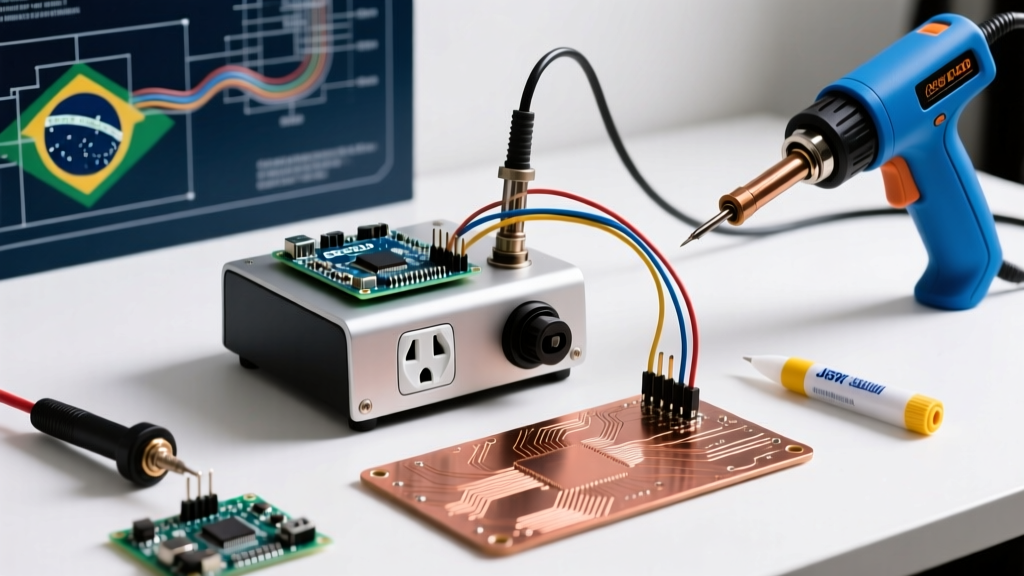
Before analyzing costs, we must define the physical and electrical parameters of the brazil electrical outlet. Brazil uses the Type N plug, governed by the ABNT NBR 14136 standard. According to the IEC World Plugs guide, Type N is based on the IEC 60906-1 specification but is implemented exclusively in Brazil and South Africa.
Voltage Fractures: 127V vs. 220V
The most dangerous aspect of Brazilian power for soldering gear is the regional voltage split:
- 127V Regions (60Hz): Includes major hubs like São Paulo, Rio de Janeiro, and Minas Gerais.
- 220V Regions (60Hz): Includes Santa Catarina, Paraná, Distrito Federal (Brasília), and parts of the Northeast.
If you purchase a traditional transformer-based soldering station (like the Hakko FX-888D or Weller WES51) calibrated for 127V in São Paulo, and later plug it into a 220V socket in Florianópolis without a step-down transformer, the primary coil will saturate, the heating element will receive double its rated voltage, and the station will catastrophically fail—often catching fire.
Amperage Limits: 10A vs. 20A Sockets
The physical brazil electrical outlet features two distinct pin diameters:
- 10A Socket: 4.0mm pin diameter (Standard for most household electronics).
- 20A Socket: 4.8mm pin diameter (Required for high-draw appliances like microwaves and heavy power tools).
Expert Warning: A high-wattage rework station (e.g., 1200W) operating on 127V will draw approximately 9.4 Amps. While this technically fits within a 10A breaker limit, continuous thermal recovery cycles can cause voltage sag and heat buildup in standard 10A wall receptacles. Always verify your lab's wiring and use a 20A receptacle for heavy rework stations to prevent melting the internal brass contacts of the outlet.
Cost Matrix: Sourcing Soldering Stations for Brazil
To determine the most cost-effective route for equipping a soldering bench in Brazil, we must compare three primary acquisition strategies. The following matrix analyzes the total landed cost for a standard 70W digital soldering station equivalent in 2026.
| Acquisition Strategy | Hardware Example | Base Price (USD) | Taxes & Shipping | Total Landed Cost | Voltage Flexibility |
|---|---|---|---|---|---|
| Local Retail (Mercado Livre) | Hakko FX-888D (127V) | $110 | $150+ (Local Markup) | $260 - $320 | None (Fixed) |
| Direct Import (DHL/FedEx) | Weller WE1010 | $125 | $130 (Import Taxes) | $255 - $280 | None (Fixed) |
| USB-C PD Ecosystem | Pinecil V2 + 100W GaN | $26 + $40 | $25 (Standard Tax) | $91 - $110 | Universal (100-240V) |
The Brutal Reality of Brazilian Import Taxes
Many international makers assume they can simply order a dual-voltage or specific-voltage station from Amazon US or Mouser and ship it to Brazil. This ignores the Receita Federal (Brazilian Federal Revenue) taxation structure. When importing electronics via courier (DHL, FedEx, UPS), your shipment is subject to:
- Imposto de Importação (II): A flat 60% tax on the total value of the goods plus shipping costs.
- ICMS (State Tax): A cascading tax that varies by state, typically ranging from 17% to 25% (São Paulo is 17%, but calculation methods often push the effective rate closer to 20-25% of the final value).
- Customs Brokerage Fees: Couriers charge an additional $15 to $30 USD administrative fee to process the customs clearance.
According to the official Remessas Internacionais guidelines from the Receita Federal, there is no tax exemption for courier shipments regardless of value. Therefore, importing a $150 soldering station will reliably result in a final cost of over $280 by the time it reaches your door in Curitiba or São Paulo.
The Hidden Costs and Dangers of Step-Down Transformers
A common workaround for makers who already own 110V/127V North American soldering stations and move to a 220V Brazilian state is the use of an autotransformer (step-down transformer). While a basic 300VA transformer might only cost $30 USD locally at a hardware store like Leroy Merlin, the hidden costs are severe:
1. Thermal Recovery Degradation
Cheap, unregulated autotransformers suffer from voltage sag under dynamic loads. When a soldering iron's tip touches a large copper ground plane, the station demands maximum current to recover thermal equilibrium. A low-quality transformer will experience a voltage drop, starving the heating element and resulting in cold solder joints and prolonged heat exposure to sensitive SMD components.
2. Ground Loop and ESD Risks
Many inexpensive transformers sold in local Brazilian markets lack a proper earth ground passthrough or isolated windings. If the transformer's grounding pin is poorly bonded, your soldering iron tip can float relative to the DUT (Device Under Test) ground, creating a severe Electrostatic Discharge (ESD) risk that can instantly destroy MOSFET gates and sensitive microcontrollers.
The 2026 Smart Solution: USB-C PD Soldering Irons
The most financially and technically sound strategy for navigating the brazil electrical outlet variance is to abandon traditional AC-powered transformer stations entirely in favor of USB-C Power Delivery (PD) soldering irons.
Devices like the Pine64 Pinecil V2 or the Miniware TS101 operate on DC voltage (typically 12V to 24V) negotiated via the USB-C PD protocol. The magic lies in the power brick. A high-quality 100W GaN (Gallium Nitride) charger from brands like Ugreen, Anker, or Baseus features a universal AC input (100V-240V, 50/60Hz).
Why This Eliminates the Brazil Outlet Problem:
- Voltage Agnostic: You can plug the 100W GaN charger into a 127V socket in Rio or a 220V socket in Brasília. The charger's internal PFC (Power Factor Correction) circuit automatically adapts, outputting a stable 20V DC to the iron.
- Plug Adaptability: If your GaN charger has a US Type A/B plug, you only need a simple, passive, $2 physical pin adapter to fit the Type N brazil electrical outlet. Because the iron draws a maximum of 4-5 Amps at 20V (100W), the AC side draw at 127V is less than 1 Amp, making cheap travel adapters perfectly safe and eliminating the need for heavy, expensive voltage transformers.
- Portability: Makers who do field repairs or attend hackathons across different Brazilian states no longer need to carry a 15-pound step-down transformer.
Actionable Buying Framework for Makers in Brazil
If you are setting up a lab or upgrading your bench in Brazil, follow this decision tree to optimize your budget and protect your equipment:
- Identify Your Local Grid: Check your utility bill (e.g., Enel, CPFL, Cemig) to confirm if your specific address is 127V or 220V. Never assume based on the state alone.
- For Precision SMD / Micro-Soldering: Purchase a USB-C PD iron (Pinecil V2 or TS101) and a reputable 100W GaN charger. Buy a high-quality Type N power cable (C5 or C7 figure-8) to replace the US plug cable on the GaN charger, eliminating the need for a physical plug adapter entirely.
- For Heavy Through-Hole / Desoldering: If you require a 70W+ traditional station (like a JBC CD-2BE or Hakko FX-951), buy locally from authorized distributors (e.g., Equipotecnica, Sayro) on Mercado Livre. The 80% local markup is actually cheaper than paying the 60% import tax plus DHL fees, and it guarantees you receive a unit with the correct factory-installed Type N plug and regional voltage calibration.
- Avoid Ungrounded Adapters: Never use a 3-prong to 2-prong "cheater" adapter to fit a grounded soldering station into an older, ungrounded 2-pin Brazilian wall socket. This defeats the ESD safety ground and poses a lethal shock hazard if the station's internal transformer fails.
Final Verdict
The brazil electrical outlet ecosystem demands respect. The combination of the unique Type N physical standard and the unpredictable 127V/220V regional split turns traditional hardware sourcing into a financial minefield. By shifting to USB-C PD technology for 90% of daily soldering tasks, makers can bypass import taxes, eliminate the need for dangerous step-down transformers, and ensure their gear survives a move from São Paulo to Santa Catarina without missing a beat.