
The NBR 14136 Standard: Anatomy of the Brazil Electrical Outlet Plug
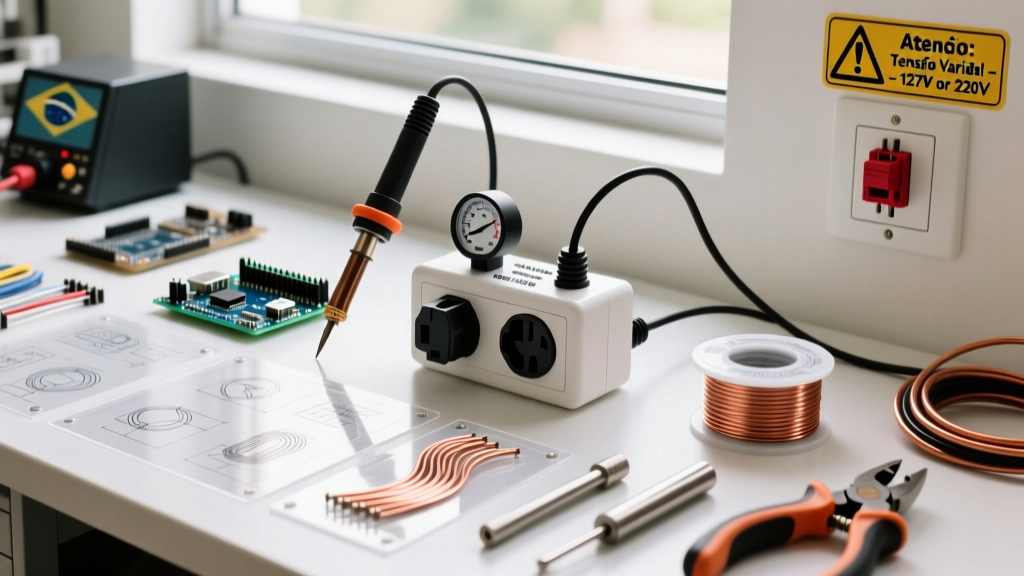
When setting up an electronics lab, importing test equipment, or traveling with professional soldering gear, understanding the local power infrastructure is a critical safety baseline. As of 2026, the Brazil electrical outlet plug operates exclusively under the NBR 14136 standard, commonly known globally as Type N. Unlike the ubiquitous Type A/B (North America) or Type C/F (Europe), Brazil utilizes a unique hexagonal recessed design with three round pins. This physical configuration was engineered specifically to prevent accidental finger contact with live pins during insertion—a vital safety feature in environments where conductive soldering fluxes, metallic tweezers, and wire clippings are prevalent.
10A vs. 20A Pin Configurations
The NBR 14136 standard dictates two distinct current ratings, differentiated by pin diameter and spacing. Confusing these or attempting physical modifications is a leading cause of lab fires.
- 10A Outlets (4.0mm pins): Designed for standard lab equipment and general electronics. A typical 70W soldering station like the Hakko FX-888D or Weller WE1010 draws less than 1A at 120V, making the 10A outlet more than sufficient for standard through-hole and SMD soldering tasks.
- 20A Outlets (4.8mm pins): Reserved for high-draw equipment. If your lab includes a 1000W reflow oven, a high-capacity hot air rework station (e.g., Quick 861DW), or a heavy-duty fume extraction system, you will need a 20A plug and dedicated circuit. Attempting to file down a 20A plug to fit a 10A socket is a severe fire hazard and directly violates OSHA electrical safety guidelines regarding equipment modification and overcurrent protection.
The 127V vs. 220V Regional Trap: A Soldering Station Killer
The most dangerous aspect of the Brazil electrical outlet plug is not its physical shape, but the invisible voltage variance behind it. Brazil does not have a unified national voltage. This regional fragmentation is responsible for thousands of dollars in destroyed laboratory equipment annually, particularly among DIYers and traveling field engineers.
Regional Voltage Breakdown
- 127V Regions (Often labeled locally as 110V): São Paulo, Rio de Janeiro, Minas Gerais, and Bahia. (Frequency: 60Hz)
- 220V Regions: Santa Catarina, Paraná, Distrito Federal (Brasília), and Ceará. (Frequency: 60Hz)
Critical Failure Mode: If you purchase a North American 120V JBC CD-2BQF soldering station and plug it directly into a 220V outlet in Florianópolis without a step-down transformer, the heating element will instantly overheat. The internal thermal fuse will blow catastrophically, and the ceramic heater core will fracture, requiring a $150+ replacement assembly. Conversely, plugging a 220V European station into a 127V outlet in São Paulo will result in severely underpowered performance; the PID controller will max out the duty cycle trying to reach 350°C, leading to premature relay failure and inadequate thermal recovery when soldering heavy multi-layer ground planes.
Grounding and ESD Protection in Brazilian Labs
Electrostatic Discharge (ESD) is the silent killer of sensitive microcontrollers, MOSFETs, and RF modules. The third pin on the Brazil electrical outlet plug is the earth ground. According to ANSI/ESD S20.20 standards, all soldering workstations must be tied to a verified common-point ground to maintain the dissipative properties (10^6 to 10^9 ohms) of your ESD mat and wrist strap.
In older Brazilian buildings (pre-2011 retrofits), you may encounter "fake grounds" where the third pin is wired to the neutral or simply left floating in the wall cavity. Relying on an unverified ground for your ESD mat can actually increase the risk of shocking a component if a fault occurs elsewhere in the building's wiring. Always verify the ground pin impedance before connecting your ESD gear to a Brazilian wall outlet.
Power Conditioning Matrix for Brazilian Soldering Setups
| Solution Type | Best Use Case | Estimated Cost (USD) | Safety Rating |
|---|---|---|---|
| Passive Travel Adapter | Dual-voltage gear (100-240V) like Fluke multimeters or USB-C oscilloscopes. | $8 - $15 | Low (No surge protection) |
| Step-Down Transformer (1000W) | 120V soldering stations used in 220V Brazilian states. | $70 - $120 | High (Galvanic isolation available) |
| Online Double-Conversion UPS | Precision rework stations and lab PCs; protects against regional brownouts. | $250 - $450 | Maximum (Pure sine wave, zero transfer) |
Step-by-Step Pre-Soldering Safety Protocol
Before plugging in any high-wattage thermal equipment into a Brazil electrical outlet plug, execute this 4-step verification protocol to protect both your hardware and your physical safety:
- Visual Recess Inspection: Ensure the hexagonal recess is not cracked or melted. A damaged faceplate can expose the live 4.0mm pins before the plug is fully seated, creating an arc-flash risk in humid environments or when hands are damp from flux cleaners.
- Multimeter Voltage Test: Set your DMM to AC Voltage. Measure Line-to-Neutral. Confirm whether the outlet is delivering ~127V or ~220V. Never trust the wall switch labels, hotel staff, or local verbal advice regarding voltage.
- Ground Integrity Check: Measure Line-to-Ground (should match Line-to-Neutral within 2V) and Neutral-to-Ground (should be < 2V). If Neutral-to-Ground reads > 5V, the grounding system is compromised or overloaded. Do not connect ESD mats or metal-chassis soldering stations.
- Polarity Verification: Use a dedicated polarity tester. While NBR 14136 does not strictly enforce left/right Line-Neutral polarization in the physical mold, modern lab equipment with internal EMI filters relies on correct polarity to safely shunt high-frequency noise to ground.
Safety Warning: Never use a "cheater plug" or ground-lifting adapter to bypass the third pin on a Brazilian outlet. Soldering irons utilize mica and ceramic insulators that can degrade over time; without a dedicated earth ground via the Type N plug, a heater core short will electrify the metal barrel of your iron, posing a lethal shock hazard. For comprehensive physical plug dimensions and safety tolerances, refer to the World Standards Type N documentation.
Mastering the nuances of the Brazil electrical outlet plug ensures your soldering lab remains safe, compliant, and protected from costly voltage-related disasters. Always prioritize verified grounding, precise voltage matching, and heavy-duty power conditioning over convenience when deploying thermal tools in the field.