
The Hidden Hazards of Basic Soldering
When makers and technicians approach basic soldering, the immediate focus is usually on the thermal danger of a 350°C iron tip. However, the most insidious risks in electronics assembly are invisible. As the electronics industry continues to shift toward stricter environmental compliance in 2026, the widespread adoption of lead-free alloys and aggressive flux chemistries has fundamentally changed the safety profile of the workbench. Understanding the intersection of thermal kinetics, chemical vaporization, and particulate exposure is critical for anyone picking up a soldering iron.
According to the UK Health and Safety Executive (HSE), rosin (colophony) flux fumes are a known respiratory sensitizer. Prolonged exposure to vaporized flux can lead to occupational asthma, a condition that can become permanent even after exposure ceases. Furthermore, while lead-free solders like SAC305 (Tin/Silver/Copper) eliminate the heavy metal toxicity of traditional Sn60/Pb40, they require higher operating temperatures, which in turn accelerates flux vaporization and increases the velocity of molten solder splatter.
Fume Extraction: Beyond the Open Window
A common and dangerous misconception in basic soldering is that a standard desk fan provides adequate ventilation. A fan merely dilutes and redirects the plume of vaporized rosin and volatile organic compounds (VOCs), often blowing it directly into the operator's breathing zone. Proper extraction requires capturing the fume at the source and filtering it through activated carbon and HEPA media.
Fume Extractor Comparison Matrix
| Category | Model Example | Filtration Type | Estimated Cost (2026) | Best Use Case |
|---|---|---|---|---|
| Benchtop Fan | Hakko FA-400 | Activated Carbon Filter | $60 - $75 | Hobbyists, occasional repair (2-4 hrs/week) |
| Enclosed Benchtop | Weller WFE2X | HEPA + Gas/Carbon | $650 - $750 | Prosumers, daily prototyping, lead-free work |
| Industrial Extractor | BOFA AD Base 1 | Dual HEPA + Deep Carbon | $900 - $1,100 | Production lines, continuous 8-hour shifts |
Pro Tip: If you are using a budget benchtop extractor like the Hakko FA-400, you must replace the carbon filter every 3 to 6 months. Once the activated carbon reaches its adsorption capacity, it will off-gas trapped VOCs back into your workspace, creating a false sense of security.
Thermal Kinetics and Burn Prevention
Soldering irons operate between 300°C and 400°C. At these temperatures, human skin suffers third-degree burns in a fraction of a second. However, direct contact with the iron is actually the second most common cause of soldering burns; the first is flux splatter.
Flux is designed to boil and clean the oxidation layer off the copper pad. When the liquid flux turns to gas, it expands rapidly. If the iron tip is too hot, or if the solder wire contains a high volume of flux core (e.g., 3% vs 2%), the expanding gas creates micro-explosions, ejecting droplets of molten solder and boiling rosin up to 15 centimeters away from the joint.
Workbench Surface Protection
Never solder directly over a wooden desk or a standard fiberglass mat. Fiberglass mats degrade, fray, and trap hot solder blobs that can later burn your wrists. In 2026, the industry standard for basic soldering workbench protection is a high-density silicone mat.
- Hakko CH1 Silicone Mat ($15 - $20): Withstands up to 500°C. Features molded compartments for holding hot tips and small components. The non-porous surface allows you to easily peel off cooled solder splatter.
- Weller WSA300 ($25 - $30): A heavier, thicker silicone option with integrated magnetic zones to keep tweezers and flush cutters from rolling off the bench.
Personal Protective Equipment (PPE) Requirements
Even with excellent fume extraction, localized splatter and accidental contact are inevitable in basic soldering. Your PPE should be viewed as the last line of defense. Below is the mandatory safety gear checklist for any electronics workbench.
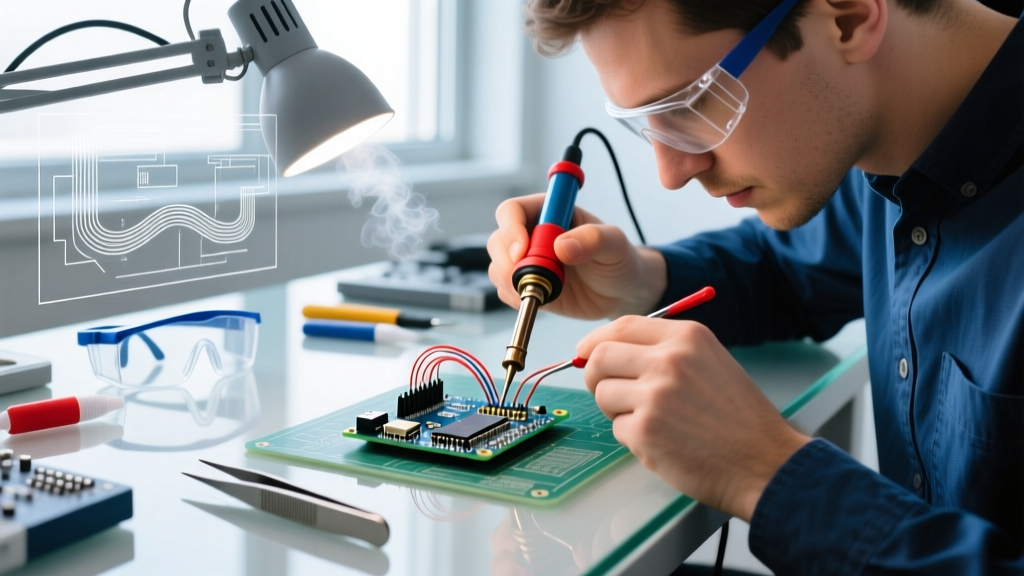
- ANSI Z87.1 Rated Safety Glasses: Standard prescription glasses do not provide adequate wrap-around protection against lateral flux splatter. Invest in a pair of 3M Virtua CCS or Uvex Genesis XC safety glasses ($8 - $15) with anti-fog coating. Soldering generates heat that will quickly fog untreated lenses, causing you to take them off and expose your eyes.
- Nitrile Gloves (for Lead & Flux Handling): While you should never wear bulky thermal gloves while actively holding a soldering iron (they reduce dexterity and can melt), wearing 4-mil nitrile gloves while handling raw solder wire, cleaning flux residue with isopropyl alcohol, or washing PCBs is critical. This prevents dermal absorption of chemicals and heavy metals.
- ESD-Safe Cotton Apron: Synthetic fabrics like polyester or nylon will melt directly into the skin if a hot solder blob lands on your lap. A heavy cotton or canvas apron provides a thermal barrier that will char rather than melt.
The 15-Second Rule: Never leave a hot soldering iron in its holder for more than 15 seconds without verifying the holder's stability. Vibrations from heavy desk equipment or bumping the bench can cause lightweight, wire-coil iron holders to tip over, dropping a 350°C tip onto your lap or power cables.
Lead Handling and Hygiene Protocols
Despite the global push for RoHS compliance, traditional Sn60/Pb40 (Tin/Lead) solder remains popular for hobbyists, aerospace, and medical electronics due to its lower melting point (183°C) and superior wetting characteristics. If your basic soldering involves leaded alloys, strict hygiene protocols are non-negotiable.
The Occupational Safety and Health Administration (OSHA) strictly regulates lead exposure. It is vital to understand that lead does not vaporize at soldering temperatures (its boiling point is 1,749°C). The primary route of lead exposure in electronics assembly is hand-to-mouth transfer. Lead dust and flux residue accumulate on your fingers, and touching your face, eating, or smoking at the bench introduces lead directly into your digestive system.
Heavy Metal Hygiene Checklist
- Dedicated Hand Washing: Wash hands with cold water and heavy-duty soap (like pumice-based mechanic's soap) immediately after soldering. Cold water keeps the pores of your skin closed, preventing lead dust from entering.
- Zero Consumption Zone: Absolutely no food, beverages, or chewing gum within a 2-meter radius of the soldering station.
- Bench Wiping: Wipe down your silicone mat and workbench weekly with a damp paper towel and a mild surfactant. Dry dusting will only aerosolize lead particulates.
Emergency Protocols and First Aid
When a thermal burn occurs, the immediate physiological response is panic, which often leads to improper first aid that worsens the tissue damage. If you sustain a burn from a soldering iron tip or molten solder splatter, follow these exact steps:
- Remove the Heat Source: Drop the iron into its stand. Do not try to catch it.
- Cool the Burn Immediately: Run the affected area under cool (not cold) running water for a minimum of 20 minutes. This halts the thermal transfer into the deeper tissue layers.
- NEVER Apply Ice: Applying ice or ice water causes rapid vasoconstriction, which restricts blood flow and exacerbates tissue necrosis. It can also cause ice burns on top of the thermal burn.
- Do Not Peel Solder Off Skin: If molten solder solidifies on your skin, do not attempt to rip it off while it is hot or immediately after cooling, as it will take the epidermis with it. Cool it with water, and seek medical attention for safe removal.
- Apply a Hydrogel Dressing: After 20 minutes of cooling, cover the area with a sterile, non-adherent hydrogel burn dressing. Avoid traditional ointments or butter, which trap heat and introduce bacteria.
Final Thoughts on Workbench Safety
Mastering basic soldering is as much about cultivating a safety-first mindset as it is about creating shiny, concave fillets. By investing in proper HEPA/carbon fume extraction, upgrading to high-temp silicone mats, and enforcing strict hygiene and PPE protocols, you ensure that your electronics hobby or profession remains sustainable for decades. For more comprehensive data on environmental and heavy metal safety, refer to the Environmental Protection Agency's (EPA) guidelines on lead safety. Protect your lungs, protect your skin, and let your focus remain entirely on the precision of your craft.