
The Shift to Desktop Automatic Soldering
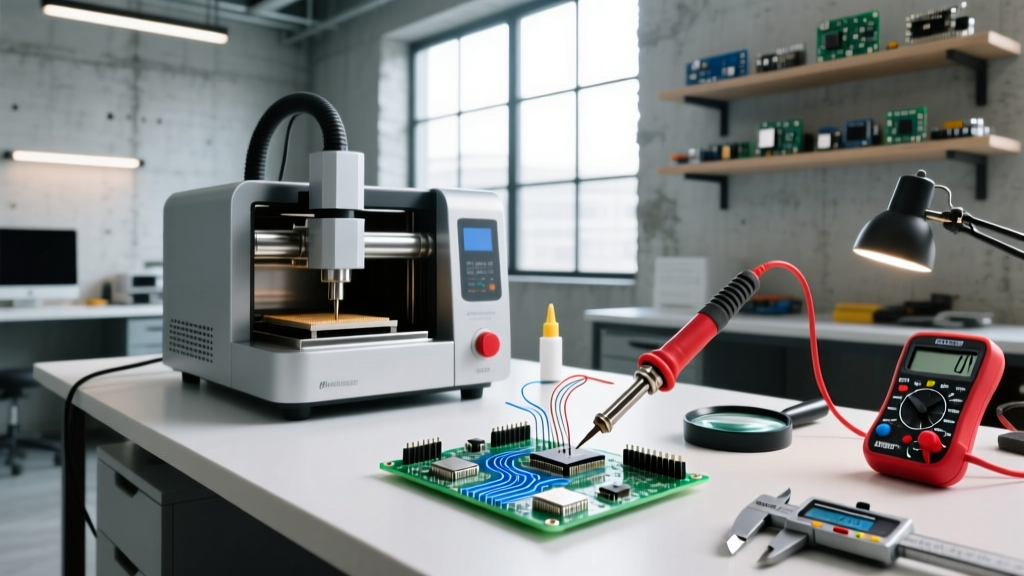
For small-to-medium electronics manufacturers, university research labs, and advanced DIY prototyping hubs, the transition from manual to automatic soldering represents a critical inflection point in production scaling. In 2026, desktop robotic soldering systems have become remarkably sophisticated, bridging the gap between hand soldering and massive industrial selective wave soldering lines. However, the decision to automate is rarely straightforward. It requires a rigorous cost analysis that looks beyond the initial sticker price of the equipment.
When evaluating automatic soldering solutions like the Hakko FR-770 or the JBC RMVE against high-end manual stations like the Pace ADS200, lab managers must account for capital expenditure (CapEx), operational expenditure (OpEx), consumable degradation, and the hidden costs of rework. This comprehensive cost analysis breaks down the true financial impact of integrating desktop automated soldering robots into your PCB assembly workflow.
Capital Expenditure (CapEx): Equipment Pricing Breakdown
The most immediate barrier to entry for automatic soldering is the upfront capital requirement. While a top-tier manual soldering station is a relatively minor line-item expense, a fully integrated desktop robotic soldering arm requires a significant investment in hardware, software licenses, and peripheral safety equipment (such as localized fume extraction and nitrogen generators).
| System Category | Example Model (2026) | Average CapEx | Primary Use Case |
|---|---|---|---|
| Premium Manual Station | Pace ADS200 / JBC CD-2BQE | $650 - $850 | Low-volume prototyping, complex rework |
| Semi-Auto Paste Dispenser | Techcon TS500 Series | $1,200 - $2,500 | SMT pad prep before reflow |
| Desktop Robotic Soldering | Hakko FR-770 / JBC RMVE | $4,200 - $5,500 | High-mix, low-to-medium volume THT/SMT |
| Industrial Selective Wave | ERSA POWERFLOW e N2 | $85,000+ | High-volume, dedicated automotive/aerospace |
For most small-batch operations, the desktop robotic category ($4,200 to $5,500) is the target. This price typically includes the robotic arm, the integrated soldering iron module, the wire feeder mechanism, and the basic teach-pendant software. However, it often excludes the necessary nitrogen supply system, which can add an additional $800 to $1,500 if your facility does not already have centralized N2 plumbing.
Operational Expenditure (OpEx): Consumables and Maintenance
The true financial divergence between manual and automatic soldering occurs on the production floor. Automated systems fundamentally alter the consumption rate and lifespan of critical consumables.
1. Soldering Tip Longevity and Thermal Management
In manual soldering, tip life is heavily dependent on operator discipline. An operator who leaves a Pace ADS200 at 400°C while idle will oxidize the tip plating rapidly, leading to a lifespan of roughly 2,000 to 4,000 joints per tip. Conversely, automatic soldering systems utilize integrated tip cleaners (usually brass wire mesh with micro-solvent application) and strict thermal profiling. The robotic arm only applies heat for the exact milliseconds required to form the intermetallic compound (IMC) layer. As a result, robotic tips routinely achieve 15,000 to 20,000 joints before replacement. While robotic-specific tips (like the JBC C115 or Hakko T18 series adapted for auto-feeders) cost roughly $35 to $50 each, the cost-per-joint drops by nearly 65% compared to manual operations.
2. Solder Wire Waste and Dross Accumulation
Human operators inherently waste solder wire. Misfeeds, accidental extrusion onto the workbench, and excessive application leading to dross buildup typically result in a 10% to 15% material waste rate. Automatic soldering systems utilize precision stepper motors for the wire feeder, extruding the exact millimeter of solder required (e.g., 14mm of 0.8mm Kester 245 core wire per joint). This reduces solder wire waste to under 2%. At current 2026 pricing of $45 to $60 per pound for high-reliability Sn63/Pb37 or SAC305 lead-free wire, this material savings compounds rapidly over a 10,000-unit production run.
3. Nitrogen Gas Consumption
To prevent tip oxidation and improve wetting characteristics, automatic soldering systems heavily rely on localized nitrogen atmospheres. A typical desktop robot consumes between 10 to 15 liters per minute of N2 during active soldering. If you are generating this on-site via a compressed air nitrogen generator, the electrical cost is negligible. However, if you are relying on delivered liquid nitrogen dewars, you must factor in approximately $0.15 to $0.25 per board in gas costs.
Defect Rates, Rework, and IPC-A-610 Compliance
Perhaps the most significant hidden cost in electronics manufacturing is rework. According to the IPC-A-610 standard for acceptability of electronic assemblies, defects such as cold solder joints, disturbed joints, and insufficient wetting require immediate remediation. Reworking a complex surface-mount or densely packed through-hole joint costs an average of $15 to $25 in labor and localized thermal stress, not including the risk of lifting pads on high-density interconnect (HDI) boards.
Manual soldering defect rates in small-batch environments typically hover between 3% and 5%, spiking during operator fatigue at the end of a shift. Automatic soldering systems eliminate human variance. By strictly controlling the pre-heat time, solder feed rate, dwell time, and retract angle, desktop robots routinely push defect rates below 0.5%. When calculating ROI, the reduction in scrap and the elimination of QA bottlenecks often justify the CapEx faster than labor savings alone.
Calculating the Break-Even Point (ROI Framework)
To determine if automatic soldering is financially viable for your specific operation, you must calculate the break-even volume. The NIST Manufacturing Extension Partnership frequently advises small manufacturers to use a comprehensive total-cost-of-ownership model rather than simple labor-replacement metrics.
The Automation ROI Formula:
Break-Even Volume (Units) = [Total CapEx + (Annual Maintenance + N2 Costs)] / [(Manual Labor Cost per Board + Manual Material Waste + Manual Rework Cost) - (Automated Machine Time Cost + Automated Material Waste)]
Real-World Scenario: If your manual labor burden rate is $35/hour, and an operator takes 4 minutes to solder a 40-pin connector (costing $2.33 per board in labor), a robotic arm programmed to solder the same connector in 90 seconds drops the machine-time cost to roughly $0.85 (based on amortized machine hourly rates). You save $1.48 per board in direct labor, plus an estimated $0.40 per board in reduced solder waste and eliminated rework. Total savings: $1.88 per board. Against a $4,800 CapEx, the system breaks even at approximately 2,553 boards. If you produce 500 boards a month, the system pays for itself in just over five months.
Strategic Decision Matrix: When to Automate
Not every project justifies the footprint and setup time of a robotic soldering arm. Use the following matrix to guide your purchasing decision.
| Production Scenario | Recommended Method | Financial Justification |
|---|---|---|
| 1-50 Prototypes (High Mix) | Premium Manual (JBC / Pace) | Programming time for robot exceeds manual soldering time. High flexibility required. |
| 50-500 Units (Complex THT) | Semi-Auto Dispensing + Manual | Use automated flux/paste dispensing to speed up manual THT soldering without full robot programming. |
| 500-5,000 Units (Repeat Runs) | Desktop Robotic (Hakko FR-770) | Amortized programming time is negligible. Massive savings in tip life, solder wire, and QA rework. |
| 10,000+ Units (Dedicated) | Selective Wave Soldering | Desktop robots are too slow for true high-volume. Pallet-based wave soldering is required. |
Frequently Asked Questions
Can automatic soldering robots handle 0402 SMT components?
While desktop robotic soldering arms are primarily designed for through-hole (THT) components, heavy SMT connectors, and wire-to-board terminations, they can technically handle larger SMT pads. However, for microscopic passives like 0402 or 0201 resistors, automated solder paste dispensing followed by reflow oven processing is vastly superior and more cost-effective than attempting to use a robotic iron.
How long does it take to program a robotic soldering path?
Modern systems like the JBC RMVE utilize 'teach-by-demonstration' or CAD-import features. An experienced technician can import a Gerber or centroid file and map the Z-heights for a 100-pin board in roughly 45 to 60 minutes. For simple 10-pin connectors, manual jog-and-teach programming takes less than 10 minutes.
Does automated soldering require special solder wire?
Yes. Automatic soldering systems require solder wire spooled on specific diameter reels (usually 250g to 500g spools) that fit the integrated feeder mechanism. Furthermore, the flux core percentage must be carefully matched to the automated feed rate; a standard 2% flux core may result in insufficient wetting during high-speed robotic joints, so a 2.5% to 3.5% no-clean flux core is often recommended for automated applications.