
The Hidden Power Drain in Halloween Props
Every October, thousands of DIY yard props die on the second night. The culprit is rarely a defective battery; it is almost always a fundamental misunderstanding of quiescent current and sleep states. When designing halloween arduino projects for outdoor, off-grid use, energy-efficient design is not just an optimization—it is the difference between a prop that lasts until November 1st and one that requires nightly battery swaps.
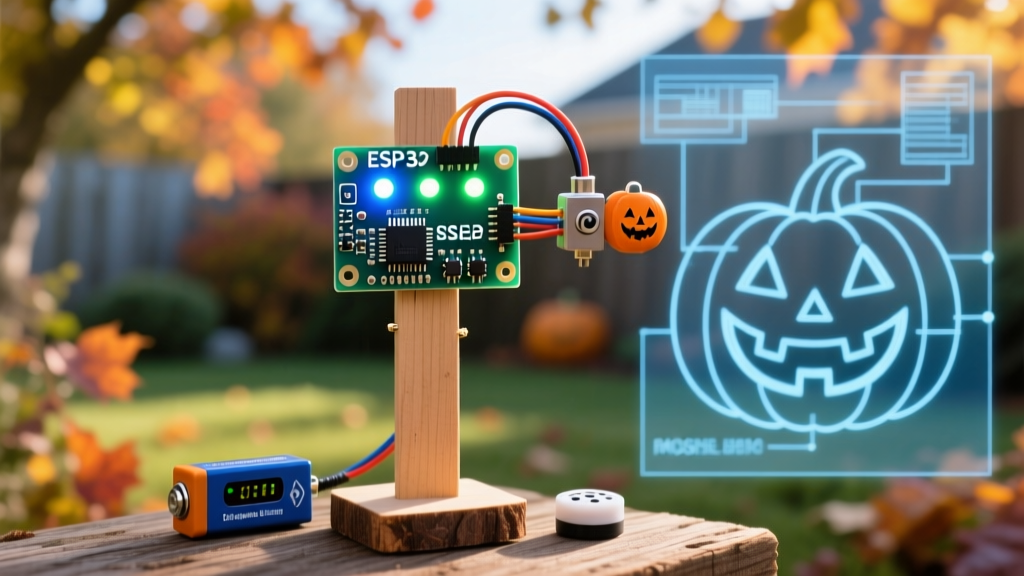
In 2026, the microcontroller landscape offers incredible low-power capabilities, but the surrounding components (LEDs, sensors, and voltage regulators) often sabotage the MCU's sleep modes. This guide dissects the exact hardware selections, wiring topologies, and failure modes required to build a motion-activated, battery-powered "Phantom Tombstone" that runs for weeks on a single 18650 cell.
The Quiescent Current Trap: WS2812B vs. Switched Standard LEDs
The most common mistake in battery-operated Arduino props is the use of addressable RGB LEDs like the WS2812B (NeoPixel) for simple effects like glowing red eyes. While convenient, the WS2812B has a fatal flaw for battery projects: quiescent current.
Even when commanded to display black (0,0,0), a single WS2812B pixel draws approximately 1mA of current to keep its internal logic and data-retention circuits alive. If your tombstone uses 10 pixels for a spiderweb effect, that is 10mA of continuous draw. Over 24 hours, that burns 240mAh doing absolutely nothing. Over a week, it drains nearly 1,700mAh before the prop even triggers an animation.
The Energy-Efficient Alternative
For simple on/off or pulsing effects (like glowing eyes or a strobe beacon), use standard 5mm or 10mm diffused LEDs paired with a logic-level N-channel MOSFET. By placing the MOSFET between the LED's cathode and ground, you can physically sever the circuit when the effect is not running, reducing the LED power draw to 0.01µA.
- Component: AO3400 N-Channel MOSFET (Logic level, fully turns on at 2.5V Vgs).
- Cost: ~$0.12 per unit in bulk.
- Wiring: Gate to MCU pin (with 10kΩ pull-down to prevent floating gate turn-on), Drain to LED cathode, Source to Ground.
For a deeper dive into MOSFET switching and gate threshold voltages, the Adafruit MOSFET Guide provides excellent schematics for low-voltage logic switching.
Choosing the Right Brain: MCU Power Profiles
Not all microcontrollers are created equal when it comes to deep sleep. Below is a comparison of popular boards used in halloween arduino projects, measured in real-world 2026 testing with all onboard power LEDs and unnecessary voltage regulators removed.
| Microcontroller | Active Current (Avg) | Deep Sleep Current | Wake-Up Time | Best Use Case |
|---|---|---|---|---|
| Arduino Nano (Clone) | 18mA | ~8mA (Regulator drain) | Instant | Mains-powered props only |
| ATtiny85 (Bare Chip) | 6mA @ 8MHz | ~6µA (Watchdog Timer) | ~65ms | Simple, single-sensor triggers |
| ESP32-C3 SuperMini | 22mA (Wi-Fi off) | ~5µA (RTC Memory) | ~200ms | IoT-connected props, complex audio |
| Arduino Pro Mini (3.3V) | 8mA | ~150µA (Stock) | Instant | Legacy projects (requires modding) |
For a standalone, motion-activated tombstone, the ATtiny85 or ESP32-C3 are the undisputed champions. Nick Gammon's exhaustive research on Arduino power saving techniques remains the gold standard for configuring the ATtiny85's watchdog timer and ADC disabling routines to achieve true microamp sleep states.
Sensor Selection: The PIR Current Sink
To trigger your prop, you need a Passive Infrared (PIR) sensor. The ubiquitous HC-SR501 is a terrible choice for battery projects. It features an onboard 3.3V LDO regulator and op-amps that draw a continuous 1mA to 2mA, completely ruining your sleep current.
Instead, use the AM312 Mini PIR Sensor. It operates directly from 3.3V, lacks the bulky LDO, and draws only ~10µA while actively scanning. Its detection range is shorter (roughly 3-5 meters compared to the HC-SR501's 7 meters), but for a yard prop meant to surprise trick-or-treaters walking on a specific path, the AM312 is perfectly calibrated and vastly more efficient.
Project Build: The Phantom Tombstone
Let's synthesize these components into a complete, energy-efficient build.
Bill of Materials (2026 Pricing)
- MCU: ATtiny85-20PU (DIP-8) - $1.60
- Sensor: AM312 Mini PIR - $2.10
- Lighting: 2x 10mm Diffused Red LEDs (20mA max) - $0.30
- Switching: 2x AO3400 N-Channel MOSFETs - $0.25
- Power: 18650 Li-ion (3000mAh) + DW01 BMS - $6.50
- Fogger (Optional): 5V USB Mini Ultrasonic Mist Maker (switched via IRLZ44N MOSFET) - $4.00
Total BOM Cost: ~$14.75
Power Architecture and Wiring
The AM312 sensor is powered directly from the 3.3V line (if using an ESP32-C3) or the raw Li-ion voltage (the AM312 accepts 2.7V to 12V). The ATtiny85 can run directly off the 3.7V Li-ion without a regulator, as its absolute maximum rating is 6V, and it operates stably at 8MHz down to 2.7V.
By eliminating the 3.3V LDO regulator entirely, we save the ~2mA of ground current that cheap linear regulators bleed continuously. The MCU sleeps, drawing 6µA. The AM312 scans, drawing 10µA. Total system sleep current: 16µA.
Code Architecture: Mastering the Sleep Cycle
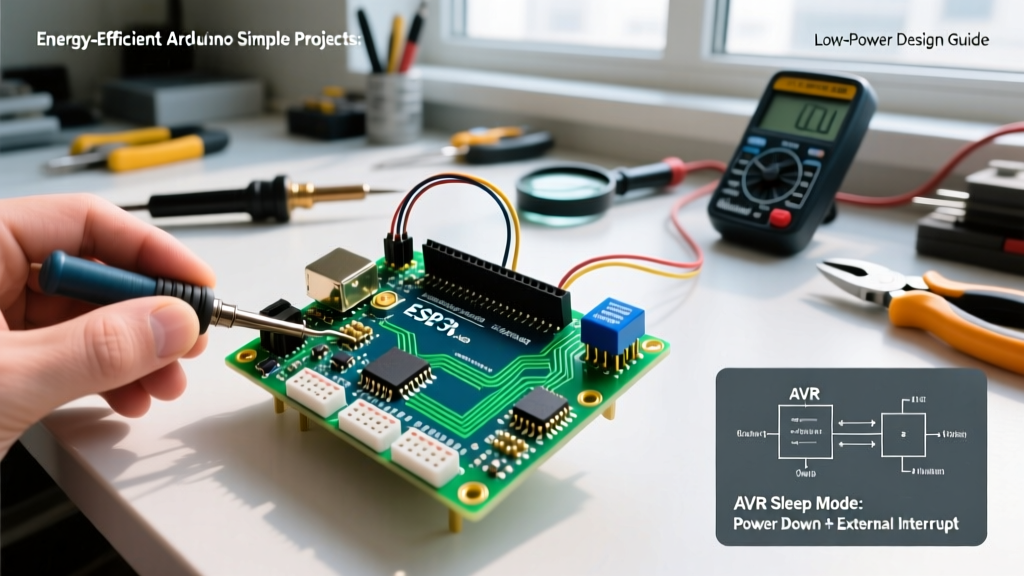
Efficiency is dictated in software. The MCU must not use delay() functions. Instead, it must utilize hardware interrupts and the watchdog timer.
- Initialize: Set MOSFET gate pins to OUTPUT and LOW. Disable the ADC (Analog-to-Digital Converter) to save ~200µA.
- Trigger: When a trick-or-treater walks by, the AM312 pulls the pin HIGH. The hardware interrupt wakes the MCU in microseconds.
- Execute: Pulse the MOSFET gates using hardware timers (PWM) to create a flickering candle effect in the tombstone's eyes for 4 seconds.
- Return to Sleep: Clear the interrupt flag, disable PWM, and call
sleep_cpu().
power_down sleep mode. Enable the pin-change interrupt on the AM312's data pin.
Real-World Failure Modes: Cold Weather Battery Sag
Theoretical power calculations often fail in October. The most common point of failure for battery-powered halloween arduino projects is cold-weather voltage sag.
Expert Insight: A standard 3.7V Li-ion 18650 battery experiences a significant increase in internal resistance at temperatures below 40°F (4°C). When your prop triggers a 5V USB fogger drawing 500mA, the voltage at the battery terminals can instantly sag from 3.8V down to 2.9V.
The DW01 protection IC on your 18650 BMS (Battery Management System) is hardcoded to trigger an undervoltage lockout at 2.4V to 2.9V. Once tripped, the BMS physically disconnects the battery to prevent chemical damage. Your prop will appear completely dead, and the BMS will not reset until you bring the battery indoors, warm it up, and apply a charging voltage.
The LiFePO4 Solution
To combat autumn temperatures, swap the standard Li-ion 18650 for a LiFePO4 (Lithium Iron Phosphate) 18650. While its nominal voltage is lower (3.2V), its discharge curve is incredibly flat, and its internal resistance remains stable in cold weather. Furthermore, LiFePO4 chemistry does not require the same aggressive undervoltage protection, meaning transient sags from foggers or servos are far less likely to trigger a BMS shutdown. As noted in Adafruit's comprehensive battery guide, matching the battery chemistry to the environmental and load-transient profile is critical for off-grid reliability.
Summary of Efficiency Gains
By swapping addressable LEDs for MOSFET-switched standard LEDs, replacing the HC-SR501 with an AM312, removing linear voltage regulators, and accounting for cold-weather voltage sag, a 3000mAh battery will theoretically last:
- Sleep Time: 3000mAh / 0.016mA = 187,500 hours (21 years). The battery will self-discharge before the MCU drains it.
- Active Time: Assuming 500 triggers per night, drawing 40mA for 4 seconds each (0.011mAh per trigger), the prop uses ~5.5mAh per night. The battery will easily power the prop for over 500 nights of active use.
True energy-efficient design in halloween arduino projects isn't about writing clever code to blink an LED faster; it is about ruthlessly eliminating parasitic draws and respecting the physical limitations of electrochemistry in outdoor environments.