
Beyond Novelties: What Makes Arduino Projects Useful?
The internet is saturated with blinking LEDs and basic weather stations. But when homeowners and DIY engineers search for Arduino projects useful enough to integrate into their daily lives, the criteria shift dramatically. A truly useful home automation project must solve a tangible problem, offer a measurable return on investment (ROI), and operate with 99.9% reliability. Off-the-shelf smart home ecosystems like Tuya or Zigbee are excellent for simple lighting, but they fall short when you need custom sensor fusion, ultra-low latency, or strict local privacy.
In 2026, with the rise of local-first smart home hubs like Home Assistant and Matter-over-Thread, the Arduino ecosystem remains a powerhouse for bridging legacy hardware with modern automation. Below, we break down three highly practical, real-world Arduino home automation builds. We provide exact component models, wiring logic, and the specific failure modes you must engineer around to ensure these systems survive in the real world.
Project 1: Multi-Zone HVAC Damper Control System
Central forced-air systems are notorious for uneven heating and cooling. According to the U.S. Department of Energy, improper zoning and thermostat placement can lead to massive energy waste. Commercial smart dampers cost upwards of $250 per zone. We can build a highly effective alternative for a fraction of the cost.
Hardware & Architecture
- Microcontroller: Arduino Mega 2560 (Requires 15+ I/O pins for multiple zones).
- Actuators: 28BYJ-48 5V Stepper Motors with ULN2003 driver boards.
- Sensors: DHT22 temperature/humidity sensors per room.
- Power: Dedicated 12V 5A switching power supply (bucked to 5V for steppers).
The 28BYJ-48 stepper motor features an internal 1:64 gear reduction, providing immense torque at low speeds—perfect for moving lightweight aluminum HVAC dampers. The ULN2003 Darlington transistor array handles the current switching, protecting the Mega’s fragile GPIO pins.
The Logic & Edge Cases
The Arduino polls the DHT22 sensors every 60 seconds. If a room deviates from the target setpoint by more than 1.5°F, the Mega sequences the stepper motor to open or close the corresponding duct damper.
Critical Failure Mode: Stepper motors do not have built-in limit switches. If the code loses track of the step count, the motor will stall against the duct wall, drawing continuous current and overheating the ULN2003 driver.
Mitigation: Implement a software timeout in your C++ code. If the motor is commanded to step for more than 2.5 seconds (the physical limit of a 90-degree damper swing), cut power to the driver pins immediately and trigger an MQTT error alert to your home hub.
Project 2: Catastrophic Water Leak Auto-Shutoff
Water damage is one of the most expensive home insurance claims. The EPA WaterSense program notes that household leaks can waste nearly 10,000 gallons of water annually, but catastrophic pipe bursts cause immediate structural ruin. A useful Arduino project must intervene before a small drip becomes a flooded basement.
Hardware & Architecture
- Microcontroller: Arduino Nano 33 IoT (Features built-in WiFi and an ECC608 crypto chip for secure MQTT).
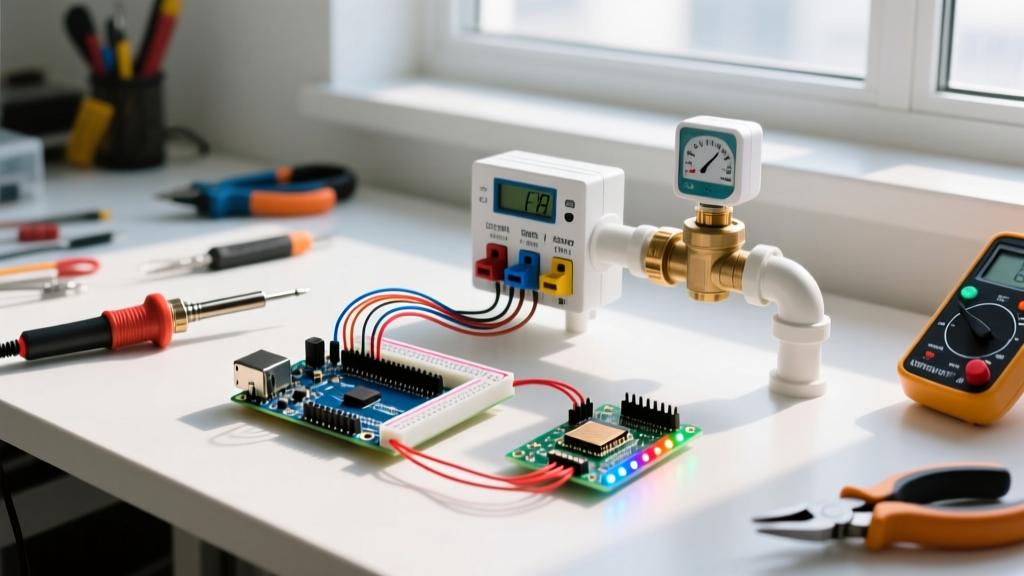
- Valve: US Solid 1" Motorized Brass Ball Valve (3-Wire, Auto-Return).
- Sensors: Resistive water leak probes placed under the water heater, washing machine, and kitchen sink.
- Power Backup: 12V UPS module with a 5F supercapacitor bank.
The Logic & Edge Cases
The Nano 33 IoT monitors the analog voltage drop across the water sensors. When water bridges the probe gap, resistance drops, triggering an interrupt. The Arduino immediately sends a HIGH signal to the valve's control wire, rotating the brass ball to the closed position in under 5 seconds.
Pro-Tip on Power Failure: If a pipe bursts and simultaneously shorts out your home's main breaker, a standard smart valve will fail in its current (open) state. By using a 3-wire auto-return valve paired with a supercapacitor bank on the 12V rail, the Arduino detects the brownout via an interrupt pin and uses the stored capacitor energy to execute one final valve-closing sequence before the system dies.
Project 3: Precision VPD Grow Tent Climate Controller
For indoor horticulture, maintaining the correct Vapor Pressure Deficit (VPD) is critical for plant transpiration and nutrient uptake. VPD requires simultaneous, precise calculations of temperature and relative humidity to control exhaust fans and humidifiers dynamically.
Hardware & Architecture
- Microcontroller: Arduino Uno R4 WiFi (Offers a 32-bit ARM Cortex-M4 for fast floating-point VPD math and native WiFi).
- Sensor: Bosch BME280 (I2C interface, vastly superior accuracy to DHT sensors).
- Switching: 4-Channel 5V Opto-Isolated Relay Module.
The Logic & Edge Cases
The Uno R4 reads the BME280 every 10 seconds, calculating the VPD using the Magnus-Tetens approximation formula. If the VPD drops below 0.8 kPa (indicating high humidity/stagnant air), the Arduino triggers the exhaust fan relay.
Critical Failure Mode: Inductive loads like inline duct fans and humidifier compressors generate massive back-EMF (electromagnetic interference) when switched off. This voltage spike can arc across the relay contacts, welding them shut, or travel back through the ground plane and fry the Uno's microcontroller.
Mitigation: Never use standard relay boards for inductive loads without protection. You must solder an RC snubber network (a 100Ω resistor in series with a 0.1µF capacitor) across the relay's COM and NO terminals. Additionally, ensure the relay board is opto-isolated and powered by a separate 5V buck converter, sharing only the ground reference with the Arduino.
Microcontroller Selection Matrix for Home Automation
Choosing the right board is the first step in ensuring your project is actually useful and not just a prototype. Here is how the top contenders stack up for 2026 home automation builds:
| Microcontroller | Architecture | Connectivity | Best Use Case | Approx. Cost (2026) |
|---|---|---|---|---|
| Arduino Mega 2560 | 8-bit AVR | None (Requires ESP-01) | High I/O pin count (HVAC Dampers, Security Zones) | $38.00 |
| Arduino Nano 33 IoT | 32-bit ARM Cortex-M0+ | WiFi, BLE, Crypto | Secure, compact sensors (Water Leak, Door Locks) | $21.50 |
| Arduino Uno R4 WiFi | 32-bit ARM Cortex-M4 | WiFi, BLE, LED Matrix | Complex math & fast processing (VPD, PID Loops) | $27.50 |
Critical Hardware Mitigations for Long-Term Reliability
To elevate your build from a weekend toy to a permanent home fixture, you must address physical layer vulnerabilities.
1. I2C Bus Capacitance and Pull-Up Resistors
Sensors like the BME280 communicate via I2C. The standard Arduino Wire library enables internal pull-up resistors, but they are weak (often 20kΩ to 50kΩ). If you run I2C cables longer than 30cm, the parasitic capacitance of the wire will round off the square wave signals, causing data corruption and system hangs.
The Fix: Disable internal pull-ups in your code and solder physical 2.2kΩ resistors between the SDA/SCL lines and the 3.3V/5V rail at the sensor end of the cable. Use 22 AWG stranded, shielded twisted-pair wire for runs exceeding 1 meter.
2. Ground Loops and Sensor Noise
When sharing a power supply between high-current actuators (like stepper motors or solenoid valves) and sensitive analog sensors, the voltage drop on the ground wire will introduce massive noise into your analog readings.
The Fix: Implement a star-ground topology. Run a dedicated ground wire from the power supply's negative terminal directly to the Arduino's GND pin, and separate ground wires directly to the motor drivers. Never daisy-chain the ground connections of high-current and low-current components.
Final Thoughts on Practical Automation
The most useful Arduino projects for home automation are not defined by their complexity, but by their reliability and the specific friction they remove from your daily life. By selecting the correct microcontroller architecture, engineering around inductive and capacitive failure modes, and writing defensive code that anticipates hardware stalls, you can build systems that rival or exceed commercial smart home offerings in both privacy and performance.