
The Community Challenge: Escaping the Arduino IDE Default Path
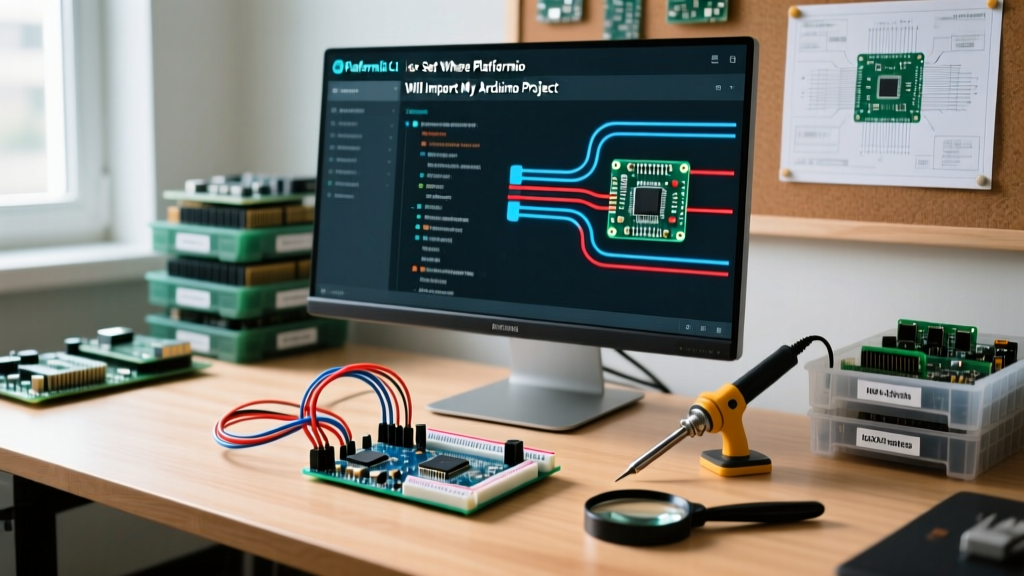
Transitioning from the Arduino IDE to PlatformIO is a rite of passage for serious embedded developers. However, one of the most frequent questions we see in the ElectricalFlux community forums is: how to set where platformio will import my arduino project without messing up existing Git repositories or monorepo structures. By default, the Arduino IDE forces your sketches into a rigid ~/Arduino directory. When you use the PlatformIO Home GUI to 'Import Arduino Project', it often dumps the converted files into a default workspace or temporary directory, completely ignoring your carefully planned version-control folder hierarchy.
Community Spotlight: 'I was building an ESP32-S3 LoRa Mesh Network for a local agriculture co-op,' shares community member Alex T. 'My entire CI/CD pipeline relied on a specific monorepo structure. When I imported my Arduino sketch via the PIO GUI, it created a nested mess in my Documents folder and broke my GitHub Actions workflow. I needed absolute control over the import destination.'
In this 2026 community showcase guide, we break down three battle-tested methods to dictate exactly where PlatformIO places your imported Arduino files, ensuring your src, lib, and include directories land exactly where your build system expects them.
Method 1: The VS Code 'Open Folder' Pre-Initialization Trick
The most common mistake developers make is opening VS Code, clicking the PlatformIO Alien icon, and selecting 'Import Arduino Project' from the home screen. This relinquishes path control to PIO's internal defaults. Instead, use the file-system-first approach.
- Create your target directory manually: Open your terminal or file explorer and create the exact folder where you want the project to live (e.g.,
C:/Workspace/AgriTech/lora-mesh-node/). - Open the folder in VS Code: Go to
File > Open Folderand select your newly created, empty directory. - Copy your Arduino files: Manually copy your
.inofile and any localsrcor custom library folders into this directory. - Initialize PlatformIO in place: Click the PlatformIO icon in the left sidebar, select PIO Home > Open, and instead of 'Import', click New Project.
- Match the details: Name the project identically to your folder, select your board (e.g.,
esp32-s3-devkitc-1), and ensure the Location dropdown is set to Custom, pointing to your currently open VS Code workspace. - Merge and Rename: PIO will generate a
platformio.iniand asrc/main.cpp. Open your original.inofile, copy the code intomain.cpp, add#include <Arduino.h>at the top, and delete the.inofile.
Method 2: The CLI Approach for Exact Path Control
For developers who prefer the terminal or are scripting their workspace setup, the PlatformIO Core CLI offers surgical precision over project initialization and import paths. This is the method Alex used to salvage his LoRa mesh project.
Instead of relying on the GUI's import wizard, you can initialize a PlatformIO environment directly inside your existing Arduino sketch folder using the PlatformIO Project Initialization command.
# Navigate to your existing Arduino sketch directory
cd ~/GitRepos/SmartHome/esp32-climate-sensor

# Initialize PIO in the current directory, specifying the board and IDE
pio project init --ide vscode --board esp32dev

# Convert the .ino file to .cpp manually or via script
mv climate_sensor.ino src/main.cpp
By running pio project init inside the target directory, PlatformIO generates the platformio.ini, .vscode configurations, and required folder structure (lib, include, test) exactly where you are currently standing. It will never move your files to an arbitrary default location. This method is highly recommended for integrating Arduino code into existing Git repositories where the root directory must remain clean.
Method 3: Remapping Directories in platformio.ini
Sometimes, you don't just want to control where the project is imported; you want to fundamentally change where PlatformIO looks for source files and libraries after the import. This is crucial for monorepos where multiple firmware targets share a common library directory located outside the standard project root.
PlatformIO allows you to override default directory paths using the Directory Options in your platformio.ini file.
| Configuration Variable | Default Path | Custom Monorepo Example | Use Case |
|---|---|---|---|
src_dir |
src |
../../shared_firmware/src |
Sharing core logic across multiple MCU boards. |
lib_dir |
lib |
../common_libs |
Centralizing custom Arduino libraries for team use. |
include_dir |
include |
../../shared_firmware/include |
Sharing global header files and pin definitions. |
data_dir |
data |
assets/spiffs_data |
Customizing the SPIFFS/LittleFS upload directory. |
To implement this, simply add the variables under your environment block:
[env:esp32dev]
platform = espressif32
board = esp32dev
framework = arduino
src_dir = ../../shared_firmware/src
lib_dir = ../common_libs
Critical Edge Cases: Why Imported Arduino Projects Fail to Compile
Setting the correct import path is only half the battle. When migrating from the Arduino IDE to PlatformIO, the build environment changes fundamentally. The Arduino IDE uses a hidden, temporary build folder and aggressive auto-inclusion. PlatformIO uses a strict, localized build matrix. Here is how to troubleshoot the most common post-import compilation failures.
1. The Missing Arduino.h Header
The Arduino IDE automatically injects #include <Arduino.h> into your sketch during the pre-processing stage. PlatformIO does not. If you import an .ino file, rename it to main.cpp, and hit build, you will immediately face 'undefined reference' errors for pinMode, digitalWrite, or Serial.
The Fix: Always add #include <Arduino.h> at the very top of your main.cpp and any custom .cpp files you add to the src directory. Header files (.h) do not strictly require it unless they utilize Arduino-specific types like String or uint8_t without including stdint.h.
2. Library Dependency Finder (LDF) Modes
In the Arduino IDE, if a library is in your global libraries folder, it is available to all sketches. PlatformIO isolates dependencies per project. Furthermore, PlatformIO's Library Dependency Finder (LDF) defaults to a 'chain' mode, meaning it only scans for #include directives in your src folder. If you have a library that dynamically includes other libraries via macros or complex C++ templates, the LDF might miss them.
The Fix: If your imported project throws 'fatal error: SomeLibrary.h: No such file or directory' despite being installed in the project's lib folder, force the LDF into a deeper scanning mode in your platformio.ini:
[env:esp32dev]
; Forces LDF to scan all directories deeply
lib_ldf_mode = deep+

; Alternatively, explicitly declare dependencies
lib_deps =
    bblanchon/ArduinoJson@^7.0.0
    knolleary/PubSubClient@^2.8.0
3. Handling Custom Hardware Abstraction Layers (HAL)
Many advanced community projects utilize custom board definitions or hardware abstraction layers that aren't natively supported by standard PlatformIO board manifests. If your imported Arduino project relied on a custom boards.txt or platform.txt override, simply importing the code won't carry over those compiler flags.
The Fix: You must manually translate custom Arduino IDE compiler flags into PlatformIO's build_flags directive. For example, if your Arduino IDE required a specific partition scheme for OTA updates, you would configure it like this:
[env:esp32_ota]
board = esp32dev
board_build.partitions = min_spiffs.csv
build_flags =
    -DCORE_DEBUG_LEVEL=4
    -DBOARD_HAS_PSRAM
Community FAQ: PlatformIO Import Paths
- Can I import an Arduino project directly from a GitHub URL?
Yes. Using the CLI, you can clone the repository to your desired custom path first, and then runpio project initinside that cloned directory. This ensures the Git history remains intact and the project root is exactly where you cloned it. - What happens to my Arduino 'sketchbook' libraries?
PlatformIO does not automatically link your global Arduino IDElibrariesfolder. It is highly recommended to use thelib_depsfeature inplatformio.inito pull libraries from the PIO Registry or GitHub. If you must use local legacy libraries, copy them into the project'slibfolder or pointlib_extra_dirsto your Arduino sketchbook path. - Does changing the import path affect the ESP32 flash upload process?
No. The physical destination of the files on your host machine's hard drive has zero impact on the serial upload process to the microcontroller. However, keeping a clean, predictable path structure prevents issues with SPIFFS/LittleFS data partition uploads, which rely on thedata_dirconfiguration.
Mastering your workspace directory structure is the first step toward professional embedded development. By taking manual control of how and where PlatformIO imports your Arduino projects, you eliminate pathing errors, streamline your Git workflows, and build a foundation for scalable IoT deployments.