
Redefining Arduino Basic Projects for Robotics
When beginners search for arduino basic projects, they are typically met with tutorials on blinking LEDs, reading potentiometers, or logging room temperature. While foundational, these projects fail to prepare builders for the physical realities of robotics: high-current inductive loads, voltage sag, and sensor noise. In 2026, the barrier to entry for amateur robotics is lower than ever, but the most common point of failure remains power management and drivetrain integration.
This guide elevates the standard arduino basic projects curriculum by walking you through the design, power architecture, and assembly of a robust 2-Wheel Drive (2WD) Obstacle-Avoiding Rover. We will bypass the outdated, inefficient motor drivers of the past decade and focus on modern, reliable component integration.
The 2026 Bill of Materials (BOM): No-Compromise Components
To build a rover that doesn't reset every time a motor stalls, we must select components based on electrical tolerances rather than just the lowest price tag. Below is the optimized BOM for a reliable 2WD platform.
| Component | Specific Model / Variant | Estimated Cost (2026) | Why This Component? |
|---|---|---|---|
| Microcontroller | Arduino Uno R4 Minima | $19.50 | 32-bit ARM Cortex-M4 offers faster math for sensor filtering; 5V tolerant I/O. |
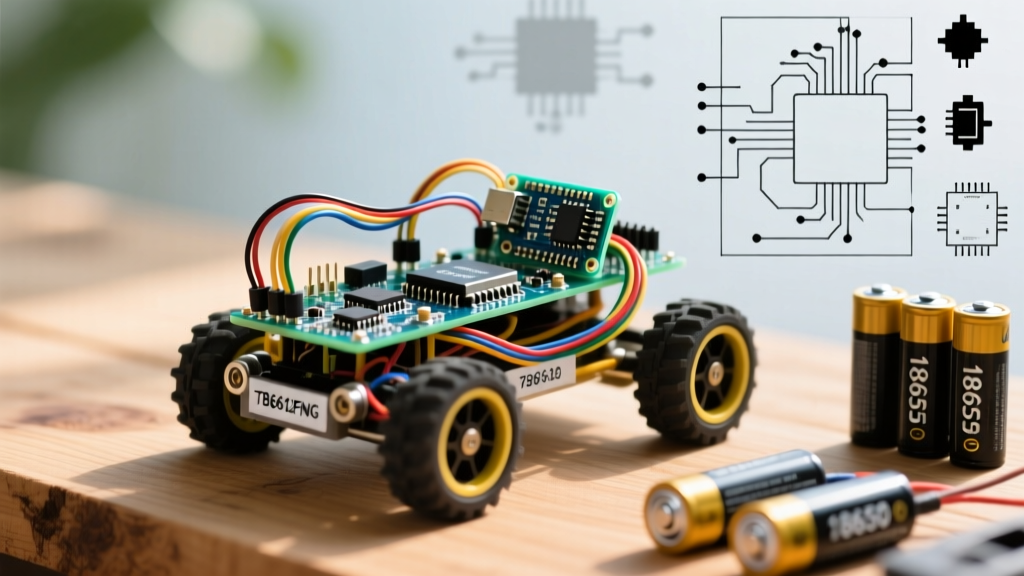
| Motor Driver | TB6612FNG Carrier (Pololu) | $4.50 | MOSFET-based H-bridge. 1.2A continuous, 3.2A peak. Vastly superior to the BJT-based L298N. |
| Chassis & Motors | Acrylic 2WD Kit w/ TT Gearmotors | $12.00 | 1:48 gear reduction provides high stall torque (approx. 8kg-cm) at low speeds. |
| Power Source | 2x 18650 Li-ion (e.g., Molicel P26A) | $14.00 | 7.4V nominal. Capable of 20A+ continuous discharge without severe voltage sag. |
| Voltage Regulator | LM2596 Buck Converter Module | $2.50 | Steps 8.4V down to 5.5V efficiently, bypassing the Uno's wasteful linear regulator. |
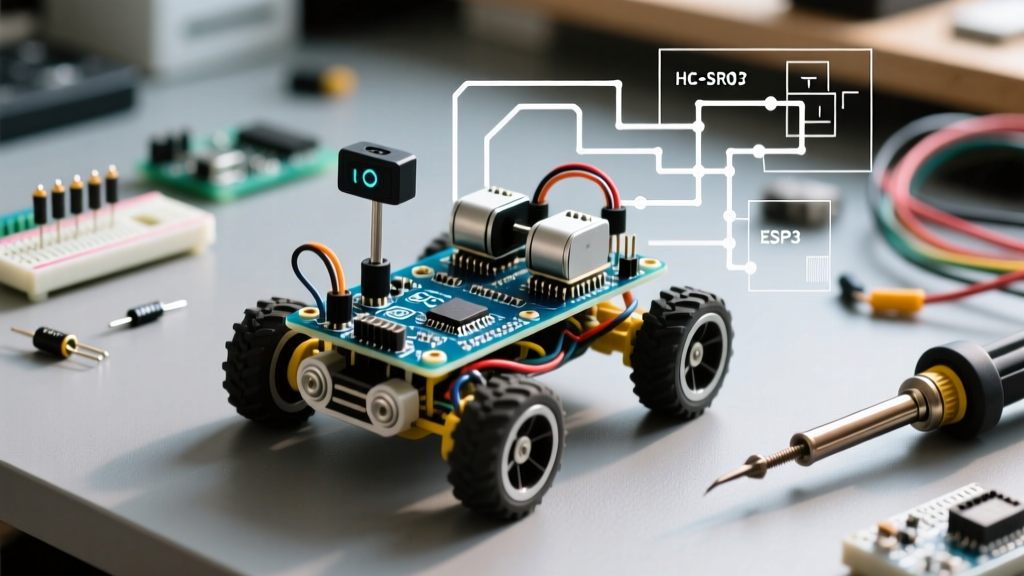
| Proximity Sensor | HC-SR04 Ultrasonic | $1.50 | 40kHz acoustic transceiver; effective range of 2cm to 400cm. |
| Sensor Pan Mechanism | SG90 Micro Servo (9g) | $2.50 | Allows 180-degree scanning without requiring the entire chassis to rotate. |
Total Hardware Cost: ~$56.50 (Excluding 18650 charger and soldering consumables).
Power Architecture: Escaping the 4x AA Battery Trap
The most pervasive failure mode in arduino basic projects involving motors is the use of 4x AA battery holders. Standard alkaline AA cells suffer from high internal resistance. When a TT gearmotor starts or hits an obstacle, it draws a stall current of up to 2 Amps. This massive current draw causes the voltage from a 4x AA pack (nominally 6V) to sag below 4.0V, instantly triggering a brownout reset on the microcontroller.
Expert Insight: Never power motors and logic from the same unregulated rail without decoupling. The back-EMF (electromotive force) generated when motors abruptly stop injects high-frequency voltage spikes back into the power lines, which can corrupt I2C/SPI data or permanently damage the MCU's silicon.
The Solution: Use two high-quality 18650 Lithium-Ion cells in series (7.4V nominal, 8.4V fully charged). According to the Arduino Uno R4 Minima Documentation, the board can accept up to 21V on the VIN pin, but feeding 8.4V into the onboard linear regulator generates excessive heat. Instead, route the 18650 pack through an LM2596 buck converter. As detailed in the Texas Instruments LM2596 Buck Regulator Datasheet, this switching regulator steps the voltage down to a clean 5.5V with over 90% efficiency. Feed this 5.5V directly into the Arduino's 5V pin (bypassing the onboard regulator) and the TB6612FNG's VCC pin.
Drivetrain Control: Why We Ditch the L298N
For years, the L298N dual H-bridge was the default for robotics kits. However, it relies on outdated Bipolar Junction Transistor (BJT) technology, resulting in a voltage drop of 1.5V to 2.0V across the chip. If you supply 6V to an L298N, your motors only see ~4.0V.
We use the TB6612FNG. As highlighted by the Pololu TB6612FNG Motor Driver Carrier specifications, this MOSFET-based driver features an on-resistance of just 0.5Ω. The voltage drop is negligible, meaning your TT motors receive nearly the full battery voltage, resulting in higher torque and longer battery life. Furthermore, the TB6612FNG supports PWM frequencies up to 100kHz, allowing for ultra-smooth motor speed control via the Arduino's analogWrite() function.
TB6612FNG Wiring Matrix
| TB6612FNG Pin | Connects To | Function / Notes |
|---|---|---|
| VCC | Arduino 5V | Logic power for the H-bridge IC. |
| VM | 18650 Pack (+) | Motor power rail (7.4V - 8.4V). |
| GND | Common Ground | Must share ground with Arduino and Battery. |
| STBY | Arduino 5V | Pull HIGH to enable the driver. LOW puts it in sleep mode. |
| PWMA / PWMB | Arduino D5 / D6 | PWM pins for speed control of Motor A and B. |
| AIN1 / AIN2 | Arduino D4 / D7 | Digital pins for Motor A direction. |
| BIN1 / BIN2 | Arduino D8 / D9 | Digital pins for Motor B direction. |
Sensor Integration: Taming the HC-SR04 Ultrasonic
The HC-SR04 is a staple of arduino basic projects, but in real-world robotics, it is notoriously noisy. The sensor operates by emitting a 40kHz acoustic burst and timing the echo using the pulseIn() function. Two major edge cases cause rovers to crash:
- Acoustic Absorption: Soft surfaces like curtains, couches, or carpets absorb high-frequency sound waves rather than reflecting them. The sensor times out, returning a false "clear path" reading, and the rover drives straight into the sofa.
- Crosstalk & Multipath Ghosting: In environments with hard, angled walls, the 40kHz pulse can bounce off multiple surfaces before returning, resulting in phantom distances that are mathematically impossible for the robot's current speed.
Implementing a Median Filter
To solve this, never rely on a single pulseIn() reading. Instead, take 5 rapid readings, discard the highest and lowest outliers, and average the remaining three. This median filtering technique eliminates transient acoustic ghosting without introducing the severe latency of a standard moving average.
Additionally, mount the HC-SR04 on an SG90 micro servo. By panning the sensor from 45° to 135° only when the forward distance drops below 30cm, you conserve battery and processing cycles, allowing the rover to make informed left/right turn decisions based on spatial mapping rather than blind bumping.
Mechanical Assembly & Troubleshooting Edge Cases
When assembling the acrylic 2WD chassis, builders often overtighten the M3 screws directly into the plastic or thin acrylic. This causes micro-fractures that shatter the chassis upon the first collision. Always use M3 brass threaded insert nuts or nylon locknuts to distribute mechanical stress.
Common Failure Modes to Watch For:
- Ground Loops: If the servo jitters erratically, it is usually due to a ground loop. The SG90 draws up to 700mA during stall. Ensure the servo ground wire is tied directly to the battery ground, not just daisy-chained through a thin breadboard trace.
- Motor Direction Inversion: If your code commands "Forward" but the rover spins in circles, one of your TT motors is wired out of phase. Simply swap the two wires on the offending motor's TB6612FNG output terminals (AO1/AO2 or BO1/BO2).
- Ultrasonic Timeout Crashes: If the
pulseIn()function lacks a timeout parameter (e.g.,pulseIn(echoPin, HIGH, 30000)), a missed echo will cause the Arduino to hang indefinitely. Always cap the timeout at 30,000 microseconds (approx 5 meters).
Conclusion: Building a Foundation for Advanced Robotics
By treating arduino basic projects with the same engineering rigor as professional robotics, you eliminate the frustration of unexplained resets and erratic sensor data. Upgrading to a TB6612FNG motor driver, implementing proper 18650 power delivery via a buck converter, and applying median filtering to your ultrasonic sensors transforms a toy-like kit into a reliable, autonomous platform. Once this 2WD foundation is mastered, you are perfectly positioned to scale up to 4WD Mecanum platforms, PID-based line tracking, and eventually, ROS2 (Robot Operating System) integration on companion SBCs.