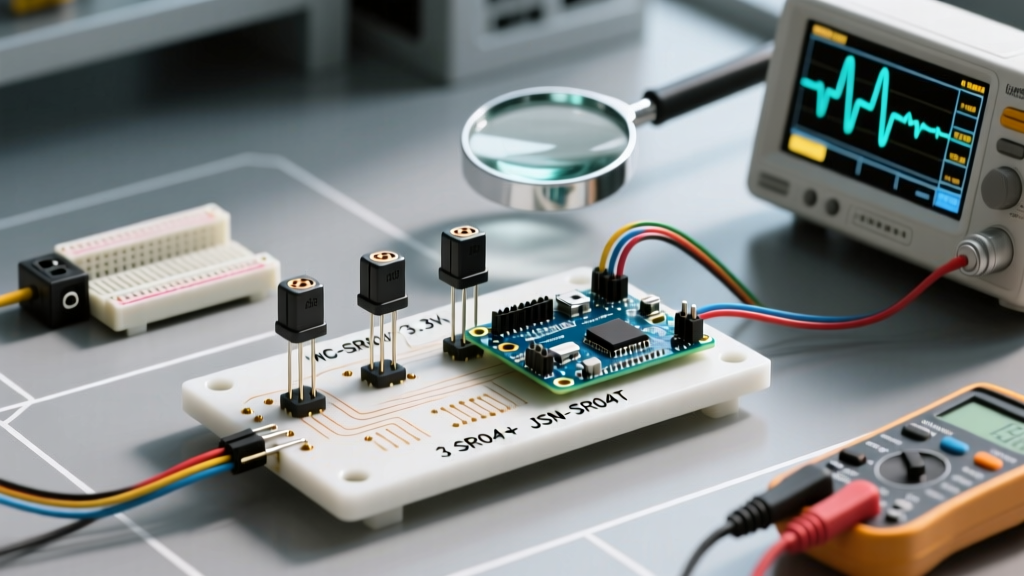

The Ultrasonic Dilemma: Beyond the Default HC-SR04
The HC-SR04 ultrasonic sensor with Arduino is arguably the most ubiquitous distance-measuring module in the DIY electronics ecosystem. Priced at roughly $1.50 to $2.00 in 2026, it serves as the default time-of-flight (ToF) introduction for thousands of makers. However, as projects graduate from breadboard prototypes to ruggedized, real-world deployments, the limitations of the classic HC-SR04 become glaringly apparent. Logic-level incompatibilities with 3.3V microcontrollers, acoustic crosstalk, and environmental drift frequently derail advanced builds.
In this component comparison, we dissect the classic HC-SR04 against its modernized sibling, the HC-SR04+, and the ruggedized, waterproof JSN-SR04T V2.0. By examining internal silicon, beam acoustics, and edge-case failure modes, you will learn exactly which 40kHz transducer belongs in your next schematic.
Quick Verdict: Which Sensor Should You Choose?
- HC-SR04 (Classic): Best for 5V Arduino Uno/Mega indoor prototypes on a strict budget.
- HC-SR04+ (Upgraded): Mandatory for ESP32, Arduino Due, or any 3.3V logic ecosystem. Eliminates the need for external logic level shifters.
- JSN-SR04T V2.0: Required for outdoor, automotive, or high-humidity environments. Features a separated waterproof probe but suffers from a larger acoustic blind spot.
Component Showdown: Specifications & Pricing Matrix
Before diving into the physics and failure modes, let us establish the baseline hardware specifications. Pricing reflects average 2026 market rates from major electronic component distributors.
| Feature | HC-SR04 (Classic) | HC-SR04+ (Upgraded) | JSN-SR04T V2.0 |
|---|---|---|---|
| Operating Voltage | 5V DC Only | 3.3V to 5V DC | 3.3V to 5V DC |
| Logic Level (Echo Pin) | 5V TTL (Requires divider for 3.3V) | Matches VCC (3.3V safe) | Matches VCC (3.3V safe) |
| Blind Spot (Min Range) | ~2 cm | ~2 cm | ~20 to 25 cm |
| Maximum Range | 400 cm | 400 cm | 450 cm |
| Environmental Rating | Indoor / Dry | Indoor / Dry | IP67 Waterproof Probe |
| Avg. Unit Price (2026) | $1.50 - $2.00 | $3.20 - $4.50 | $8.50 - $12.00 |
Deep Dive: The Classic HC-SR04
The standard HC-SR04 relies on a pair of 40kHz piezoelectric transducers—one for transmitting an acoustic burst, and one for listening for the echo. Internally, the timing and signal conditioning are typically handled by an EM78P153N 8-bit microcontroller or a comparable unmarked SOP-16 ASIC. The module sends an 8-cycle burst at 40kHz when the Trigger pin is held high for at least 10 microseconds.
The 3.3V Logic Trap
The most common point of failure for modern makers using the HC SR04 ultrasonic sensor with Arduino-compatible boards like the ESP32 or Arduino Nano 33 IoT is the Echo pin's output voltage. The classic HC-SR04 outputs a strict 5V TTL signal on the Echo pin. Feeding a 5V signal directly into a 3.3V GPIO pin on an ESP32 will eventually degrade or destroy the silicon. While a simple resistor voltage divider (e.g., 1kΩ and 2kΩ) solves this, it adds wiring complexity and parasitic capacitance that can slightly skew nanosecond-level timing measurements.
The Logic-Level Savior: HC-SR04+
Recognizing the industry's shift toward 3.3V microcontrollers, manufacturers released the HC-SR04+. Visually identical to the classic model, the '+' variant features a redesigned PCB with an onboard voltage regulator and logic-level shifting circuitry. If you power the VCC pin with 3.3V, the Echo pin will safely output a 3.3V high signal. This native compatibility makes the HC-SR04+ the undisputed champion for mixed-voltage robotics projects, eliminating the need for bulky logic level converters like the BSS138 MOSFET modules.
The Rugged Alternative: JSN-SR04T V2.0
When your project involves liquid level sensing, outdoor obstacle avoidance, or high-humidity greenhouses, the exposed mesh of the HC-SR04 will quickly corrode or short-circuit. The JSN-SR04T solves this by separating the transducer from the control board, connecting them via a 2.5-meter shielded cable. The transducer itself is sealed with an epoxy-like acoustic resin, granting it an IP67 waterproof rating.
Critical Warning: V1.0 vs V2.0 Hardware Bug
If sourcing the JSN-SR04T, you must verify you are receiving the V2.0 board revision. The older V1.0 revision suffered from a catastrophic firmware bug: if the acoustic echo was absorbed or missed entirely, the module would pull the Echo pin high indefinitely, hanging the Arduino'spulseIn()function and freezing the entire sketch. V2.0 introduces a hardware timeout mechanism that forces the Echo pin low after roughly 65ms, preventing MCU lockups.
The Blind Spot Trade-off
The JSN-SR04T's waterproofing comes at a steep acoustic cost. Due to the heavy damping material used to seal the transducer and the higher power required to push sound through the resin, the sensor has a massive blind spot of 20 to 25 cm. Any object placed closer than 20cm will either return a 0cm reading or cause severe multipath interference inside the transducer housing. It is strictly a mid-to-long-range sensor.
Real-World Failure Modes & Edge Cases
Ultrasonic sensing is not magic; it is physics. Understanding these edge cases will separate amateur builds from professional-grade deployments.
- Temperature and Humidity Drift: The HC-SR04 calculates distance by assuming the speed of sound is exactly 343 meters per second (at 20°C / 68°F). However, the speed of sound drops to 331 m/s at 0°C. Over a 4-meter distance, this temperature differential introduces a measurement error of nearly 14 cm. For precision applications, you must integrate a DS18B20 temperature sensor and apply the formula:
v = 331.3 + (0.606 * T)in your Arduino code to dynamically adjust the distance calculation. - Acoustic Crosstalk: If you mount three HC-SR04 sensors on the front of a robot and fire them simultaneously, Sensor A will hear the echo from Sensor B's transmission, resulting in phantom obstacles. You must sequence your pings with a minimum 35-millisecond delay between each sensor to allow acoustic reflections to dissipate below the noise floor.
- Acoustic Impedance Mismatch: Ultrasonic sensors struggle with sound-absorbing materials (foam, heavy curtains, wool) and highly angled surfaces. If a 40kHz wave hits a surface at a 45-degree angle, the sound deflects away from the receiver rather than bouncing back, resulting in a false "out of range" reading.
Software Optimization: Ditching pulseIn()
The official Arduino Ping tutorial relies on the pulseIn() function. While fine for basic tests, pulseIn() is a blocking function. It halts the Arduino's CPU, waiting for the Echo pin to change state. If an object is 4 meters away, your MCU is paralyzed for up to 24 milliseconds. In a fast-moving robot or a system reading IMU data, a 24ms blind spot is unacceptable.
Expert engineers utilize the NewPing Library by Tim Eckel. NewPing leverages hardware timer interrupts to read the Echo pin in the background. This non-blocking approach allows your Arduino to execute motor control loops and wireless telemetry concurrently while waiting for the ultrasonic echo. Furthermore, NewPing includes built-in median filtering, firing 5 rapid pings and discarding the highest and lowest outliers to eliminate acoustic noise.
Frequently Asked Questions
Can I use the HC-SR04 to measure the water level in a tank?
Technically yes, but it is highly discouraged. The HC-SR04 PCB is uncoated, and the high humidity directly above a water tank will cause the 5V traces to corrode or short via electrolysis within weeks. Use the waterproof JSN-SR04T V2.0 for liquid level sensing, ensuring the probe is mounted at least 25cm above the maximum water line to respect its blind spot.
Why is my HC-SR04 returning random spikes of 30,000 cm?
A reading of roughly 30,000 cm (or the maximum timeout value of your pulseIn function) indicates that the receiver never detected an echo. This happens when the sound wave is absorbed by soft materials, deflected by an extreme angle, or if the 5V supply rail is sagging under the 15mA inrush current required to fire the transducer. Ensure your Arduino's 5V rail can supply adequate current, or power the sensor's VCC directly from a dedicated buck converter.
Does the color of the target object affect ultrasonic range?
No. Unlike infrared (IR) or LiDAR ToF sensors, which rely on optical reflectivity and struggle with black or matte surfaces, ultrasonic sensors rely on acoustic impedance. A black piece of foam will absorb sound (bad), but a black piece of hard plastic will reflect sound perfectly (good). Color is entirely irrelevant to 40kHz acoustic waves.
For further reading on integrating these modules into complex environments, consult the Adafruit Ultrasonic Sensor Guide for additional wiring diagrams and CAD mounting templates to minimize chassis vibration interference.