
The 2026 Landscape of Arduino Air Quality Monitoring
Building a reliable environmental monitor requires more than just connecting a module to an I2C bus. As indoor air quality (IAQ) standards tighten and smart home integrations become more sophisticated, selecting the right arduino air quality sensor is critical. According to the U.S. Environmental Protection Agency (EPA), indoor pollutant levels can be two to five times higher than outdoor levels, making precise, localized monitoring a necessity for modern DIY HVAC automation and health-tracking projects.
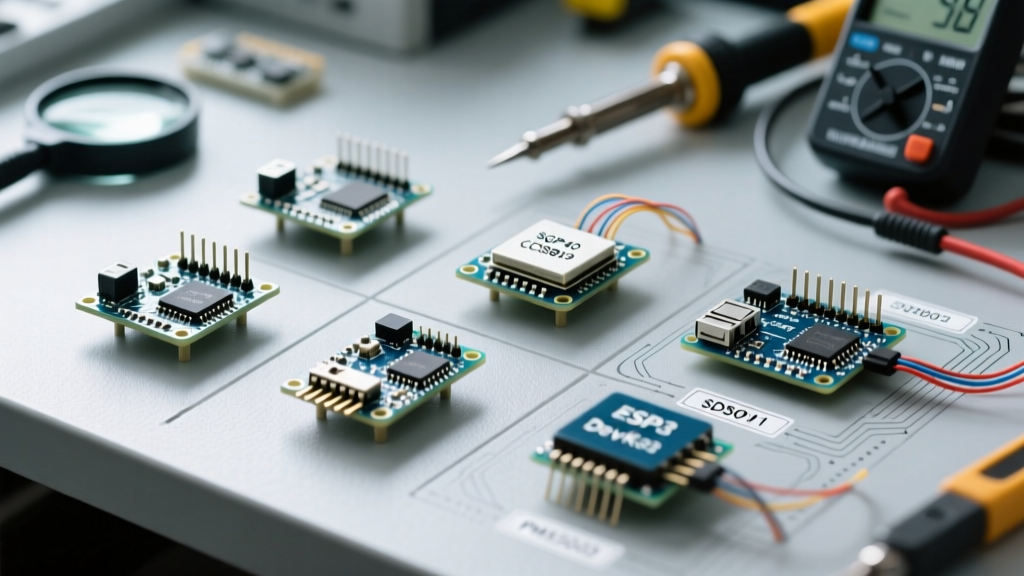
In this component comparison, we strip away the marketing fluff and examine three dominant sensor architectures available in 2026: Metal Oxide (MOx) VOC sensing, AI-enabled multi-gas environmental chips, and laser-scattering particulate matter counters. We will evaluate the Sensirion SGP40, Bosch BME688, and Plantower PMS5003 based on real-world integration challenges, data reliability, and hardware failure modes.
Component Comparison Matrix
| Feature | Sensirion SGP40 | Bosch BME688 | Plantower PMS5003 |
|---|---|---|---|
| Primary Target | Volatile Organic Compounds (VOCs) | Environmental + Custom AI Gas Signatures | Particulate Matter (PM1.0, PM2.5, PM10) |
| Sensing Tech | MOx (Metal Oxide) Chemiresistor | MOx + Temp/Hum/Pressure | Laser Light Scattering |
| Interface | I2C (up to 3.4 MHz) | I2C / SPI | UART (9600 Baud) |
| Logic Level | 1.8V to 3.6V | 1.2V to 3.6V | 3.3V (Strict) |
| Avg. Price (2026) | $6.00 - $9.00 | $12.00 - $16.00 | $14.00 - $20.00 |
| Output Metric | VOC Index (0-500) | IAQ Index / Raw Resistance | µg/m³ (Mass Concentration) |
Deep-Dive: Sensirion SGP40 (VOC Indexing)
The SGP40 is purpose-built for IAQ monitoring. Unlike older MOx sensors that output raw resistance values requiring complex logarithmic conversions, the SGP40 features an onboard microcontroller that runs the Sensirion Environmental Algorithm (SEA). It outputs a standardized VOC Index from 0 to 500, where 100 represents the average baseline of a typical indoor environment.
Integration Realities
- Baseline Drift: The SGP40 relies on a dynamic baseline. If the sensor is powered off for more than 12 hours, it loses its learned baseline. Upon reboot, it requires 10 to 14 days of continuous runtime to fully recalibrate its background compensation algorithm. For battery-powered Arduino nodes that sleep deeply, this sensor is a poor fit.
- Measurement Cycle: The sensor requires a 10-second measurement interval to properly heat the MOx element and sample the gas. Polling it faster yields no new data and wastes power.
- Cleaning Chemical Interference: Exposing the SGP40 to high concentrations of isopropyl alcohol (e.g., wiping the enclosure with cleaning wipes) will temporarily saturate the MOx layer, pegging the VOC index at 500 for several hours until the molecule desorbs.
Deep-Dive: Bosch BME688 (AI-Enabled Environmental)
The Bosch BME688 is a powerhouse that combines temperature, humidity, barometric pressure, and gas sensing into a single 3.0 x 3.0 mm LGA package. Its standout feature for 2026 is compatibility with the Bosch BME AI-Studio, allowing developers to train custom neural networks to recognize specific gas signatures (e.g., distinguishing between coffee roasting and a natural gas leak).
Integration Realities
- Heater Profiles: To measure VOCs, the BME688 must pulse its internal heater (typically to 320°C for 150ms). This localized heating affects the onboard temperature and humidity readings. You must use Bosch's BSEC 2.0 library to mathematically compensate for this thermal cross-talk; otherwise, your temperature data will be skewed by 1.5°C to 2.0°C.
- SPI vs I2C: While I2C is common, the BME688's I2C implementation can be finicky with certain Arduino Wire library clock-stretching bugs on older ATmega328P chips. Using the SPI interface is highly recommended for production reliability.
Deep-Dive: Plantower PMS5003 (Particulate Matter)
While MOx sensors detect gases, the PMS5003 uses laser scattering to physically count dust, smoke, and allergen particles, outputting mass concentrations for PM1.0, PM2.5, and PM10 in µg/m³. It is the gold standard for DIY wildfire smoke detectors and cleanroom monitors.
Integration Realities
- UART Framing: The PMS5003 outputs a continuous 32-byte serial frame at 9600 baud, starting with the magic bytes
0x42 0x4D. When usingSoftwareSerialon an Arduino Uno, timer interrupts can cause dropped bytes, resulting in checksum failures. Always use Hardware Serial (e.g., on an Arduino Mega or ESP32) or implement a robust ring-buffer state machine to parse the frames. - Active vs. Passive Mode: By default, the sensor streams data continuously (Active). You can pull the SET pin low to enter Passive mode, allowing your microcontroller to request data on-demand, which is crucial for reducing serial bus congestion in multi-sensor arrays.
Critical Wiring Realities: The 5V Logic Trap
Expert Warning: The most common cause of premature PMS5003 and SGP40 failure in Arduino projects is ignoring logic level thresholds. The Arduino Uno and Mega operate at 5V logic. The PMS5003 TX pin outputs 3.3V (which the Uno reads fine), but if you connect the Uno's 5V TX pin to the PMS5003's RX pin for passive mode control, you will degrade the sensor's internal UART transceiver over time. Always use a bidirectional logic level shifter (like the BSS138-based modules) or a simple CD4050B non-inverting buffer when interfacing 5V microcontrollers with 3.3V environmental sensors.
Furthermore, physical placement matters. The Arduino's onboard linear voltage regulator (often an L7805) dissipates significant heat. If you mount an SGP40 or BME688 breakout board directly adjacent to the voltage regulator or the main MCU die, your ambient temperature and relative humidity calculations will be fundamentally compromised by the PCB thermal gradient. Use a 4-pin JST-SH cable to physically separate the sensor from the main logic board.
Field Failure Modes & Edge Cases
When deploying these sensors outside the lab bench, expect the following edge cases:
- PMS5003 Fan Bearing Wear: The PMS5003 relies on an internal micro-fan to draw air across the laser diode. These fans typically use cheap sleeve bearings that begin to whine and eventually seize after 8,000 to 10,000 hours of continuous use. For 24/7 deployments, wire the fan's VCC to a MOSFET controlled by the Arduino, running the fan for only 30 seconds before and during the measurement cycle to extend its lifespan to several years.
- BME688 Humidity Hysteresis: If the BME688 is moved rapidly from a cold environment (e.g., an outdoor 5°C winter morning) to a warm, humid indoor environment, condensation can form inside the sensor cavity. The humidity reading will peg at 100% and take hours to dry out. Implement a software check: if RH > 98% for more than 10 minutes, trigger a high-temperature heater burn-off cycle to evaporate the condensation.
- SGP40 Ozone Blindness: MOx sensors are highly sensitive to VOCs like ethanol and formaldehyde, but they are notably poor at detecting ground-level ozone (O3) or carbon monoxide (CO). If your project requires CO monitoring for garage safety, you must add a dedicated electrochemical sensor like the Alphasense CO-A4; the SGP40 will not protect you from exhaust fumes.
The Expert Verdict
There is no single 'best' sensor; the correct choice depends entirely on your project's environmental targets. If you are building a smart bathroom exhaust fan triggered by aerosol sprays or cleaning chemicals, the SGP40 is the most cost-effective and easiest to integrate via its 0-500 index. If you are developing a commercial-grade weather and IAQ station and need to differentiate between cooking odors and chemical off-gassing, invest the time into the BME688 and its AI-Studio ecosystem. Finally, if your primary concern is wildfire smoke, dust, or HVAC filter efficiency, the PMS5003 is mandatory, as gas sensors cannot detect physical particulate matter.